


More than 1 million people thronged Hong Kong’s streets for a New Year’s Day pro-democracy rally, organizers claimed, as protesters looked to carry their movement’s momentum into this year.
“Based on the counting until 6:15pm and a comparison with the march on June 9, we believe the total turnout for today’s march has surpassed the 1.03 million on June 9,” the Civil Human Rights Front said in a statement, referring to last year’s massive rally that kicked off the territory’s pro-democracy campaign.
However, authorities forced organizers to end the rally earlier than planned after clashes between protesters and the police.
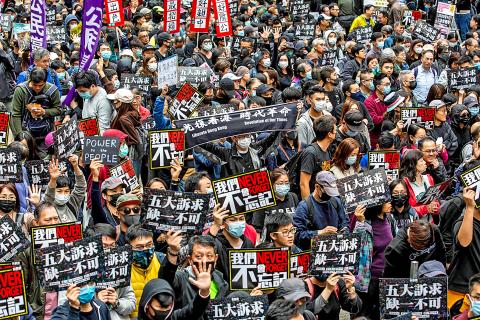
Photo: AFP
Hong Kong has been battered by nearly seven months of unrest, with frequent clashes between police and protesters as the territory battles its biggest political crisis in decades.
Despite a peaceful start yesterday, violence erupted near the march as it snaked through the Wan Chai district on Hong Kong Island. Riot police used pepper spray and tear gas, while protesters lobbed Molotov cocktails.
The front was ordered to end the rally soon after the clashes began.
“The police have ... asked us to dismiss the rally,” the organizers told marchers using megaphones. “Please calmly and slowly leave the scene right now.”
In now-familiar scenes, riot police were seen taking positions at several locations, including the Mass Transit Railway’s Wan Chai Station.
Black-clad, masked protesters also gathered to set up makeshift barricades, while some businesses were vandalized in the afternoon.
The unrest in Hong Kong was sparked by a proposal to allow extraditions to mainland China, bringing millions out on to the streets in June last year. It has since morphed into a larger revolt against what many fear is Beijing’s tightening control.
China and the Hong Kong administration have refused to cede to the protesters’ demands, which include fully free elections in the territory, an inquiry into alleged police misconduct and amnesty for the nearly 6,500 people arrested during the movement — nearly one-third of them under the age of 20.
“It is sad that our demands from 2019 need to be carried forward to 2020,” the front’s Jimmy Sham (岑子傑) said at the start of the rally.


RESILIENCE: Taiwan plays a key role in semiconductors, energy, information infrastructure and advanced manufacturing, AIT Director Raymond Greene said Taiwan’s continued investment in deterrence and resilience remains vital, especially in uncrewed systems and other emerging technologies, American Institute in Taiwan (AIT) Director Raymond Greene said yesterday. Greene made the remarks at the annual National Strategic Summit on Supply Chain Resilience held by the Research Institute for Democracy, Society and Emerging Technology (DSET), a government-backed think tank. As Taiwan last year became the US’ fourth-largest trading partner and supply chain security is becoming more important, cooperation in emerging technologies continues to deepen between the two countries, he said. The US is committed to accelerating innovation, building key infrastructure, strengthening cooperation

The National Chungshan Institute of Science and Technology yesterday showcased its locally developed variants of the Vision 60 robotic patrol dog, which it plans to deploy on the nation’s outlying territories in the South China Sea. The variants were produced under the Joint Lab project — created by the institute and domestic companies — and assembled with domestically produced motors, lenses and artificial intelligence (AI) systems alongside licensed tech from the US, Missile and Rocket Systems Research Division deputy director Jen Kuo-kang (任國光) told the media event at a military base in Taipei’s Dazhi (大直) area. Taiwan has built up its strengths

RIGHT DIRECTION: Taiwan’s efforts to prevent forced labor include a proposal to ‘fully prohibit’ employers from withholding workers’ documents, an official said Taiwan is to establish a mechanism to restrict imports of goods linked to forced labor, the Executive Yuan said yesterday, after the US proposed imposing additional tariffs on Taiwanese goods over labor concerns. “The Ministry of Labor and the Ministry of Economic Affairs are to establish an interministerial review procedure,” Executive Yuan spokesperson Michelle Lee (李慧芝) said at a news briefing in Taipei. “The government is to use the Foreign Trade Act [貿易法] as the legal basis to restrict imports of goods produced with forced labor” and bring its supply chain governance more in line with international standards on human rights, resilience

NOT IMMEDIATE: Taiwan has a chance to appeal the proposed 10 percent tariff before it starts, while other countries face a 12.5 percent tariff from the trade office Taiwan is among 60 economies determined by the US to have failed to impose or enforce a ban on the importation of goods produced with forced labor, according to a notice released on Tuesday by the Office of the US Trade Representative (USTR), which proposed imposing an additional 10 percent or more tariff on them. The USTR in a statement said that following an investigation, it had determined under Section 301 of the Trade Act of 1974 that the failure of the 60 economies to impose and effectively enforce a prohibition on the importation of goods produced with forced labor is


 RSS
RSS