


The Taipei District Prosecutors’ Office said that Ho Jianghua (何建華), a legislator-at-large nominee for the Chinese Unification Promotion Party (CUPP), could be charged with vote-buying after allegedly leading a five-day tour on which most expenses were paid by the Chinese government.
On Monday, Ho was to be released on NT$200,000 bail, but she told prosecutors that she could not pay. They still released her, but restricted her travel.
The investigation is “political persecution,” Ho said, adding that the tour was unrelated to the Jan. 11 elections.

Photo: Screen grab from Facebook
“The participants paid the NT$7,800 cost of the five-day trip,” Ho said. “It was not vote-buying.”
The 16 tour participants were questioned and released on Monday, without bail.
Investigators said they have enough evidence of Chinese funds subsidizing the tour, which started in Kinmen and traveled via the “small three links” — from Penghu, Kinmen and Lienchiang (Matsu) counties — to Xiamen in China’s Fujian Province.
A cost of NT$7,800 per person only covers the airfare and other transportation costs (NT$6,600), as well as travel insurance and an administration fee (NT$1,200), leaving accommodation, meals and other expenses to be covered by Chinese funds, the investigators said.
An examination of cellphone messages showed that participants urged friends to vote for the party and its candidates in the election, and included messages that read: “Thanks to Chairwoman [Ho]” and “Hope our chairwoman gets elected,” the investigators said.
This indicated that the tour was meant to garner votes for the CUPP and Ho, they added.
Ho, 56, is a high-ranking member of the pro-China CUPP, founded by Chang An-le (張安樂).
Ho is also chairwoman of the Taipei-based Chinese Women’s Federation, a pro-China organization whose members are mostly Chinese women who married and settled in Taiwan.
The organization’s Facebook and social media pages support Taiwan’s annexation by China and other pro-Beijing views, while condemning advocates of Taiwanese independence.
Born in China’s Hunan Province, Ho in 1996 married her Taiwanese husband and came to live in Taiwan. Having fulfilled residency requirements and received citizenship, she is eligible to vote and run for public office.

CROSS-STRAIT COLLABORATION: The new KMT chairwoman expressed interest in meeting the Chinese president from the start, but she’ll have to pay to get in Beijing allegedly agreed to let Chinese Nationalist Party (KMT) Chairwoman Cheng Li-wun (鄭麗文) meet with Chinese President Xi Jinping (習近平) around the Lunar New Year holiday next year on three conditions, including that the KMT block Taiwan’s arms purchases, a source said yesterday. Cheng has expressed interest in meeting Xi since she won the KMT’s chairmanship election in October. A source, speaking on condition of anonymity, said a consensus on a meeting was allegedly reached after two KMT vice chairmen visited China’s Taiwan Affairs Office Director Song Tao (宋濤) in China last month. Beijing allegedly gave the KMT three conditions it had to

STAYING ALERT: China this week deployed its largest maritime show of force to date in the region, prompting concern in Taipei and Tokyo, which Beijing has brushed off Deterring conflict over Taiwan is a priority, the White House said in its National Security Strategy published yesterday, which also called on Japan and South Korea to increase their defense spending to help protect the first island chain. Taiwan is strategically positioned between Northeast and Southeast Asia, and provides direct access to the second island chain, with one-third of global shipping passing through the South China Sea, the report said. Given the implications for the US economy, along with Taiwan’s dominance in semiconductors, “deterring a conflict over Taiwan, ideally by preserving military overmatch, is a priority,” it said. However, the strategy also reiterated

‘BALANCE OF POWER’: Hegseth said that the US did not want to ‘strangle’ China, but to ensure that none of Washington’s allies would be vulnerable to military aggression Washington has no intention of changing the “status quo” in the Taiwan Strait, US Secretary of Defense Pete Hegseth said on Saturday, adding that one of the US military’s main priorities is to deter China “through strength, not through confrontation.” Speaking at the annual Reagan National Defense Forum in Simi Valley, California, Hegseth outlined the US Department of Defense’s priorities under US President Donald Trump. “First, defending the US homeland and our hemisphere. Second, deterring China through strength, not confrontation. Third, increased burden sharing for us, allies and partners. And fourth, supercharging the US defense industrial base,” he said. US-China relations under
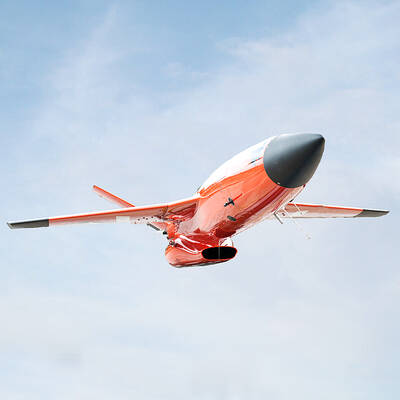
The Chien Feng IV (勁蜂, Mighty Hornet) loitering munition is on track to enter flight tests next month in connection with potential adoption by Taiwanese and US armed forces, a government source said yesterday. The kamikaze drone, which boasts a range of 1,000km, debuted at the Taipei Aerospace and Defense Technology Exhibition in September, the official said on condition of anonymity. The Chungshan Institute of Science and Technology and US-based Kratos Defense jointly developed the platform by leveraging the engine and airframe of the latter’s MQM-178 Firejet target drone, they said. The uncrewed aerial vehicle is designed to utilize an artificial intelligence computer


 RSS
RSS