


Lawmakers yesterday passed amendments to the National Intelligence Services Act (國家情報工作法), which stipulate that intelligence personnel who spy for an external force and leak information on national defense, national security or communications security could face life imprisonment.
The act previously stipulated a prison term of at least seven years for personnel spying for an external force, or three to 10 years if leaked intelligence was not in the three categories.
People who have access to sources of intelligence, channels, agencies or personnel, or information pertaining to the upholding of mobile or land-based communications security would face a prison term of 10 years to life if they are found to have leaked classified information as spies for a benign or hostile external force, the new rules say.
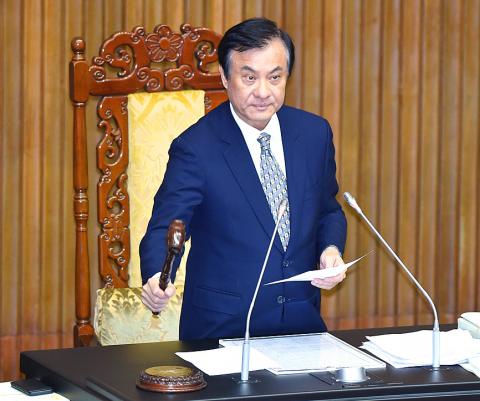
Photo: Liao Chen-huei, Taipei Times
The 30-year statute of limitations for such charges was extended to a lifetime.
If they leaked other classified information while spying for an external force, they would face a prison term of seven to 10 years, the rules say.
People who are not engaged in spying activities, but who leak intelligence would face a prison term of at least seven years, while those who illegally access such information would face three to 10 years behind bars, they say.
Those who illegally damage, destroy or conceal intelligence would face a prison term of three to seven years and a fine of NT$2 million (US$65,970), the amended act says.
The minimum penalty for active or retired intelligence personnel who have been recruited by an external force to conduct espionage missions was raised from three to seven years in prison.
The penalty would also apply to personnel found to have attempted to spy for an external force, the amendments say.
Intelligence personnel who exploit rules in the act that allow them to go undercover or establish companies, stores or organizations to leak intelligence would face 1.5 times the punishments and a fine of up to NT$10 million if they are found to have benefited from their infractions, they say.
Intelligence agencies should pin down, study and analyze commercial secrets that are unduly gathered, stolen, leaked or transferred at the instruction of a benign or hostile external force, they say.
Also passed was a supplementary resolution sponsored by Democratic Progressive Party legislators Wang Ting-yu (王定宇), Wu Kuen-yu (吳焜裕) and Chen Man-li (陳曼麗), as well as independent Legislator Freddy Lim (林昶佐) that grants active intelligence personnel and their family members discounted medical fees at military hospitals.
Intelligence personnel who have accrued seniority and their families should be granted the same healthcare and childrearing benefits that retired military personnel receive, the resolution says.
As intelligence personnel are the most susceptible group to being recruited by external forces, and their lives and the lives of their families are at risk whenever they are abroad, the benefits would make them more willing to stay in their posts longer, the legislators said.
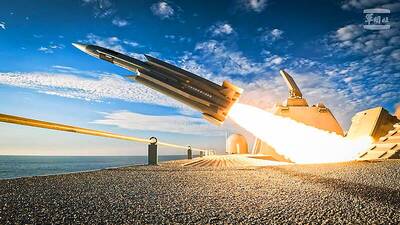
DETERRENCE: With 1,000 indigenous Hsiung Feng II and III missiles and 400 Harpoon missiles, the nation would boast the highest anti-ship missile density in the world With Taiwan wrapping up mass production of Hsiung Feng II and III missiles by December and an influx of Harpoon missiles from the US, Taiwan would have the highest density of anti-ship missiles in the world, a source said yesterday. Taiwan is to wrap up mass production of the indigenous anti-ship missiles by the end of year, as the Chungshan Institute of Science and Technology has been meeting production targets ahead of schedule, a defense official with knowledge of the matter said. Combined with the 400 Harpoon anti-ship missiles Taiwan expects to receive from the US by 2028, the nation would have
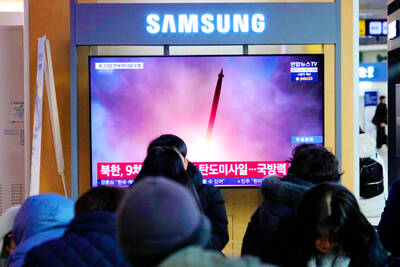
North Korea yesterday fired about 10 ballistic missiles to the sea toward Japan, the South Korean Joint Chiefs of Staff (JCS) said, days after Pyongyang warned of “terrible consequences” over ongoing South Korea-US military drills. Pyongyang recently dashed hopes of a diplomatic thaw with Seoul, Washington’s security ally, describing its latest peace efforts as a “clumsy, deceptive farce.” Seoul’s military detected “around 10 ballistic missiles launched from the Sunan area in North Korea toward the East Sea [Sea of Japan] at around 1:20pm,” JCS said in a statement, referring to South Korea’s name for the body of water. The missiles
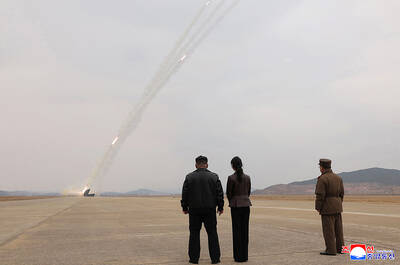
North Korea tested nuclear-capable rocket launchers, state media reported yesterday, a day after Seoul detected the launch of about 10 ballistic missiles. The test comes after South Korean and US forces launched their springtime military drills, due to run until Thursday. North Korean leader Kim Jong-un on Saturday oversaw the testing of the multiple rocket launcher system (MRLS), the Korean Central News Agency (KCNA) said. The test involved 12 600mm-caliber ultra-precision multiple rocket launchers and two artillery companies, it said. Kim said the drill gave Pyongyang’s enemies, within the 420km striking range, a sense of “uneasiness” and “a deep understanding

‘UNWAVERING FRIENDSHIP’: A representative of a Japanese group that co-organized a memorial, said he hopes Japanese never forget Taiwan’s kindness President William Lai (賴清德) yesterday marked the 15th anniversary of the Tohoku earthquake and tsunami, urging continued cooperation between Taiwan and Japan on disaster prevention and humanitarian assistance. Lai wrote on social media that Taiwan and Japan have always helped each other in the aftermath of major disasters. The magnitude 9 earthquake struck northeastern Japan on March 11, 2011, triggering a massive tsunami that claimed more than 19,000 lives, according to data from Japanese authorities. Following the disaster, Taiwan donated more than US$240 million in aid, making it one of the largest contributors of financial assistance to Japan. In addition to cash donations and


 RSS
RSS