


A self-confessed Chinese spy has given Australia’s counterespionage agency inside intelligence on how Beijing conducts its interference operations abroad and revealed the identities of China’s senior military intelligence officers in Hong Kong, media reported.
Australian Treasurer Josh Frydenberg yesterday told reporters that the detailed accusations of China infiltrating and disrupting democratic systems in Taiwan, Australia and Hong Kong are “very disturbing.”
The Nine network newspapers reported that Chinese defector Wang Liqiang told the Australian Security and Intelligence Organization (ASIO) that he was involved in the kidnapping in 2015 of one of five Hong Kong booksellers suspected of selling dissident materials.
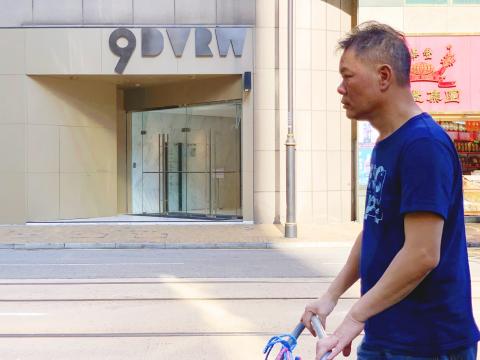
Photo: AP
The incident has been a reference point for protesters during the unrest in Hong Kong.
Using a South Korean passport, Wang said he meddled in last year’s local elections in Taiwan and claimed there were plans to disrupt the Jan. 11 presidential and legislative elections.
He said he helped funnel about 20 million yuan (US$2.8 million at the current exchange rate) of campaign donations to Kaohsiung Mayor Han Kuo-yu (韓國瑜), the Chinese Nationalist Party’s (KMT) presidential candidate.
He would be the first Chinese intelligence operative to blow his cover.
“I have personally been involved and participated in a series of espionage activities,” Wang reportedly said in a sworn statement to ASIO last month.
He revealed that he was part of a Hong Kong-based investment firm that was a front for the Chinese government to conduct political and economic espionage in Hong Kong, including infiltrating universities and directing harassment and cyberattacks against dissidents.
Wang said he faced detention and possible execution if he returned to China.
He said he was living in Sydney with his wife and infant son on a tourist visa and had requested political asylum.
The Australian Home Affairs Department told The Associated Press that it does not comment on individual cases.
“The purpose of protection visas is to safeguard people who cannot return to their home country due to a well-founded fear of persecution or risk of harm,” a spokesperson said. “Each case is assessed on its merits.”
The Ministry of Foreign Affairs did not respond to a faxed request for comment on Wang. In Hong Kong, calls to the China Innovation Investment Ltd (中國創新投資) office went unanswered. The company was identified by Wang as a front for Chinese intelligence operations in the territory.
According to its Web site, it is an investment holding company incorporated in the Cayman Islands in February 2002 and listed on the Hong Kong Stock Exchange in August the same year.
It has investments in several companies in Hong Kong and China that are involved in energy storage products, lighting products, energy saving and media terminals.
Resource-rich Australia relies on China for one-third of its export earnings, but relations have been frosty for some time.
The Australian government has been trying to neutralize China’s influence by banning foreign political donations and all covert foreign interference in domestic politics.
“These are very disturbing reports,” Frydenberg said. “The matter is now in the hands of the appropriate law enforcement agencies.”
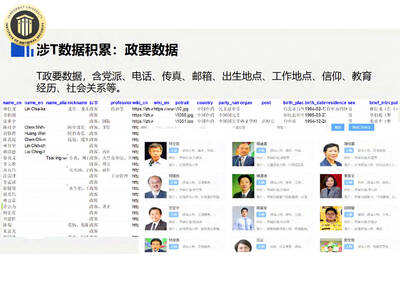
NETWORK-MAPPING PROJECT: The database contains 170 detailed files of Taiwanese politicians and about 23 million records of household registration data in Taiwan China has developed a network-mapping project targeting political figures and parties in Taiwan to monitor public opinion during elections and to craft tailored influence campaigns aimed at dividing Taiwanese society, according to documents leaked by Chinese technology firm GoLaxy (中科天璣). The documents, collected by Taipei-based Doublethink Lab, showed a database was specifically created to gather detailed information on Taiwanese political figures, including their political affiliations, job histories, birthplaces, residences, education, religion and a brief biography about them. Several notable Taiwanese politicians are in the database, including President William Lai (賴清德), former president Tsai Ing-wen (蔡英文), Minister of Foreign Affairs Lin Chia-lung (林佳龍),
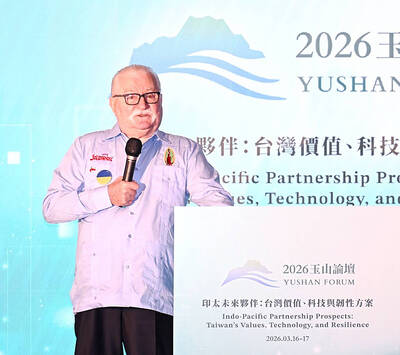
RECOGNITION: Former Fijian prime minister Mahendra Chaudhry said that Taiwan’s New Southbound Policy serves as a stabilizing force in the Indo-Pacific region Taiwan can lead the unification of the Chinese people, Nobel Peace Prize laureate and former Polish president Lech Walesa said in Taipei yesterday, adding that as the world order is changing, peaceful discussion would find good solutions, and that the use of force and coercion would always fail. Walesa made the remarks during his keynote address at a luncheon of the Yushan Forum in Taipei, titled “Indo-Pacific Partnership Prospects: Taiwan’s Values, Technology and Resilience,” organized by the Taiwan-Asia Exchange Foundation with the Ministry of Foreign Affairs. Walesa said that he had been at the forefront of a big peaceful revolution and “if
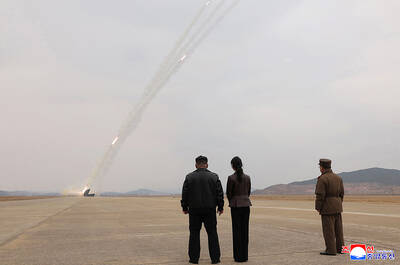
North Korea tested nuclear-capable rocket launchers, state media reported yesterday, a day after Seoul detected the launch of about 10 ballistic missiles. The test comes after South Korean and US forces launched their springtime military drills, due to run until Thursday. North Korean leader Kim Jong-un on Saturday oversaw the testing of the multiple rocket launcher system (MRLS), the Korean Central News Agency (KCNA) said. The test involved 12 600mm-caliber ultra-precision multiple rocket launchers and two artillery companies, it said. Kim said the drill gave Pyongyang’s enemies, within the 420km striking range, a sense of “uneasiness” and “a deep understanding
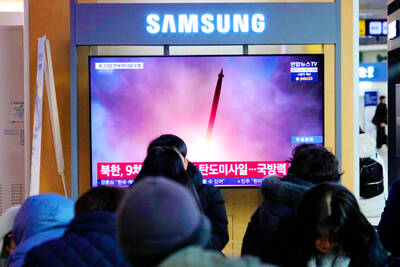
North Korea yesterday fired about 10 ballistic missiles to the sea toward Japan, the South Korean Joint Chiefs of Staff (JCS) said, days after Pyongyang warned of “terrible consequences” over ongoing South Korea-US military drills. Pyongyang recently dashed hopes of a diplomatic thaw with Seoul, Washington’s security ally, describing its latest peace efforts as a “clumsy, deceptive farce.” Seoul’s military detected “around 10 ballistic missiles launched from the Sunan area in North Korea toward the East Sea [Sea of Japan] at around 1:20pm,” JCS said in a statement, referring to South Korea’s name for the body of water. The missiles


 RSS
RSS