


The Ministry of Transportation and Communications (MOTC) yesterday rolled out 40 government projects worth more than NT$100 billion (US$3.28 billion) at its annual Investment Solicitation Convention.
The convention has drawn about 250 companies from across the nation and overseas, the ministry said.
Minister of Transportation and Communications Lin Chia-lung (林佳龍) told the opening ceremony that the ministry had launched investment projects worth NT$170 million in the past three years, for which it was ranked No. 1 by the Ministry of Finance in terms of attracting investments from the private sector.
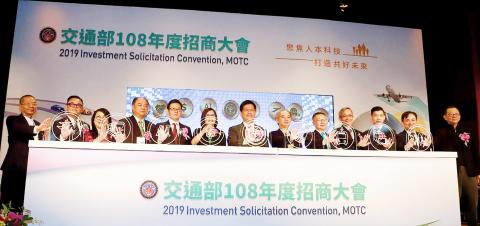
Photo: CNA
The convention is different this year, because not only would it showcase infrastructure projects and land development plans in airports, seaports and railway stations, it would also include projects involving the development of applications that could be used in transportation systems, Lin said.
“We are entering the era of 5G services and we want to show the business opportunities related to the Internet of Things, including electric buses and logistics services,” he said.
Wang Hsiou-shih (王秀時), head of the finance ministry’s Department for the Promotion of Private Participation in Infrastructure Projects, said that 1,721 government projects were built or invested in by private contractors as of August, with the value of the signed contracts totaling NT$1.61 trillion.
These contracts have helped reduce government expenditure by NT$1.63 trillion, raise the Treasury’s revenue by about NT$870 billion and create 260,000 jobs, he said.
Wang said that 271 of the contracts, worth a total of NT$622.8 billion, were signed by the MOTC.
The amount accounted for 39 percent of the total investment by the private sector in government projects this year, he said.
Invest Taiwan Center director-general Emile Chang (張銘斌) said that as of last week, Taiwanese businessperople returning from China have invested more than NT$700 billion in Taiwan to avoid risks caused by a US-China trade dispute.
Meanwhile, the nation’s exports have risen by 20 percent, Chang said, adding that another NT$225 billion of investment from returning Taiwanese firms is expected by the end of this year.
As of last month, investments made by overseas contractors topped NT$300 billion, Chang added.
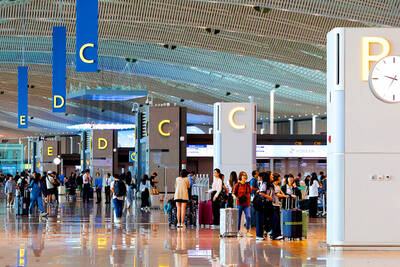
South Korea has adjusted its electronic arrival card system to no longer list Taiwan as a part of China, a move that the Ministry of Foreign Affairs said would help facilitate exchanges between the two sides. South Korea previously listed “Taiwan” as “Taiwan (China)” in the drop-down menus of its online arrival card system, where people had to fill out where they came from and their next destination. The ministry had requested South Korea make a revision and said it would change South Korea’s name on Taiwan’s online immigration system from “Republic of Korea” to “Korea (South),” should the issue not be

Tainan, Taipei and New Taipei City recorded the highest fines nationwide for illegal accommodations in the first quarter of this year, with fines issued in the three cities each exceeding NT$7 million (US$220,639), Tourism Administration data showed. Among them, Taipei had the highest number of illegal short-term rental units, with 410. There were 3,280 legally registered hotels nationwide in the first quarter, down by 14 properties, or 0.43 percent, from a year earlier, likely indicating operators exiting the market, the agency said. However, the number of unregistered properties rose to 1,174, including 314 illegal hotels and 860 illegal short-term rental
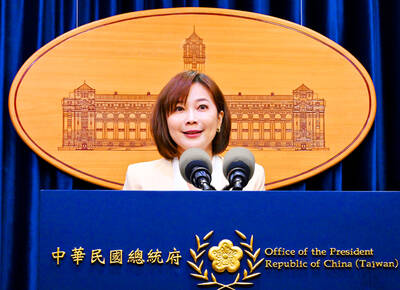
ECONOMIC COERCION: Such actions are often inconsistently applied, sometimes resumed, and sometimes just halted, the Presidential Office spokeswoman said The government backs healthy and orderly cross-strait exchanges, but such arrangements should not be made with political conditions attached and never be used as leverage for political maneuvering or partisan agendas, Presidential Office spokeswoman Karen Kuo (郭雅慧) said yesterday. Kuo made the remarks after China earlier in the day announced 10 new “incentive measures” for Taiwan, following a landmark meeting between Chinese President Xi Jinping (習近平) and Chinese Nationalist Party (KMT) Chairwoman Cheng Li-wun (鄭麗文) in Beijing on Friday. The measures, unveiled by China’s Xinhua news agency, include plans to resume individual travel by residents of Shanghai and China’s Fujian

Chinese President Xi Jinping (習近平) and Chinese Nationalist Party (KMT) Chairwoman Cheng Li-wun (鄭麗文) met in Beijing yesterday, where they vowed to bring people on both sides of the Taiwan Strait closer to facilitate the “great rejuvenation of the Chinese nation.” The meeting was held in the East Hall of the Great Hall of the People, a venue typically reserved for meetings between Xi and foreign heads of state. In public remarks prior to a closed-door meeting, Xi, in his role as head of the Chinese Communist Party (CCP), said that Taiwan is historically part of China, and remains an “inalienable” and


 RSS
RSS