


Hundreds of residents yesterday gathered at a forum in downtown Taipei, where housing prices are the highest in the nation, to demand housing justice.
The forum, held by the Housing Right Reform Union, took place at a plaza near the intersection of Zhongxiao E Road and Dunhua S Road, where the Snails Without Shells movement was launched 30 years ago.
The forum called on the government to implement a “List Real Price 2.0” policy, levy taxes on people who hoard properties and step up efforts to build social housing.
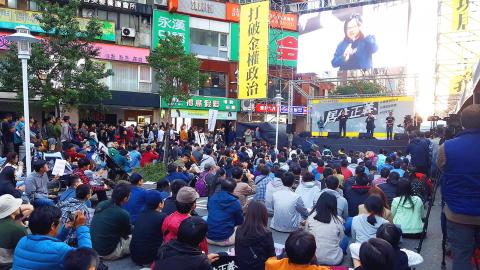
Photo: Yang Hsin-hui, Taipei Times
Participants chanted slogans, vowing to realize housing justice by beating plutocracy.
Organization of Urban Re-s secretary-general Peng Yang-kae (彭揚凱) said that finding housing is difficult for young Taiwanese, due to homeowners and construction companies driving up property prices, an unregulated rental market and an underdeveloped “social housing security net.”
From 2003 to 2013, the government believed that high housing prices could drive economic growth, which would in turn boost people’s income and make them more likely to purchase homes, but the theory has been proven wrong, as steep prices did not bring the economic benefits that the government had expected, Peng said.
President Tsai Ing-wen (蔡英文) during her campaign for the 2016 presidential election asked the right questions with her housing platform, which promised to make housing information transparent, push housing tax reforms and build social housing, but the problems have not been solved, Peng said.
He urged people to pay close attention to politicians and who among them portray themselves as in favor of more reasonable housing prices, but have actually blocked efforts to achieve that goal.
Huang Li-ling (黃麗玲), an associate professor at National Taiwan University’s Graduate Institute of Building and Planning, said that people who benefit from high housing prices say that prices increase due to high demand, but in reality, a large number of unused homes remain unsold.
With the nation’s social housing coverage falling far behind that of advanced nations, such as the Netherlands, France and South Korea, and being even lower than the coverage in Myanmar, Vietnam and Indonesia, she said that people should follow the example of environmental advocate Greta Thunberg at a UN summit on climate change in September and ask the Taiwanese politicians: “How dare you?”
Chinese Nationalist Party (KMT) Legislator William Tseng (曾銘宗) told the forum that the party supports “List Real Price 2.0.”
However, union cofounder and New Power Party Legislator Huang Kuo-chang (黃國昌) said that only two KMT legislators voted in favor of the policy during the previous legislative session, while the other 33 were absent.
Some lawmakers from the ruling Democratic Progressive Party did not vote for the policy, which was sponsored by the Executive Yuan, he said.
When similar proposals emerged in 2011, they were struck down at the Legislative Yuan, he said, adding that then-KMT legislator Wu Yu-sheng (吳育昇) had attributed the outcome to pushback from construction companies, which would not accept being required to register the real-time prices of pre-sold homes.
He asked participants to review the housing policies proposed by politicians during their election campaigns in 2014, 2016 and last year to find out whether they have delivered on their promises.
Former Taipei Department of Urban Development commissioner and union cofounder Lin Jou-min (林洲民) said that he hopes the government would act on the event’s three appeals to spare participants from having to gather again at the same location in 30 years.

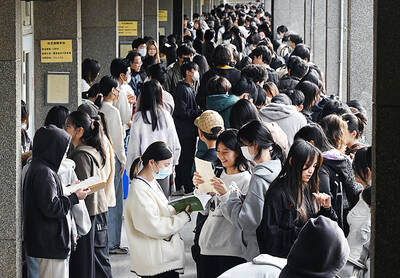
A global survey showed that 60 percent of Taiwanese had attained higher education, second only to Canada, the Ministry of the Interior said. Taiwan easily surpassed the global average of 43 percent and ranked ahead of major economies, including Japan, South Korea and the US, data from the Organisation for Economic Co-operation and Development (OECD) for 2024 showed. Taiwan has a high literacy rate, data released by the ministry showed. As of the end of last year, Taiwan had 20.617 million people aged 15 or older, accounting for 88.5 percent of the total population, with a literacy rate of 99.4 percent, the data

NEW LOW: The council in 2024 based predictions on a pessimistic estimate for the nation’s total fertility rate of 0.84, but last year that rate was 0.69, 17 percent lower An expected National Development Council (NDC) report expects the nation’s population to drop below 12 million by 2065, with the old-age dependency ratio to top 100 percent sooner than 2070, sources said yesterday. The council is slated to release its latest population projections in August, using an ultra-low fertility model, the sources said. The previous report projected that Taiwan’s population would fall to 14.37 million by 2070, but based on a new estimate of the total fertility rate (TFR) — the average number of children born to a woman over her lifetime — the population is expected to reach 12 million by

CCP ‘PAWN’? Beijing could use the KMT chairwoman’s visit to signal to the world that many people in Taiwan support the ‘one China’ principle, an academic said Chinese Nationalist Party (KMT) Chairwoman Cheng Li-wun (鄭麗文) yesterday arrived in China for a “peace” mission and potential meeting with Chinese President Xi Jinping (習近平), while a Taiwanese minister detailed the number of Chinese warships currently deployed around the nation. Cheng is visiting at a time of increased Chinese military pressure on Taiwan, as the opposition-dominated Legislative Yuan stalls a government plan for US$40 billion in extra defense spending. Speaking to reporters before going to the airport, Cheng said she was going on a “historic journey for peace,” but added that some people felt uneasy about her trip. “If you truly love Taiwan,
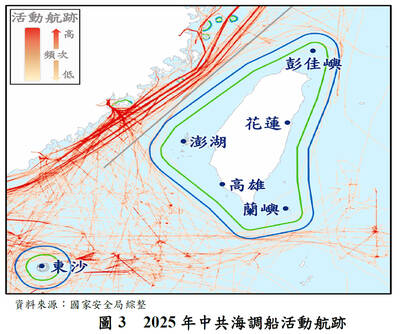
INTENSIFYING THREATS: Beijing’s tactics include massive attacks on the government service network, aircraft and naval vessel incursions and damaging undersea cables China is prepared to interfere in November’s nine-in-one local elections by launching massive attacks on the Taiwanese government’s service network (GSN), a report published by the National Security Bureau showed. The report was submitted to the Legislative Yuan ahead of the bureau’s scheduled briefing at the Foreign Affairs and National Defense Committee tomorrow. The national security team has identified about 13,000 suspicious Internet accounts and 860,000 disputed messages, the bureau said of China’s cognitive warfare against Taiwan. The disputed messages focus on major foreign affairs, national defense and economic issues, which were produced using generative artificial intelligence (AI) and distributed through Chinese


 RSS
RSS