


A Guinness World Record was set yesterday as 3,000 Taiwanese born through in vitro fertilization (IVF) gathered in Taichung to form a map of the world.
Vice President Chen Chien-jen (陳建仁) told the gathering that it was advances in medical science that made such a large number of IVF births possible.
The event was especially significant due to China’s political pressure, which obstructs Taiwan from sharing its achievements in medical science and immunology with the world through participation in the WHO and other international medical organizations, Chen said.
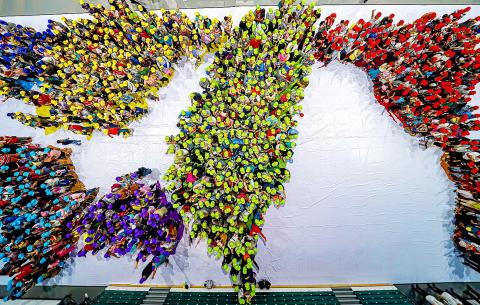
Photo: Chen Chien-chih, Taipei Times
The nation’s IVF achievements have also played a role in its relationships with Southeast Asian nations, he said, adding that Taiwan has helped 700 Filipino couples have children through IVF.
Taiwan would do its utmost to help others through its New Southbound Policy, Chen added.
Taichung-based Lee Women’s Hospital, which specializes in IVF and fertility treatments, organized the event as part of yesterday’s IVF World Expo.
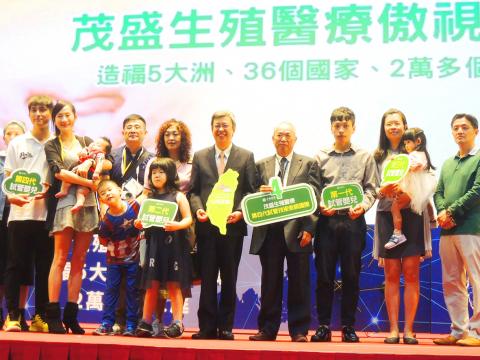
Photo: CNA
The first IVF operations in Taiwan were conducted in 1987, and Taiwanese doctors had a 20 percent success rate, hospital director Lee Mao-sheng (李茂盛) said.
Today, with the assistance of artificial intelligence, the hospital has an 80 percent success rate, he said.
As people are getting married later, more people are seeking IVF treatment, and the average age of women requesting the procedure is 39, he said.
Chen Ying-chieh (陳英傑), who was the first Taiwanese to be born through IVF, attended the event to thank Lee.
Lee said he recalled the efforts of Chen Ying-chieh’s mother, who underwent six rounds of IVF treatment before doctors were successful.
For the photograph, participants donned caps colored according the continent that they were representing and then arranged into the shapes of continents.
However, Taiwan was larger proportionately to recognize the contributions Taiwanese doctors have made to IVF, the hospital said.
The photograph was taken by an aerial drone.
The hospital set a world record in 2011 for the most people born through IVF gathered in one place, when 1,232 people attended, hospital officials said.
Several politicians attended yesterday’s event, including New Power Party Legislator Hung Tzu-yung (洪慈庸), Democratic Progressive Party (DPP) legislators Huang Kuo-shu (黃國書) and Chang Liao Wan-chien (張廖萬堅), who represent electoral districts in the city; Chuang Ching-cheng (莊競程), an assistant professor of biomedical engineering at National Chiao Tung University who is standing for the legislature for the DPP for a Taichung seat; and Taiwan Statebuilding Party spokesman Chen Po-wei (陳柏惟).

PROVOCATIVE: Chinese Deputy Ambassador to the UN Sun Lei accused Japan of sending military vessels to deliberately provoke tensions in the Taiwan Strait China denounced remarks by Japan and the EU about the South China Sea at a UN Security Council meeting on Monday, and accused Tokyo of provocative behavior in the Taiwan Strait and planning military expansion. Ayano Kunimitsu, a Japanese vice foreign minister, told the Council meeting on maritime security that Tokyo was seriously concerned about the situation in the East China and South China seas, and reiterated Japan’s opposition to any attempt to change the “status quo” by force, and obstruction of freedom of navigation and overflight. Stavros Lambrinidis, head of the EU delegation to the UN, also highlighted South China Sea

SILENCING CRITICS: In addition to blocking Taiwan, China aimed to prevent rights activists from speaking out against authoritarian states, a Cabinet department said The Ministry of Foreign Affairs (MOFA) yesterday condemned transnational repression by Beijing after RightsCon, a major digital human rights conference scheduled to be held in Zambia this week, was abruptly canceled due to Chinese pressure over Taiwanese participation. This year’s RightsCon, the world’s largest conference discussing issues “at the intersection of human rights and technology,” was scheduled to take place from tomorrow to Friday in Lusaka, and expected to draw 2,600 in-person attendees from 150 countries, along with 1,100 online participants. However, organizers were forced to cancel the event due to behind-the-scenes pressure from China, the ministry said, expressing its “strongest condemnation”
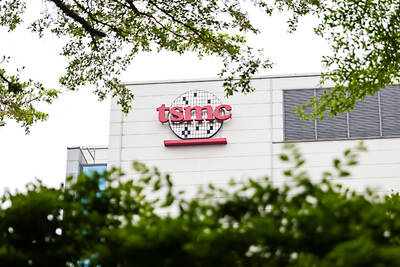
Taiwan Semiconductor Manufacturing Co (TSMC, 台積電), the world’s largest contract chipmaker, said it expects its 2-nanometer (2nm) chip capacity to grow at a compound annual rate of 70 percent from this year to 2028. The projection comes as five fabs begin volume production of 2-nanometer chips this year — two in Hsinchu and three in Kaohsiung — TSMC senior vice president and deputy cochief operating officer Cliff Hou (侯永清) said at the company’s annual technology symposium in Silicon Valley, California, last week. Output in the first year of 2-nanometer production, which began in the fourth quarter of last year, is expected to
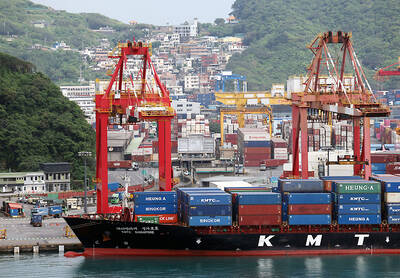
Taiwan’s economy grew far faster than expected in the first quarter, as booming demand for artificial intelligence (AI) applications drove a surge in exports, spilling over into investment and consumption, the Directorate-General of Budget, Accounting and Statistics (DGBAS) said yesterday. GDP growth was 13.69 percent year-on-year during the January-to-March period, beating the DGBAS’ February forecast by 2.23 percentage points and marking the most robust growth in nearly four decades, DGBAS senior official Chiang Hsin-yi (江心怡) told a news conference in Taipei. The result was powered by exports, which remain the backbone of Taiwan’s economy, Chiang said. Outbound shipments jumped 51.12 percent year-on-year to


 RSS
RSS