


A school exchange trip to China was cover for a Chinese indoctrination program, Miaoli County Councilor Lo Kuei-hsing (羅貴星) and Democratic Progressive Party Legislator Huang Kuo-shu (黃國書) said yesterday after more than 100 students and teachers returned to Taiwan following an extended stay in China’s Fujian Province due to inclement weather.
Parents of students from Tongsiao Junior High School in the county were working to arrange alternative travel home for their children, who were on an “education and sports exchange” in China, after their planned return via ferry was canceled due to inclement weather, Lo said, adding that the parents discovered that the group had been exposed to “Chinese propaganda” and “political indoctrination.”
The group of mostly baseball and softball players was staying in Pingtan County, but parents discovered that they were targets of the Chinese Communist Party’s Department of United Front Work and its provincial authorities, Lo said.
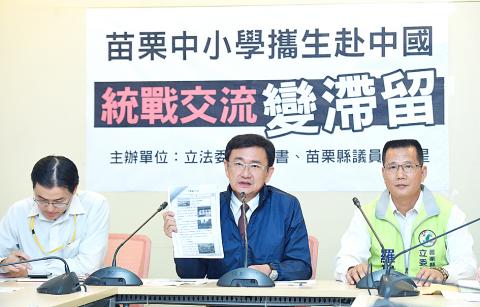
Photo: Liao Chen-huei, Taipei Times
“They paid only NT$1,000 each for the trip to cover registration and administrative fees,” Huang said. “The rest of their expenses, including ferry tickets, insurance, local transportation, accommodation and meals, were covered by the Chinese side.”
School officials told parents that the group was to go on a sports exchange, while a Taiwanese businessman working in China was listed as a sponsor of the trip, Huang said.
However, the businessman’s listing was a deception, as the trip was sponsored and organized by an agency of the Fujian Provincial Government, he said.
“Chinese authorities funded all the expenses and made all the arrangements,” Lo said. “After arriving, the group was taken on tours of modern buildings and development projects in Pingtan.”
The trip was to showcase the “new face of China” and to tout its “glorious achievements” to brainwash young Taiwanese into embracing unification with China, he said.
“We want to know why a sports trip turned into a Chinese propaganda and indoctrination program,” Huang said.
“Why did Miaoli County officials not grant permission for the trip, but the schools ignored it and went ahead on the all-expenses paid junket?” he asked. “Were the Ministry of Education and the Mainland Affairs Council not aware of indoctrination targeting our students?”
The group consisted of 92 students, nine teachers and several parents. They departed on Thursday last week, taking advantage of the long holiday weekend, sailing on the Hai Xia Hao from Taichung Port to the Port of Pingtan.
However, their planned return on Monday was canceled due to high winds and waves, Lo said.
They returned to Taiwan last night after arrangements by transportation officials saw them travel from Fujian’s Xiamen City by ferry to Kinmen County, where they boarded a flight to Taiwan, Lo said.
Council Deputy Minister Chiu Chui-cheng (邱垂正) said that China has been luring young Taiwanese and using cultural exchanges to conceal its “united front” tactics.
The council and the ministry would discuss whether a reporting mechanism for schools visiting China for educational exchanges should be established to ensure the safety of students and faculty while allowing healthy cross-strait exchanges to proceed, Chiu said.
Additional reporting by Chung Li-hua

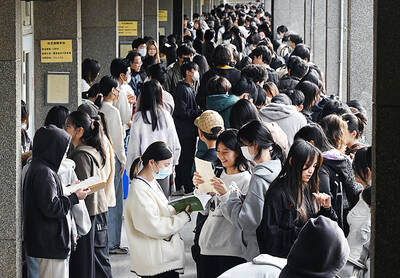
A global survey showed that 60 percent of Taiwanese had attained higher education, second only to Canada, the Ministry of the Interior said. Taiwan easily surpassed the global average of 43 percent and ranked ahead of major economies, including Japan, South Korea and the US, data from the Organisation for Economic Co-operation and Development (OECD) for 2024 showed. Taiwan has a high literacy rate, data released by the ministry showed. As of the end of last year, Taiwan had 20.617 million people aged 15 or older, accounting for 88.5 percent of the total population, with a literacy rate of 99.4 percent, the data

NEW LOW: The council in 2024 based predictions on a pessimistic estimate for the nation’s total fertility rate of 0.84, but last year that rate was 0.69, 17 percent lower An expected National Development Council (NDC) report expects the nation’s population to drop below 12 million by 2065, with the old-age dependency ratio to top 100 percent sooner than 2070, sources said yesterday. The council is slated to release its latest population projections in August, using an ultra-low fertility model, the sources said. The previous report projected that Taiwan’s population would fall to 14.37 million by 2070, but based on a new estimate of the total fertility rate (TFR) — the average number of children born to a woman over her lifetime — the population is expected to reach 12 million by

CCP ‘PAWN’? Beijing could use the KMT chairwoman’s visit to signal to the world that many people in Taiwan support the ‘one China’ principle, an academic said Chinese Nationalist Party (KMT) Chairwoman Cheng Li-wun (鄭麗文) yesterday arrived in China for a “peace” mission and potential meeting with Chinese President Xi Jinping (習近平), while a Taiwanese minister detailed the number of Chinese warships currently deployed around the nation. Cheng is visiting at a time of increased Chinese military pressure on Taiwan, as the opposition-dominated Legislative Yuan stalls a government plan for US$40 billion in extra defense spending. Speaking to reporters before going to the airport, Cheng said she was going on a “historic journey for peace,” but added that some people felt uneasy about her trip. “If you truly love Taiwan,
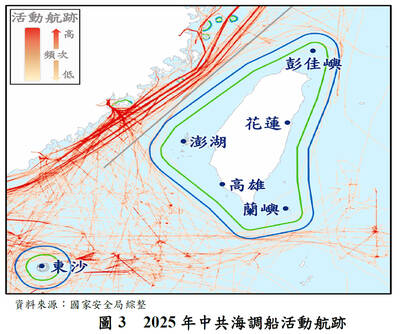
INTENSIFYING THREATS: Beijing’s tactics include massive attacks on the government service network, aircraft and naval vessel incursions and damaging undersea cables China is prepared to interfere in November’s nine-in-one local elections by launching massive attacks on the Taiwanese government’s service network (GSN), a report published by the National Security Bureau showed. The report was submitted to the Legislative Yuan ahead of the bureau’s scheduled briefing at the Foreign Affairs and National Defense Committee tomorrow. The national security team has identified about 13,000 suspicious Internet accounts and 860,000 disputed messages, the bureau said of China’s cognitive warfare against Taiwan. The disputed messages focus on major foreign affairs, national defense and economic issues, which were produced using generative artificial intelligence (AI) and distributed through Chinese


 RSS
RSS