


As Taiwanese have unequivocally rejected the “one country, two systems” formula that China has proposed for it, the Chinese government should stop embarrassing itself by harassing Taiwan, the Mainland Affairs Council (MAC) said yesterday.
The council issued the statement in response to China’s Taiwan Affairs Office (TAO), which criticized President Tsai Ing-wen’s (蔡英文) Double Ten National Day address as an attempt to “vilify the ‘one country, two systems’ policy, thereby stoking anti-China sentiment.”
Tsai’s address “exposed the Democratic Progressive Party administration’s pro-Taiwanese independence nature, which runs counter to the overall interests of the Zhonghua minzu [ethnic Chinese groups],” TAO spokesman Ma Xiaoguang (馬曉光) said earlier yesterday.
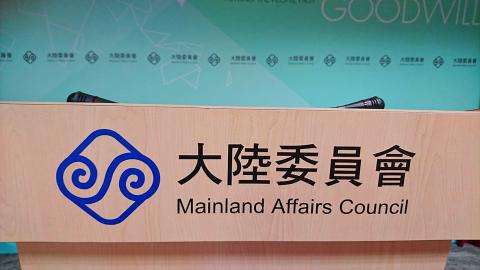
Photo: Chung Li-hua, Taipei Times
The speech “smacks of confrontational thinking and animosity” and was an attempt to belittle “one country, two systems” to stoke anti-China sentiment, he said.
Tsai is trying to weaken mainstream public opinion in Taiwan: a desire for an improved economy, livelihood and cross-strait ties, and by doing so she can somehow “reap the electoral benefits,” he said.
The speech was deliberately misleading for portraying peaceful unification between the two sides of the Taiwan Strait — a “shared hope of all Chinese” — as a threat to Taiwan, he added.
She has also colluded with “Western anti-China forces” to portray the grand plan of revitalizing the Zhonghua minzu as a challenge to regional security, Ma said.
The council said that Tsai’s address reflected the Taiwanese collective will to safeguard the nation’s sovereignty and democracy, bolster Taiwan’s stride toward the international community, as well as the mainstream opinion of rejecting “one country, two systems.”
The council expressed regret over Beijing continuing to adopt a hostile cross-strait policy, its inability to engage in introspection and its attempts to cover up its flawed Taiwan policy with skewed criticism that Taipei “either wants unification or independence.”
Chinese President Xi Jinping (習近平) in a speech on Jan. 2 included a proposal to impose a “one country, two systems” framework on Taiwan, thereby ramping up the pressure on Taipei, the council said, adding that this has led the international community and Taiwanese to view the Chinese Communist Party (CCP) as a threat to regional security.
The CCP has been accusing the Taiwanese government of attempting to gain independence to divert attention from its incompetence in handling its own domestic affairs, the council said.
It is an established fact in international relations that the Republic of China is a sovereign nation, the council said, and while Taiwanese want peace in the Taiwan Strait, they certainly would not compromise that when threatened.
The Chinese government should heed the steadfast resolve of Taiwanese to safeguard their sovereignty, and to protect their democracy and freedom, and understand that any attempt to threaten the “status quo” would be courting hostility with hostility, the council said.
Cross-strait relations will only be brought onto the correct path when China begins to recognize the reality in cross-strait relations and stopping its bullying of Taiwan, it said.

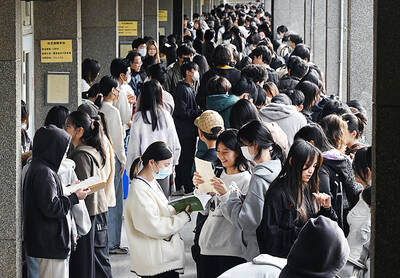
A global survey showed that 60 percent of Taiwanese had attained higher education, second only to Canada, the Ministry of the Interior said. Taiwan easily surpassed the global average of 43 percent and ranked ahead of major economies, including Japan, South Korea and the US, data from the Organisation for Economic Co-operation and Development (OECD) for 2024 showed. Taiwan has a high literacy rate, data released by the ministry showed. As of the end of last year, Taiwan had 20.617 million people aged 15 or older, accounting for 88.5 percent of the total population, with a literacy rate of 99.4 percent, the data
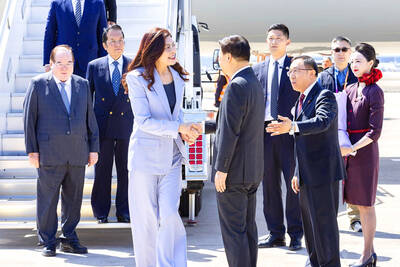
CCP ‘PAWN’? Beijing could use the KMT chairwoman’s visit to signal to the world that many people in Taiwan support the ‘one China’ principle, an academic said Chinese Nationalist Party (KMT) Chairwoman Cheng Li-wun (鄭麗文) yesterday arrived in China for a “peace” mission and potential meeting with Chinese President Xi Jinping (習近平), while a Taiwanese minister detailed the number of Chinese warships currently deployed around the nation. Cheng is visiting at a time of increased Chinese military pressure on Taiwan, as the opposition-dominated Legislative Yuan stalls a government plan for US$40 billion in extra defense spending. Speaking to reporters before going to the airport, Cheng said she was going on a “historic journey for peace,” but added that some people felt uneasy about her trip. “If you truly love Taiwan,

NEW LOW: The council in 2024 based predictions on a pessimistic estimate for the nation’s total fertility rate of 0.84, but last year that rate was 0.69, 17 percent lower An expected National Development Council (NDC) report expects the nation’s population to drop below 12 million by 2065, with the old-age dependency ratio to top 100 percent sooner than 2070, sources said yesterday. The council is slated to release its latest population projections in August, using an ultra-low fertility model, the sources said. The previous report projected that Taiwan’s population would fall to 14.37 million by 2070, but based on a new estimate of the total fertility rate (TFR) — the average number of children born to a woman over her lifetime — the population is expected to reach 12 million by
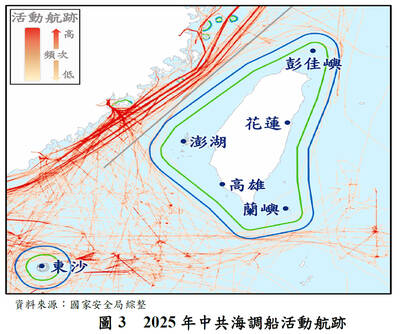
INTENSIFYING THREATS: Beijing’s tactics include massive attacks on the government service network, aircraft and naval vessel incursions and damaging undersea cables China is prepared to interfere in November’s nine-in-one local elections by launching massive attacks on the Taiwanese government’s service network (GSN), a report published by the National Security Bureau showed. The report was submitted to the Legislative Yuan ahead of the bureau’s scheduled briefing at the Foreign Affairs and National Defense Committee tomorrow. The national security team has identified about 13,000 suspicious Internet accounts and 860,000 disputed messages, the bureau said of China’s cognitive warfare against Taiwan. The disputed messages focus on major foreign affairs, national defense and economic issues, which were produced using generative artificial intelligence (AI) and distributed through Chinese


 RSS
RSS