


National Police Agency Director-General Chen Ja-chin (陳家欽) yesterday vowed to conduct a strict investigation into an attack against Hong Kong singer, actor and democracy campaigner Denise Ho (何韻詩) on Sunday in Taipei.
Evidence showed that the attack was premeditated and organized, Chen said, adding that a task force would investigate “Chinese Unification Promotion Party [CUPP] personnel who might be involved in the case.”
Ho was speaking to reporters ahead of a rally in support of the pro-democracy protests in Hong Kong when a masked man came from behind and splashed her with red paint.
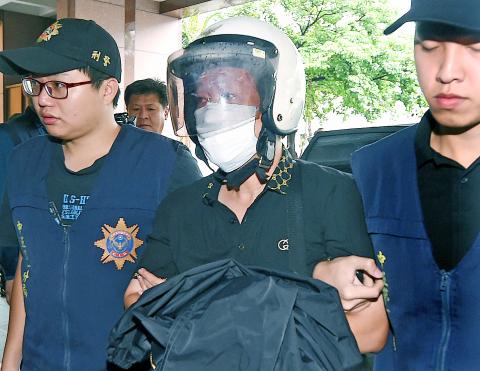
Photo: Chu Pei-hsiung, Taipei Times
Dachen Nostalgia Culture Association member Hu Chih-wei (胡志偉) was arrested allegedly trying to flee the scene.
Liang Tai-fu (梁太富), an alleged accomplice of Hu, was also arrested at the scene, Taipei police have said.
Hu is believed to be a CUPP member.
Police yesterday said they have arrested seven other suspects, and seized water balloons, signs, a megaphone, a CUPP vest and other items.
Police said they believe the attack was organized by Chen Yu-ta (陳友達).
Chen, 54, and others allegedly met in New Taipei City’s Banciao District (板橋) on Sunday morning to plan the attack, police said, adding that only Ho was targeted.
Ho yesterday said she would take legal action against the suspects for intimidation, public humiliation and loss of property to prevent similar harassment and threats from happening to others.
Premier Su Tseng-chang (蘇貞昌) and lawmakers across party lines condemned the attack.
CUPP members who splashed red paint on Ho apparently “have no respect for law,” New Power Party (NPP) Chairman Hsu Yung-ming (徐永明) said.
The CUPP was involved in an attack on Hong Kong democracy advocate Joshua Wong (黃之鋒) when he arrived at Taiwan Taoyuan International Airport in 2017, Hsu said.
For a long time, the CUPP has been used as a front to cover for organized crime linked to Beijing, he said.
“China is reaching its fist into Taiwan,” he said.
To curb Chinese infiltration, lawmakers should pass legislation requiring people and organizations to disclose whether they are being controlled by a foreign government, he said.
Meanwhile, convener of the now-banned Hong Kong National Party Andy Chan (陳浩天) said recent incidents show that many Chinese nationals have been staging attacks on Hong Kongers in Taiwan in an organized manner to interfere with their freedom of speech.
While Taiwan provides a valuable space for Hong Kongers to express their voice in their fight for democracy, he said he hoped the Taiwanese government would crack down on China-controlled organizations in Taiwan before it is too late.
“‘Chinazi’ will not leave Taiwan or Hong Kong alone. It will infiltrate and launch attacks. It must be stopped,” he said.
Additional reporting by Wang Kuan-jen and CNA

‘NO SECURITY RISK’: The Railway Bureau reassured the public that the technicians’ activities were limited to technical guidance and did not involve sensitive systems The Railway Bureau yesterday said it had invited eight Chinese technicians to assist with an airport MRT construction project. The bureau issued the confirmation after an Internet user said Chinese nationals had entered the construction zone of Taiwan Taoyuan International Airport’s Terminal 3 project. They asked why “individuals from an enemy state” were allowed access to such a major national infrastructure project, which raised serious concerns over Taiwan’s industrial safety, sensitive systems and information security. The bureau’s Northern Region Engineering Branch Office said subcontractor Taiwan Handle Industrial Co (台灣手把工業) of the Taoyuan airport MRT’s “Contract No. CU05 Project A14 Station Civil, MEP &

A US uncrewed surface vessel (USV) encountered multiple Chinese warships during an autonomous transit of the Taiwan Strait, US defense company Seasats said in a statement on Wednesday. Seasats announced that a Lightfish USV had completed the first autonomous transit of the Taiwan Strait. Over five days, the USV traversed the entire length of the Strait while constantly monitoring surface vessel traffic, the company said. The Lightfish encountered multiple Chinese warships, one of which was a Chinese People’s Liberation Army Navy (PLAN) Type 056 corvette, it said. The Chinese vessels were operating “well within Taiwan’s exclusive economic zone without transmitting their identity via the
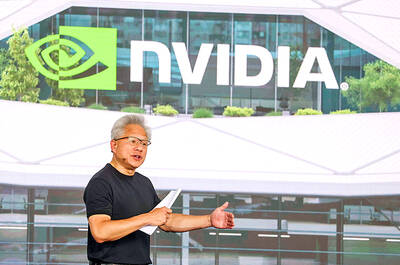
‘BOOMING’: ’ The number of partners we have here is incredible. You can see from their stock prices. They’re doing so well, they’re so happy,’ Jensen Huang said Nvidia Corp’s spending in Taiwan has ballooned to about US$150 billion a year, 10 times the US$10 billion to US$15 billion the company spent five years ago, Nvidia chief executive officer Jensen Huang (黃仁勳) said yesterday, suggesting Taiwan’s strategic importance in the global artificial intelligence (AI) supply chain. “Taiwan is the epicenter of the AI revolution. This is where the chips come, packaging comes. This is where the systems are made. This is where AI supercomputers were created,” Huang said at a meeting for the company’s employees in Beitou-Shilin Technology Park (北投士林科技園區) in Taipei, the planned site of Nvidia’s Taipei headquarters. “Taiwan
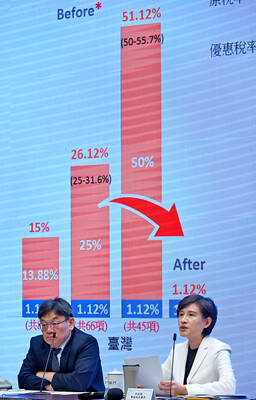
GREATER REACH? Auto parts and wood products would face tariffs of up to 15%, matching those targeting the EU, Japan and South Korea, Vice Premier said The US has announced that preferential tariff treatment for Taiwan’s non-semiconductor Section 232 goods would take effect retroactively from May 1, the Executive Yuan said yesterday. The US government yesterday posted a notice on the Federal Register’s public inspection Web site previewing tariff concessions for Taiwan under a memorandum of understanding (MOU) on Taiwan-US investment after two months of negotiations. The MOU signed on Jan. 15 stipulated three major preferential tariff arrangements: a 15 percent “reciprocal” tariff rate for Taiwan without stacking most-favored nation (MFN) rates; preferential Section 232 treatment for semiconductors and related products; and preferential Section 232 treatment for non-semiconductor


 RSS
RSS