


A veteran supporter of cross-strait exchanges has been arbitrarily detained in China for 420 days, sources told the Liberty Times (the sister newspaper of the Taipei Times) yesterday.
The case was revealed by Shih Chien University chair professor Chiang Min-chin (江岷欽) on Jaw Shaw-kong’s (趙少康) political talk show on Thursday evening, when he said that Southern Taiwan Union of Cross-strait Relations Associations chairman Tsai Chin-shu (蔡金樹) is being detained at a prison in China’s Fujian Province.
Tsai is allegedly being held on charges relating to state security, Chiang said, citing sources in China.
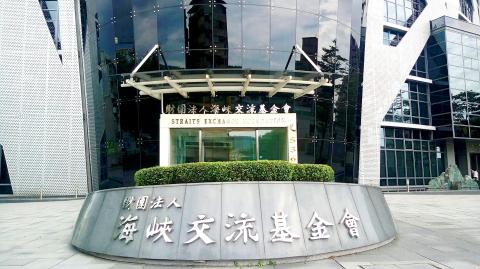
Photo: Chung Li-hua, Taipei Times
After investigating the claim, the Liberty Times reported that Tsai has been in detention for 420 days.
Sources with knowledge of the matter said that Tsai was allegedly detained by state security officers on July 22 last year while awaiting a connecting flight in Xiamen.
The sources added that they had not been able to obtain information about Tsai’s situation other than that he is “safe.”
The Straits Exchange Foundation yesterday said that Tsai’s family members had contacted the foundation for help in August last year and that it immediately sent a letter to its Chinese counterpart, the Association for Relations Across the Taiwan Straits, to inquire about Tsai’s whereabouts, but that it has not received any concrete response.
Chiang said that Tsai, who he has known since they were students together, is “as blue as can be,” referring to his support for the Chinese Nationalist Party (KMT).
“However, he has been jailed all the same. Whether you are in the pan-blue or pan-green camp, everyone is in danger amid the backsliding in cross-strait relations and lack of mutual judicial assistance,” Chiang said.
Tsai, 60, holds a master’s degree in political science from National Sun Yat-sen University and a doctorate from Xiamen University’s Graduate Institute for Taiwan Studies.
He is also chairman of the Kaohsiung Association for Research on Cross-Strait Relations and taught at the Fortune Institute of Technology, among other schools.
He has been promoting cross-strait exchanges for more than 20 years.
Members of Tsai’s family have said they hope that the government would help bring him back to Taiwan.
Meanwhile, the family of Morrison Lee (李孟居) yesterday published an open letter, in which they expressed the hope that Chinese authorities would soon complete their investigation against him so that he could return home.
Lee, 44, went missing in Shenzhen after attending an Aug. 18 anti-extradition bill rally in Hong Kong.
China’s Taiwan Affairs Office on Wednesday confirmed that Lee is under investigation on suspicion of engaging in criminal activity harmful to national security.
The letter said that the family would send a lawyer to visit Lee on their behalf to learn about the charges he is facing.
It also expressed the hope that family members could visit Lee and urged the Chinese authorities to grant the request.
The family said it had not asked any individual or political party to speak about the case on its behalf and that media reports about the case do not represent their stance on the matter.
The family said that it did not want “political factors” making Lee’s situation any more difficult.
Additional reporting by CNA
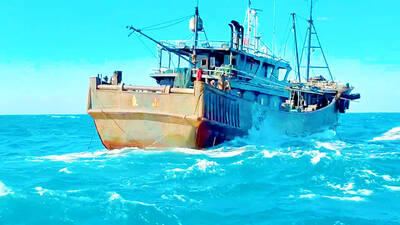
MAKING WAVES: China’s maritime militia could become a nontraditional threat in war, clogging up shipping lanes to prevent US or Japanese intervention, a report said About 1,900 Chinese ships flying flags of convenience and fishing vessels that participated in China’s military exercises around Taiwan last month and in January have been listed for monitoring, Coast Guard Administration (CGA) Deputy Director-General Hsieh Ching-chin (謝慶欽) said yesterday. Following amendments to the Commercial Port Act (商港法) and the Law of Ships (船舶法) last month, the CGA can designate possible berthing areas or deny ports of call for vessels suspected of loitering around areas where undersea cables can be accessed, Oceans Affairs Council Minister Kuan Bi-ling (管碧玲) said. The list of suspected ships, originally 300, had risen to about 1,900 as

Right-wing political scientist Laura Fernandez on Sunday won Costa Rica’s presidential election by a landslide, after promising to crack down on rising violence linked to the cocaine trade. Fernandez’s nearest rival, economist Alvaro Ramos, conceded defeat as results showed the ruling party far exceeding the threshold of 40 percent needed to avoid a runoff. With 94 percent of polling stations counted, the political heir of outgoing Costa Rican President Rodrigo Chaves had captured 48.3 percent of the vote compared with Ramos’ 33.4 percent, the Supreme Electoral Tribunal said. As soon as the first results were announced, members of Fernandez’s Sovereign People’s Party
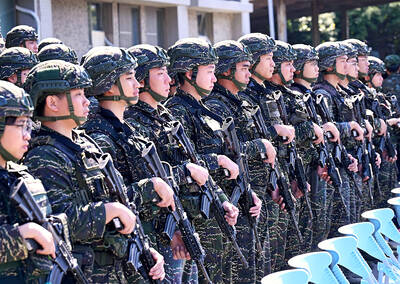
MORE RESPONSIBILITY: Draftees would be expected to fight alongside professional soldiers, likely requiring the transformation of some training brigades into combat units The armed forces are to start incorporating new conscripts into combined arms brigades this year to enhance combat readiness, the Executive Yuan’s latest policy report said. The new policy would affect Taiwanese men entering the military for their compulsory service, which was extended to one year under reforms by then-president Tsai Ing-wen (蔡英文) in 2022. The conscripts would be trained to operate machine guns, uncrewed aerial vehicles, anti-tank guided missile launchers and Stinger air defense systems, the report said, adding that the basic training would be lengthened to eight weeks. After basic training, conscripts would be sorted into infantry battalions that would take

GROWING AMBITIONS: The scale and tempo of the operations show that the Strait has become the core theater for China to expand its security interests, the report said Chinese military aircraft incursions around Taiwan have surged nearly 15-fold over the past five years, according to a report released yesterday by the Democratic Progressive Party’s (DPP) Department of China Affairs. Sorties in the Taiwan Strait were previously irregular, totaling 380 in 2020, but have since evolved into routine operations, the report showed. “This demonstrates that the Taiwan Strait has become both the starting point and testing ground for Beijing’s expansionist ambitions,” it said. Driven by military expansionism, China is systematically pursuing actions aimed at altering the regional “status quo,” the department said, adding that Taiwan represents the most critical link in China’s


 RSS
RSS