


The Tainan City Government yesterday declared the “Taiwan People’s Communist Party Matsu Temple” (台灣人民共產黨天后宮) in Sinying District (新營) an illegal building, saying that its owner would be given one week to make improvements.
After an inspection by city officials earlier in the day, Tainan Public Works Bureau official Lin Shang-ching (林尚卿) said that the building is on a 550 ping (1,818m2) plot of farmland, which by definition should be used only for agricultural purposes.
Activities on the plot, including paving concrete over farmland, and digging an artificial pond without the proper permits are contraventions of the Regional Planning Act (區域計畫法), he said, adding that the construction company had not obtained a proper permit for the work.
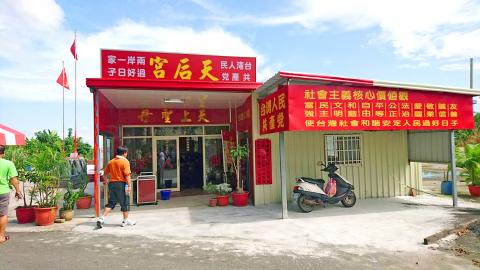
Photo: Yang Chin-cheng, Taipei Times
The building, which was converted into a shrine by Lin Te-wang (林德旺) — head of the Taiwan People’s Communist Party (台灣人民共產黨) — flies the five-star red flag of the People’s Republic of China (PRC).
Lin Te-wang had left for China’s Fujian Province to escort a sculpture of the goddess Matsu (媽祖) back to the temple, party staff said, adding that he was scheduled to return last night and enshrine the sculpture in the evening.
One party worker accused the government of “political oppression,” as Lin Te-wang had only recently rented the property, which was previously a betel nut shop.
Attempts to rent a building in the district to serve as the party’s headquarters were futile, as no one wanted to lease to it, the worker added.
While the party was established in 2007, it has not provided the documents to confirm its status as a party required by 2017 amendments to the Political Party Act (政黨法), Tainan Bureau of Civil Affairs official Mai Yuan-teng (麥原騰) said.
As the headquarters of a political party, the building serves as a place of assembly and administration, but it has created public safety concerns due to breaches of multiple regulations, the Public Works Bureau said.
Earlier this week, Democratic Progressive Party Legislator Wang Ting-yu (王定宇) said that as religion is incompatible with the PRC, the so-called temple is not a place of worship, but rather a conduit for the Chinese Communist Party (CCP).
Using a place of religious worship as cover for the CCP is disrespecting the gods, he said.
Taiwan guarantees liberty and numerous freedoms, but not the freedom to break the law, Wang said, adding that if the temple is illegal, it must be torn down.
That it openly flies the national flag of the PRC, which has not renounced the use of force to annex Taiwan, is intolerable, he said.

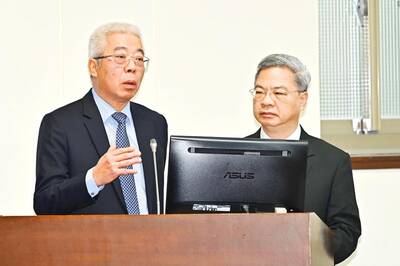
Taiwan has arranged for about 8 million barrels of crude oil, or about one-third of its monthly needs, to be shipped from the Red Sea this month to bypass the Strait of Hormuz and ease domestic supply pressures, CPC Corp, Taiwan (CPC, 台灣中油) said yesterday. The state-run oil company has worked with Middle Eastern suppliers to secure routes other than the Strait of Hormuz, through which about 20 percent of the world’s oil and liquefied natural gas typically passes, CPC chairman Fang Jeng-zen (方振仁) said at a meeting of the legislature’s Economics Committee in Taipei. Suppliers in Saudi Arabia have indicated they
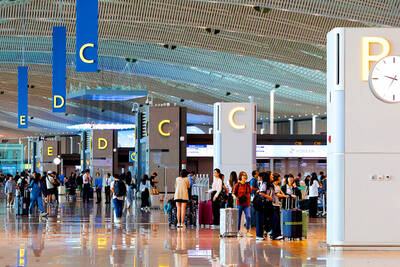
South Korea has adjusted its electronic arrival card system to no longer list Taiwan as a part of China, a move that the Ministry of Foreign Affairs said would help facilitate exchanges between the two sides. South Korea previously listed “Taiwan” as “Taiwan (China)” in the drop-down menus of its online arrival card system, where people had to fill out where they came from and their next destination. The ministry had requested South Korea make a revision and said it would change South Korea’s name on Taiwan’s online immigration system from “Republic of Korea” to “Korea (South),” should the issue not be

Tainan, Taipei and New Taipei City recorded the highest fines nationwide for illegal accommodations in the first quarter of this year, with fines issued in the three cities each exceeding NT$7 million (US$220,639), Tourism Administration data showed. Among them, Taipei had the highest number of illegal short-term rental units, with 410. There were 3,280 legally registered hotels nationwide in the first quarter, down by 14 properties, or 0.43 percent, from a year earlier, likely indicating operators exiting the market, the agency said. However, the number of unregistered properties rose to 1,174, including 314 illegal hotels and 860 illegal short-term rental
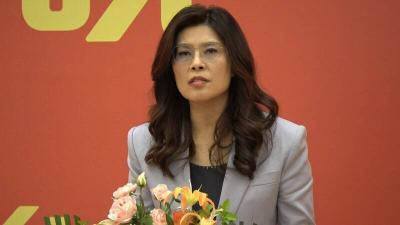
Both sides of the Taiwan Strait share a political foundation based on the “1992 consensus” and opposition to Taiwanese independence, Chinese Nationalist Party (KMT) Chairwoman Cheng Li-wun (鄭麗文) today said during her meeting with Chinese President Xi Jinping (習近平). Both sides of the Strait should plan and build institutionalized and sustainable mechanisms for dialogue and cooperation based on that foundation to make peaceful development across the Strait irreversible, she said. Peace is a shared moral value across the Strait, and both sides should move beyond political confrontation to seek institutionalized solutions to prevent war, she said. Mutually beneficial cross-strait relations are what the


 RSS
RSS