


Following new developments in a duty-free cigarette smuggling scandal, President Tsai Ing-wen (蔡英文) yesterday said that it is time to root out illicit practices that have long been a part of the nation’s bureaucracy, while the Presidential Office said that a preliminary investigation has produced no evidence of wrongdoing by mid to high-level officials.
Tsai said that she has entrusted the judiciary and new National Security Bureau (NSB) Director-General Chiu Kuo-cheng (邱國正) to investigate the case, and demanded that mismanagement and disciplinary problems found at China Airlines (中華航空), the Airport Police Bureau and national security agencies be corrected.
“We will respect the results of the investigation and all infractions found must be rectified,” Tsai said.
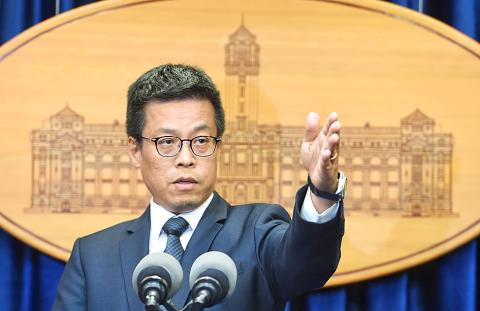
Photo: Liu Hsin-de, Taipei Times
“We have to face these illicit practices that have accumulated within the bureaucracy for many years,” she said. “Now that they have been exposed, they must be fixed.”
Presidential Office spokesman Alex Huang (黃重諺) told a media briefing that five trucks dispatched to transport items from Taiwan Taoyuan International Airport were controlled by NSB units.
“Two of the trucks were borrowed from the Presidential Office by the NSB’s presidential security units. They contained no illegal items, only luggage and transport equipment,” Huang said. “The large cache of cigarette cartons was transported on the three other trucks.”
A preliminary investigation found no involvement by mid to high-level officials at the Presidential Office or the National Security Council, he said, but added that “disciplinary measures are being assessed for the presidential security units implicated in the case.”
“An internal investigation has found that presidential security units under the NSB made large purchases of foreign duty-free goods to take advantage of the president’s overseas state visits,” Huang said.
The Taipei District Prosecutors’ Office, in coordination with the Ministry of Justice Investigation Bureau, yesterday searched five China Airlines offices, including those of its subsidiary, China Pacific Catering Services (華膳空廚), and its in-flight service supply division, corporate communications office, and cargo services and logistics division.
The raids began in the morning and ended at about 7pm, with investigators taking several cartons of materials.
Prosecutors also summoned for questioning NSB officers Wu Tsung-hsien (吳宗憲) and Chang Heng-chia (張恒嘉), who have been held with restricted communications.
On Thursday, prosecutors had searched their rooms at an NSB dormitory at the president’s residence.
Prosecutors yesterday also responded to a report by the China Times, saying that they did not enter the president’s official residence and that prior notice was given to Presidential Office staff.
Meanwhile, China Airlines handed out a first wave of punishments, demoting senior vice president Lo Ya-mei (羅雅美) to special assistant to the chairman and chartered flight division vice president Chiu Chang-hsin (邱彰信) to coordinator at the office of the airline’s president.
Lo and Chiu were responsible for arranging the chartered flights for Tsai’s visit to the nation’s four Caribbean allies, as well as previous trips in March and August last year to allies in the South Pacific and Latin America respectively.
The demotions are to take effect on Thursday next week, the airline said.
Additional reporting by Cheng Wei-chi

The National Chungshan Institute of Science and Technology yesterday showcased its locally developed variants of the Vision 60 robotic patrol dog, which it plans to deploy on the nation’s outlying territories in the South China Sea. The variants were produced under the Joint Lab project — created by the institute and domestic companies — and assembled with domestically produced motors, lenses and artificial intelligence (AI) systems alongside licensed tech from the US, Missile and Rocket Systems Research Division deputy director Jen Kuo-kang (任國光) told the media event at a military base in Taipei’s Dazhi (大直) area. Taiwan has built up its strengths

RIGHT DIRECTION: Taiwan’s efforts to prevent forced labor include a proposal to ‘fully prohibit’ employers from withholding workers’ documents, an official said Taiwan is to establish a mechanism to restrict imports of goods linked to forced labor, the Executive Yuan said yesterday, after the US proposed imposing additional tariffs on Taiwanese goods over labor concerns. “The Ministry of Labor and the Ministry of Economic Affairs are to establish an interministerial review procedure,” Executive Yuan spokesperson Michelle Lee (李慧芝) said at a news briefing in Taipei. “The government is to use the Foreign Trade Act [貿易法] as the legal basis to restrict imports of goods produced with forced labor” and bring its supply chain governance more in line with international standards on human rights, resilience

NOT IMMEDIATE: Taiwan has a chance to appeal the proposed 10 percent tariff before it starts, while other countries face a 12.5 percent tariff from the trade office Taiwan is among 60 economies determined by the US to have failed to impose or enforce a ban on the importation of goods produced with forced labor, according to a notice released on Tuesday by the Office of the US Trade Representative (USTR), which proposed imposing an additional 10 percent or more tariff on them. The USTR in a statement said that following an investigation, it had determined under Section 301 of the Trade Act of 1974 that the failure of the 60 economies to impose and effectively enforce a prohibition on the importation of goods produced with forced labor is

TIT-FOR-TAT: The US allegedly revoked the visa of a Chinese national working at Xinhua News Agency in the US in response to Beijing’s expulsion of Vivian Wang The Presidential Office yesterday condemned China for expelling a New York Times correspondent from Beijing following the newspaper’s interview with President William Lai (賴清德), saying the move highlighted Beijing’s suppression of press freedom and its threat to international news media. Taiwan has noted a series of recent incidents in which Beijing used similar tactics to “threaten and pressure international media outlets and journalists,” Presidential Office spokeswoman Karen Kuo (郭雅慧) said in a statement. “This concerns not only press freedom and freedom of expression, but also the safety of journalists, and Taiwan and relevant partners are paying close attention to the situation,” she


 RSS
RSS