


Minister of Transportation and Communications Lin Chia-lung (林佳龍) yesterday said that he would not cover up any illegal behavior by the management of China Airlines Ltd (CAL, 中華航空) and would hold top officials accountable following the detention of two National Security Bureau employees.
China Airlines’ largest shareholder, the China Aviation Development Foundation, is controlled by the government, with Deputy Minister of Transportation and Communications Wang Kwo-tsai (王國材) serving as board chairman.
After claiming on Monday that a National Security Bureau official who accompanied President Tsai Ing-wen (蔡英文) on her visit to Taiwan’s Caribbean allies tried to use officials’ speedy clearance through customs to smuggle in cigarettes, New Power Party Legislator Huang Kuo-chang (黃國昌) yesterday accused the airline’s management of complicity.
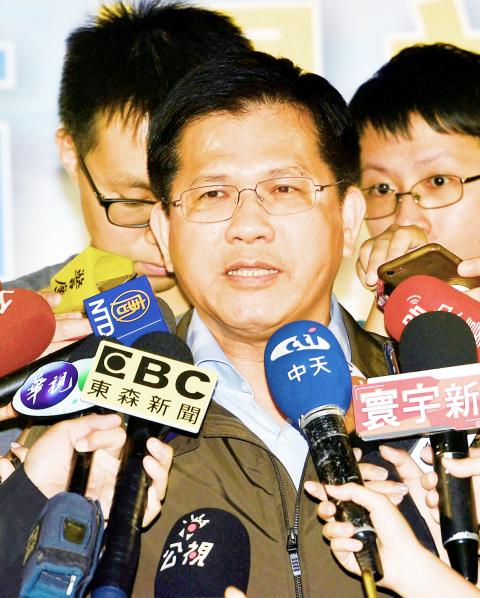
Photo: CNA
Asked about Huang’s allegations, Lin said that he had asked the airline to launch an internal probe and to cooperate fully with an investigation by prosecutors, adding that the airline should clarify its responsibility in the matter.
“I have also asked the airline to tell the public whether similar incidents have happened in the past and how they were handled,” Lin said. “I will not tolerate illegal behavior on the part of the airline, nor will I impede accountability for this case from reaching the highest levels of the airline’s management.”
Asked if the airline should investigate incidents that might have occurred during former president Ma Ying-jeou’s (馬英九) two terms, Lin said that investigators should follow the evidence wherever it takes them.
The airline’s integrity is in question and the investigation should not stop at the present incident, Lin said, adding that the company probe should be comprehensive.
Asked if CAL chairman Hsieh Shih-chien (謝世謙) — who assumed the position in April after a strike by pilots in February — would be asked to step down because of the incident, Lin said that the ministry would examine all of the evidence and determine what personnel changes were needed.
The ministry would also ensure that the airline’s probe is transparent, as the public should be allowed to see the results, he said.
Lin said that an investigation of the incident would not affect the appointment of a new CAL president, a position that remains vacant.
Taipei City Councilor William Hsu (徐弘庭) of the Chinese Nationalist Party (KMT) said that the incident has shown how the Democratic Progressive Party has placed many of its own people in management positions in the airline.
The incident was a “corrupt custom” that has been practiced for years, Lin said, adding that the airline should take full responsibility for it to regain the public’s trust.

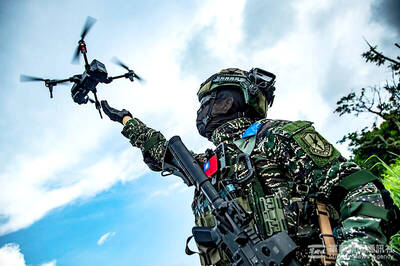
RESILIENCE: Taiwan plays a key role in semiconductors, energy, information infrastructure and advanced manufacturing, AIT Director Raymond Greene said Taiwan’s continued investment in deterrence and resilience remains vital, especially in uncrewed systems and other emerging technologies, American Institute in Taiwan (AIT) Director Raymond Greene said yesterday. Greene made the remarks at the annual National Strategic Summit on Supply Chain Resilience held by the Research Institute for Democracy, Society and Emerging Technology (DSET), a government-backed think tank. As Taiwan last year became the US’ fourth-largest trading partner and supply chain security is becoming more important, cooperation in emerging technologies continues to deepen between the two countries, he said. The US is committed to accelerating innovation, building key infrastructure, strengthening cooperation

The National Chungshan Institute of Science and Technology yesterday showcased its locally developed variants of the Vision 60 robotic patrol dog, which it plans to deploy on the nation’s outlying territories in the South China Sea. The variants were produced under the Joint Lab project — created by the institute and domestic companies — and assembled with domestically produced motors, lenses and artificial intelligence (AI) systems alongside licensed tech from the US, Missile and Rocket Systems Research Division deputy director Jen Kuo-kang (任國光) told the media event at a military base in Taipei’s Dazhi (大直) area. Taiwan has built up its strengths

RIGHT DIRECTION: Taiwan’s efforts to prevent forced labor include a proposal to ‘fully prohibit’ employers from withholding workers’ documents, an official said Taiwan is to establish a mechanism to restrict imports of goods linked to forced labor, the Executive Yuan said yesterday, after the US proposed imposing additional tariffs on Taiwanese goods over labor concerns. “The Ministry of Labor and the Ministry of Economic Affairs are to establish an interministerial review procedure,” Executive Yuan spokesperson Michelle Lee (李慧芝) said at a news briefing in Taipei. “The government is to use the Foreign Trade Act [貿易法] as the legal basis to restrict imports of goods produced with forced labor” and bring its supply chain governance more in line with international standards on human rights, resilience
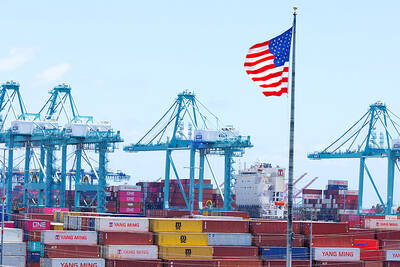
NOT IMMEDIATE: Taiwan has a chance to appeal the proposed 10 percent tariff before it starts, while other countries face a 12.5 percent tariff from the trade office Taiwan is among 60 economies determined by the US to have failed to impose or enforce a ban on the importation of goods produced with forced labor, according to a notice released on Tuesday by the Office of the US Trade Representative (USTR), which proposed imposing an additional 10 percent or more tariff on them. The USTR in a statement said that following an investigation, it had determined under Section 301 of the Trade Act of 1974 that the failure of the 60 economies to impose and effectively enforce a prohibition on the importation of goods produced with forced labor is


 RSS
RSS