

Male students at New Taipei Municipal Banqiao Senior High School will be allowed to wear skirts to school, starting with the new semester in September, in a bid to promote gender equality, the school’s management said yesterday.
The school board last month scrapped a dress code regulation, which stipulated that male students can only wear trousers to school, student affairs division head Lin San-wei (林三維) said.
The move allows male students to wear skirts to school should they choose to without risking punishment, he said.
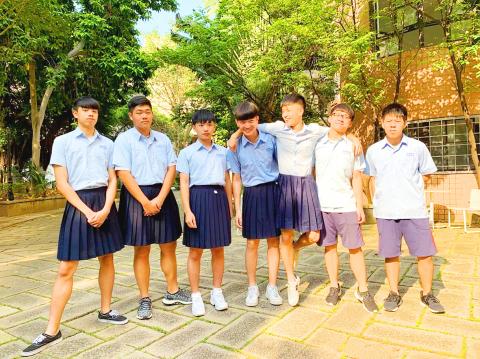
Photo courtesy of the Students Association of New Taipei Municipal Banqiao Senior High School
Female students can continue to wear skirts or trousers to school, he added.
The decision was made “not to encourage male students to wear skirts,” but to create a gender-equal campus and show more respect to students’ choices, Lin said.
The school and the Ministry of Education said that the school could be the first in the nation to allow male students to wear skirts on campus.
The school’s management also changed a rule that required female students to wear only black or blue skirts or trousers, saying they are now free to wear skirts or trousers in any color, as long as they are a solid color.
The changes came two months after the school held a week-long student-initiated “men wearing skirts” activity aimed at breaking gender stereotypes and highlighting personal freedoms.
The event coincided with the 73rd anniversary of the school’s founding.
The ministry welcomes the school’s decision to break gender stereotypes, Department of Student Affairs and Special Education Director Cheng Nai-wen (鄭乃文) said.
School administrations are allowed to make changes in dress and hair codes as long as they consult students and parent representatives, and adhere to democratic procedures, according to the regulations.
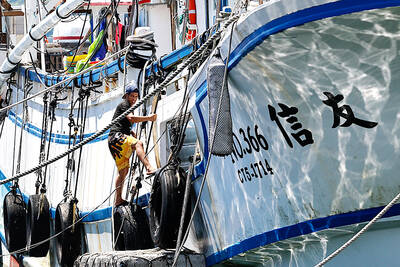
BAVI: Taipei, New Taipei City, Taoyuan and others announced work and class closures today, with the storm expected to affect Taiwan through tomorrow The outer rain bands of Typhoon Bavi would begin affecting Taiwan today, with its storm circle reaching land this evening and its level-10 wind radius covering all of northern Taiwan by noon tomorrow, an official said yesterday. The Central Weather Administration (CWA) issued a sea warning for the storm at 2:30pm yesterday, advising of heightened danger in eastern areas and in the Bashi Channel south of Taiwan. Typhoon Bavi is expected to bring strong winds, extremely heavy rainfall and rough seas to Taiwan today and tomorrow, with the heaviest rain forecast for mountainous areas and sustained winds of up to 12 on
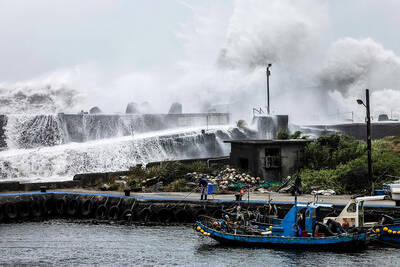
Typhoon Bavi was expected to have its strongest impact on Taiwan from last night through daytime today, with its storm circle forecast to reach areas from New Taipei City’s northeast coast to Yilan and Hualien counties early today, the Central Weather Administration (CWA) said yesterday. As of 6pm yesterday, the center of the typhoon was about 590km east of Taiwan’s southernmost tip at Oluanpi (鵝鑾鼻), moving northwest at 26kph, the CWA said. The storm was packing maximum sustained winds of 155kph near its center, with gusts reaching 191kph. It had a radius of 380km. A land warning, issued at 5:30am yesterday, remains in
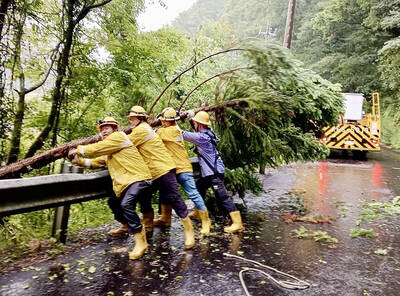
Typhoon Bavi lashed Taiwan yesterday, injuring 113 people, prompting the evacuation of 14,605 residents and knocking out power in 234,481 households, the government said. Most of the injuries were due to people falling off motorcycles or bicycles due to strong winds and slippery roads, and others occurred during the typhoon preparations, Central Emergency Operations Center (CEOC) data as of 8pm yesterday showed. No fatalities or severe injuries had been reported as of press time last night. Due to flooding and landslide risks, 14,605 people had been evacuated nationwide, led by 5,182 people in Hualien County, 2,096 in Taichung, 1,700 in New Taipei,
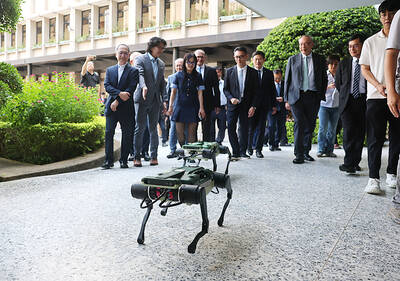
APPLICATIONS: The robots are capable of disaster and firefighting response, autonomous navigation, swarm operations as well as underground tunnel inspections, the ministry said The Ministry of Economic Affairs is working with the Industrial Technology Research Institute (ITRI) and industry partners to create a homegrown program to develop four-legged robots to tap into the US$4 billion global robot dog market. The initiative aims to leverage Taiwan’s strengths in information and communications technology, semiconductors and precision machinery to build indigenous technologies and a non-China supply chain, the ministry said. Technology is evolving from robotic arms to wheeled, quadruped and humanoid robots with autonomous mobility capabilities, it said. Driven by rapid advancements in generative artificial intelligence (AI), visual recognition, sensors and high-performance computing, robots are now capable of


 RSS
RSS