


More than 400kg of meat allegedly harvested from whales and dolphins was intercepted by the Coast Guard Administration in Yilan County’s Suao Township (蘇澳) on Wednesday, even though hunting cetaceans has been banned for more than two decades, the Ocean Conservation Administration (OCA) said yesterday.
The Forestry Bureau, which previously managed protected species before transferring responsibility to the OCA, in 1995 listed all cetaceans as protected and banned hunting and trading in the animals, the OCA said.
On Wednesday afternoon, the Yilan County Government informed the OCA that Coast Guard Administration officials in Suao had stopped a driver surnamed Lin (林), who was delivering 449.5kg of meat seemingly cut from cetaceans, it said.
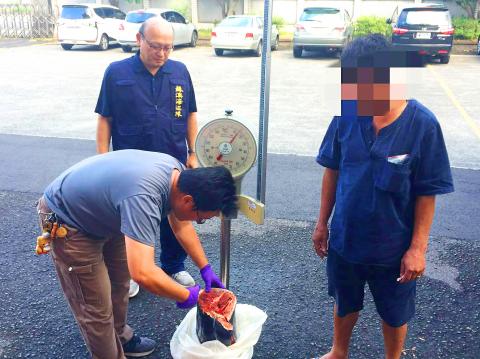
Photo courtesy of the Coast Guard Administration
The Ministry of Justice’s Investigation Bureau is to perform DNA identification on the sampled meat, the OCA said.
The driver is being investigated for contravening the Wildlife Conservation Act (野生動物保育法), which imposes a prison term of six months to five years or a fine of between NT$300,000 and NT$1.5 million (US$9,653 and US$48,267) on those harassing, abusing, hunting, slaughtering or trading protected species or products made from them, it said.
Lin initially claimed he was delivering shark meat, which is not banned, but county agricultural officials judged from its appearance that it might have been taken from cetaceans, Coast Guard Administration Fleet Branch Seventh Corps Deputy Captain Yang Chi (楊淇) said.
The slain creatures might have been caught in the waters off Yilan and sold to people near industrial parks in Yunlin and Changhua counties, Yang said, adding that further investigation would be required.
The possible consumers are foreign workers who are said to prefer meat with a heavier flavor, while Taiwanese could also be the likely buyers, he said.
Businesspeople from central and southern Taiwan often visit Suao to collect cetacean meat, Yang said, citing information obtained from local fishers.
Consumers often order dolphin meat at restaurants by asking for “No. 12 pork,” because dolphins are “sea pigs” in Hoklo (commonly known as Taiwanese) and pigs are ranked 12th in the Chinese zodiac, he added.
Despite the ban on hunting protected species, there is demand, OCA Marine Conservation Division head Ko Ching-lin (柯慶麟) said.
The seized meat is being stored at a county government warehouse and it would be destroyed when the judicial investigation closes, Ko said.

PROVOCATIVE: Chinese Deputy Ambassador to the UN Sun Lei accused Japan of sending military vessels to deliberately provoke tensions in the Taiwan Strait China denounced remarks by Japan and the EU about the South China Sea at a UN Security Council meeting on Monday, and accused Tokyo of provocative behavior in the Taiwan Strait and planning military expansion. Ayano Kunimitsu, a Japanese vice foreign minister, told the Council meeting on maritime security that Tokyo was seriously concerned about the situation in the East China and South China seas, and reiterated Japan’s opposition to any attempt to change the “status quo” by force, and obstruction of freedom of navigation and overflight. Stavros Lambrinidis, head of the EU delegation to the UN, also highlighted South China Sea

The final batch of 28 M1A2T Abrams tanks purchased from the US arrived at Taipei Port last night and were transported to the Armor Training Command in Hsinchu County’s Hukou Township (湖口), completing the military’s multi-year procurement of 108 of the tanks. Starting at 12:10am today, reporters observed more than a dozen civilian flatbed trailers departing from Taipei Port, each carrying an M1A2T tank covered with black waterproof tarps. Escorted by military vehicles, the convoy traveled via the West Coast Expressway to the Armor Training Command, with police implementing traffic control. The army operates about 1,000 tanks, including CM-11 Brave Tiger

Taiwan Semiconductor Manufacturing Co (TSMC, 台積電), the world’s largest contract chipmaker, said it expects its 2-nanometer (2nm) chip capacity to grow at a compound annual rate of 70 percent from this year to 2028. The projection comes as five fabs begin volume production of 2-nanometer chips this year — two in Hsinchu and three in Kaohsiung — TSMC senior vice president and deputy cochief operating officer Cliff Hou (侯永清) said at the company’s annual technology symposium in Silicon Valley, California, last week. Output in the first year of 2-nanometer production, which began in the fourth quarter of last year, is expected to

Taiwan’s drone exports surged past US$100 million in the first quarter, exceeding last year’s full-year total, with the Czech Republic emerging as the largest buyer, the Ministry of Economic Affairs said. Exports of complete drones reached US$115.85 million in the period, about 1.2 times the total recorded for all of last year, the ministry said in a report. Exports to the Czech Republic accounted for about US$100 million, far outpacing other markets. Poland, last year’s top destination, recorded about US$11.75 million in the first quarter. Taiwan’s drone exports have expanded rapidly in the past few years, with last year’s total


 RSS
RSS