


The National Communications Commission (NCC) yesterday said that it has launched an investigation into CtiTV (中天) and China Television (CTV,中視) after a story published by the Financial Times on Wednesday alleged that China’s Taiwan Affairs Office has been giving direct instructions to the editorial departments of both stations on how they should cover cross-strait issues.
The two stations’ intensive coverage of Kaohsiung Mayor Han Kuo-yu (韓國瑜) during his election campaign last year contributed to the emergence of a “Han Wave,” a political fervency that not only helped him win the mayoral election, but catapulted him to political stardom, the story added.
The report cited statements from a China Times reporter and a CtiTV journalist, who spoke on condition of anonymity.
NCC Department of Broadcasting and Content specialist Chen Shu-ming (陳書銘) confirmed that the NCC had asked the management of CtiTV and CTV to visit the commission and explain themselves.
As it is an internal investigation, the results would be discussed at a NCC commissioners’ meeting before they are made public, he said.
“We have closely monitored the situation and launched an administrative investigation. Should there be clear evidence showing that foreign powers are trying to interfere in the operations of the nation’s broadcast media, and compromising their independence and professionalism, we would handle the case based on three broadcasting regulations. If the case has generated national security concerns, we would turn it over to the responsible agencies per the regulations stated in the National Security Act (國家安全法) and the Act Governing Relations Between the People of the Taiwan Area and the Mainland Area (兩岸人民關係條例),” the commission said in a statement.
On Wednesday, the NCC had released a report that showed that certain news channels dedicated a significantly higher percentage of airtime to the coverage of specific politicians.
Except for Taiwan Television and Chinese Television System, which dedicated more time to stories related to Taipei Mayor Ko Wen-je and former premier William Lai (賴清德), Han dominated the airwaves on the other nine news channels in terms of stories related to politicians and in terms of the time devoted to such coverage, regardless of if the story was positive or negative, the commission’s survey found.
The top three channels on which Han received the most coverage among all politicians were CtiTV, TVBS and ERA TV.
Specifically, Han was in 67.94 percent of CtiTV’s stories about politicians and accounted for 68.31 percent of the news, the survey showed.
CtiTV was also found to have covered Han the most during a survey in the two weeks leading to up the elections on Nov. 24 last year, as well as in March this year.
CtiTV and CTV are owned by Want Want China Times Group (旺旺中時), which also owns the Chinese-language China Times.
Critics of the group have often labeled its media outlets as “red media” that favor China and many participated in a protest against the group on Ketagalan Boulevard last month.
CTV and CtiTV issued a joint statement accusing the Financial Times story of being fake news that intended to malign the media group and threatened to sue any media outlet or individual who quoted from the story.
President Tsai Ing-wen (蔡英文), when asked to comment about the story on her trip to Central America, said that she had heard similar stories, adding that Taiwanese should be particularly alert to manipulative and false information, and help prevent the spread of such information.

‘NO SECURITY RISK’: The Railway Bureau reassured the public that the technicians’ activities were limited to technical guidance and did not involve sensitive systems The Railway Bureau yesterday said it had invited eight Chinese technicians to assist with an airport MRT construction project. The bureau issued the confirmation after an Internet user said Chinese nationals had entered the construction zone of Taiwan Taoyuan International Airport’s Terminal 3 project. They asked why “individuals from an enemy state” were allowed access to such a major national infrastructure project, which raised serious concerns over Taiwan’s industrial safety, sensitive systems and information security. The bureau’s Northern Region Engineering Branch Office said subcontractor Taiwan Handle Industrial Co (台灣手把工業) of the Taoyuan airport MRT’s “Contract No. CU05 Project A14 Station Civil, MEP &

A US uncrewed surface vessel (USV) encountered multiple Chinese warships during an autonomous transit of the Taiwan Strait, US defense company Seasats said in a statement on Wednesday. Seasats announced that a Lightfish USV had completed the first autonomous transit of the Taiwan Strait. Over five days, the USV traversed the entire length of the Strait while constantly monitoring surface vessel traffic, the company said. The Lightfish encountered multiple Chinese warships, one of which was a Chinese People’s Liberation Army Navy (PLAN) Type 056 corvette, it said. The Chinese vessels were operating “well within Taiwan’s exclusive economic zone without transmitting their identity via the

Taiwan is still in the process of assessing the possibility of recruiting workers from Eswatini, the Ministry of Foreign Affairs said yesterday, adding that its goal is to help Eswatini upgrade its vocational training centers. If there are plans to recruit workers from Eswatini, safeguarding national security, protecting public health and ensuring the employment rights of Taiwanese would be prerequisites, Department of West Asian and African Affairs Director-General Yen Chia-liang (顏嘉良) told a news conference. Key considerations would also include filling labor shortages in specific industries, and fostering bilateral professional and technical exchanges, he said. Yen was asked about the progress of labor
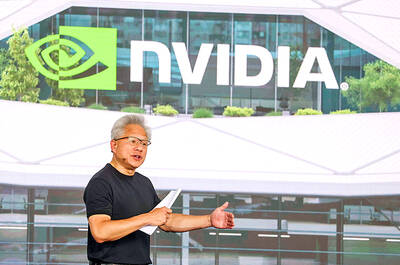
‘BOOMING’: ’ The number of partners we have here is incredible. You can see from their stock prices. They’re doing so well, they’re so happy,’ Jensen Huang said Nvidia Corp’s spending in Taiwan has ballooned to about US$150 billion a year, 10 times the US$10 billion to US$15 billion the company spent five years ago, Nvidia chief executive officer Jensen Huang (黃仁勳) said yesterday, suggesting Taiwan’s strategic importance in the global artificial intelligence (AI) supply chain. “Taiwan is the epicenter of the AI revolution. This is where the chips come, packaging comes. This is where the systems are made. This is where AI supercomputers were created,” Huang said at a meeting for the company’s employees in Beitou-Shilin Technology Park (北投士林科技園區) in Taipei, the planned site of Nvidia’s Taipei headquarters. “Taiwan


 RSS
RSS