


Tens of thousands of people yesterday crowded Taipei’s Ketagalan Boulevard to support Kaohsiung Mayor Han Kuo-yu’s (韓國瑜) possible run in next year’s presidential election.
Despite heavy rain that began in the afternoon, Han’s supporters, mostly wearing red, arrived from across the nation, many waving Republic of China (ROC) flags and chanting slogans.
The rally organizer said that as of 2:30pm more than 250,000 people had gathered.
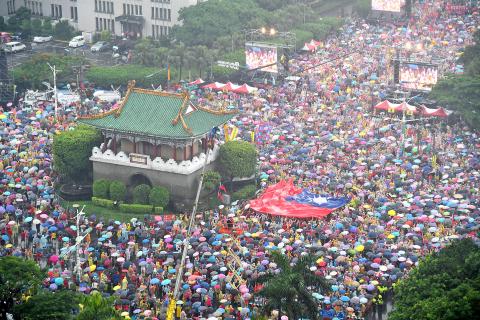
Photo: CNA
There were claims that the number exceeded 300,000 people at about 4:20pm, and aerial views showed the crowd extending into Zhongshan S Road and Renai Road when Han arrived just before 5pm.
Han and his wife, Lee Chia-fen (李佳芬), walked through the crowd to the stage, while people called out “dong suan” (凍蒜, “get elected”) in Hoklo (commonly known as Taiwanese) and “president for the common people, Taiwan solidarity.”
Han said that he left home to attend military school in Kaohsiung at the age of 18 and has not been afraid of anything since, including rumors or smear campaigns, but he is beginning to fear for the ROC’s future.
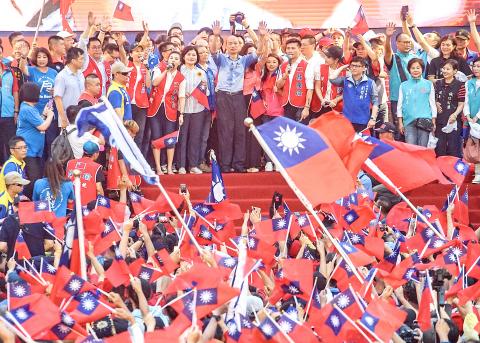
Photo: CNA
“No matter who becomes president, they should hold on to the principle: ‘Taiwan should be safe, the people should be wealthy,’” he said.
Han accused the Democratic Progressive Party of not improving people’s lives and President Tsai Ing-wen (蔡英文) of not accepting the so-called “1992 consensus,” while not daring to declare Taiwanese independence.
If he becomes president, he would ensure that other nations do not initiate war with Taiwan, while implementing “get-rich diplomacy” and pursuing stable cross-strait relations, Han said.
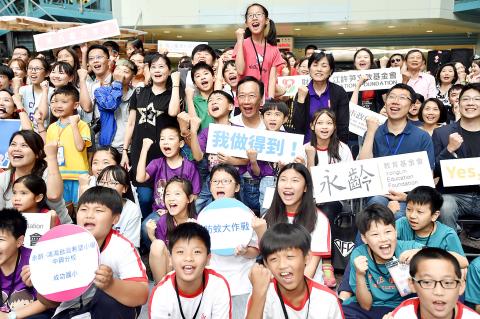
Photo: Chien Jung-fong, Taipei Times
“Talk of loving Taiwan and protecting its sovereignty are all nonsense, because it is a matter of course that whoever becomes president must do those things, so one should not use those terms simply to deceive people and solicit votes,” he said.
Han said that he is worried about the high unemployment rate, low salaries and expensive housing market, and that Taiwan should build free economic zones to boost economic growth.
“[The presidential election] is a battle of life and death for the ROC,” he said. “I am willing to bear any important post in 2020, even if it means being beaten and smashed to pieces for the ROC.”
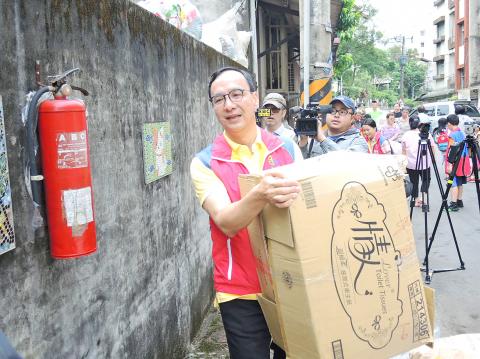
Photo: Weng Yu-huang, Taipei Times
Han has not yet officially announced his intention to compete in the Chinese Nationalist Party’s (KMT) presidential primary, although he said he does not oppose the idea of the party including his name in the primary.
Asked about the rally, Hon Hai Precision Industry Co (鴻海精密) chairman Terry Gou (郭台銘), who is vying for the KMT’s presidential nomination, said he has many economy-related events planned.
The public would witness whether he is simply campaigning or if he actually has plans for the economy, Gou said.
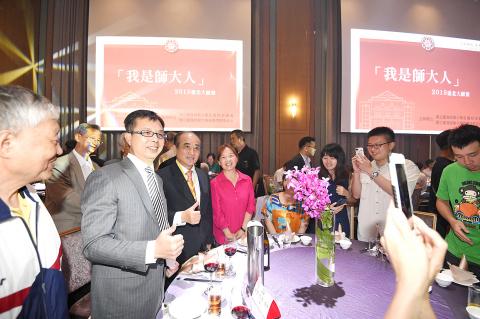
Photo: George Tsorng, Taipei Times
Former New Taipei City mayor Eric Chu (朱立倫), another KMT presidential hopeful, said that he felt no pressure.
“Han might put his focus on rallies, but I put mine on doing good deeds,” Chu said on the sidelines of an environmental event in New Taipei City, at which he worked as a volunteer.
Legislator Wang Jin-pyng (王金平), also a KMT presidential hopeful and a former legislative speaker, said that Han’s rally was one that was “happy and morale-boosting,” adding that those who attended are all potential KMT supporters.
The KMT plans to select its presidential candidate based on the results of public opinion polls, which are to be conducted by five polling firms between Wednesday and July 15. The winner is to be named at the party’s next national congress on July 28.
Additional reporting by Weng Lu-huang, Chen Yun and CNA

‘NO SECURITY RISK’: The Railway Bureau reassured the public that the technicians’ activities were limited to technical guidance and did not involve sensitive systems The Railway Bureau yesterday said it had invited eight Chinese technicians to assist with an airport MRT construction project. The bureau issued the confirmation after an Internet user said Chinese nationals had entered the construction zone of Taiwan Taoyuan International Airport’s Terminal 3 project. They asked why “individuals from an enemy state” were allowed access to such a major national infrastructure project, which raised serious concerns over Taiwan’s industrial safety, sensitive systems and information security. The bureau’s Northern Region Engineering Branch Office said subcontractor Taiwan Handle Industrial Co (台灣手把工業) of the Taoyuan airport MRT’s “Contract No. CU05 Project A14 Station Civil, MEP &

A US uncrewed surface vessel (USV) encountered multiple Chinese warships during an autonomous transit of the Taiwan Strait, US defense company Seasats said in a statement on Wednesday. Seasats announced that a Lightfish USV had completed the first autonomous transit of the Taiwan Strait. Over five days, the USV traversed the entire length of the Strait while constantly monitoring surface vessel traffic, the company said. The Lightfish encountered multiple Chinese warships, one of which was a Chinese People’s Liberation Army Navy (PLAN) Type 056 corvette, it said. The Chinese vessels were operating “well within Taiwan’s exclusive economic zone without transmitting their identity via the
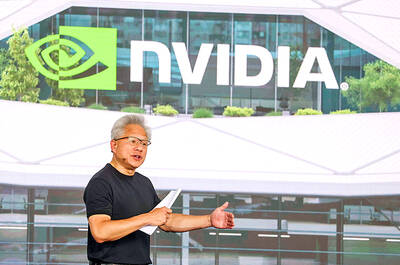
‘BOOMING’: ’ The number of partners we have here is incredible. You can see from their stock prices. They’re doing so well, they’re so happy,’ Jensen Huang said Nvidia Corp’s spending in Taiwan has ballooned to about US$150 billion a year, 10 times the US$10 billion to US$15 billion the company spent five years ago, Nvidia chief executive officer Jensen Huang (黃仁勳) said yesterday, suggesting Taiwan’s strategic importance in the global artificial intelligence (AI) supply chain. “Taiwan is the epicenter of the AI revolution. This is where the chips come, packaging comes. This is where the systems are made. This is where AI supercomputers were created,” Huang said at a meeting for the company’s employees in Beitou-Shilin Technology Park (北投士林科技園區) in Taipei, the planned site of Nvidia’s Taipei headquarters. “Taiwan
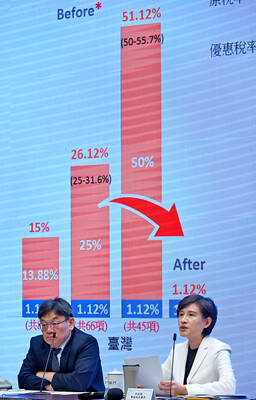
GREATER REACH? Auto parts and wood products would face tariffs of up to 15%, matching those targeting the EU, Japan and South Korea, Vice Premier said The US has announced that preferential tariff treatment for Taiwan’s non-semiconductor Section 232 goods would take effect retroactively from May 1, the Executive Yuan said yesterday. The US government yesterday posted a notice on the Federal Register’s public inspection Web site previewing tariff concessions for Taiwan under a memorandum of understanding (MOU) on Taiwan-US investment after two months of negotiations. The MOU signed on Jan. 15 stipulated three major preferential tariff arrangements: a 15 percent “reciprocal” tariff rate for Taiwan without stacking most-favored nation (MFN) rates; preferential Section 232 treatment for semiconductors and related products; and preferential Section 232 treatment for non-semiconductor


 RSS
RSS