


China for the first time on Friday made clear what it wants to see from the US in talks to end their trade dispute, laying bare the deep differences that still exist between the two sides.
In a wide-ranging interview with Chinese media after talks in Washington ended, Chinese Vice Premier Liu He (劉鶴) said that to reach an agreement the US must remove all extra tariffs, set targets for Chinese purchases of goods in line with real demand, and ensure that the text of the deal is “balanced” to ensure the “dignity” of both nations.
Liu’s three conditions underscore the work still to be done if an accord is to be reached between the world’s two largest economies.
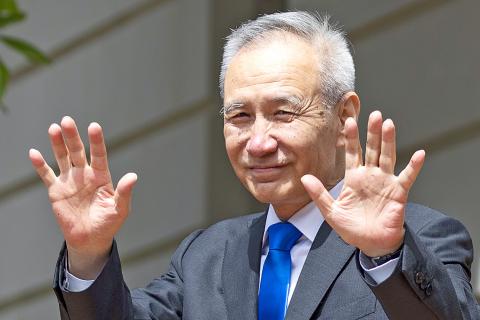
Photo: Bloomberg
US President Donald Trump’s administration told China that it has a month to seal a trade deal or face tariffs on all its exports to the US.
That threat was made during talks on Friday in Washington, hours after Trump upped the ante by imposing a second round of punitive duties on US$200 billion in Chinese goods.
The talks are under close scrutiny across global financial markets and US stocks turned positive after negotiators on both sides said the session had gone fairly well.
Liu said both sides agreed to keep talking, despite what he called “some temporary resistance and distractions,’’ and to hold meetings in Beijing.
He dismissed the idea that talks had broken down.
“It’s normal to have hiccups during the negotiations. It’s inevitable,” he said.
China has not yet detailed how it would retaliate to the latest increase in tariffs.
Liu also struck a note of defiance.
“For the interest of the people of China, the people of US and the people of the whole world, we will deal with this rationally, but China is not afraid, nor are the Chinese people,” he said. “China needs a cooperative agreement with equality and dignity.”
In a series of tweets that cheered markets, Trump on Friday said that the talks with China had been candid and constructive.
Further talks are possible, but there was no immediate plan for the next round, a person familiar with the negotiations said.
Liu’s comments revealed a new fault line. Whereas US negotiators previously accused China of walking back on commitments to change laws on technology transfers, as well as other issues, Liu argued that the US team was pushing for bigger Chinese purchases to level the trade imbalance than had originally been agreed.
Liu said that Chinese President Xi Jinping (習近平) and Trump had achieved an initial consensus “on a number” when they met in Argentina.
That “is a very serious issue and can’t be changed easily,” Liu said.
The amount of purchases by China should be “in line with reality,” the official Xinhua news agency said in a commentary yesterday.
China also sees the removal of all the extra tariffs that have been imposed since last year as a precondition to a deal, whereas US negotiators see retention of some duties as a key mechanism to enforce a deal.
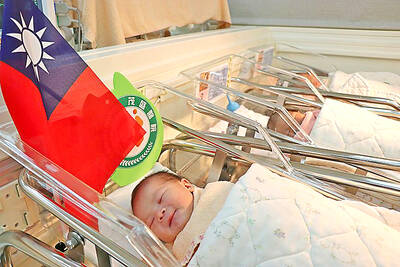
AGING: As of last month, people aged 65 or older accounted for 20.06 percent of the total population and the number of couples who got married fell by 18,685 from 2024 Taiwan has surpassed South Korea as the country least willing to have children, with an annual crude birthrate of 4.62 per 1,000 people, Ministry of the Interior data showed yesterday. The nation was previously ranked the second-lowest country in terms of total fertility rate, or the average number of children a woman has in her lifetime. However, South Korea’s fertility rate began to recover from 2023, with total fertility rate rising from 0.72 and estimated to reach 0.82 to 0.85 by last year, and the crude birthrate projected at 6.7 per 1,000 people. Japan’s crude birthrate was projected to fall below six,
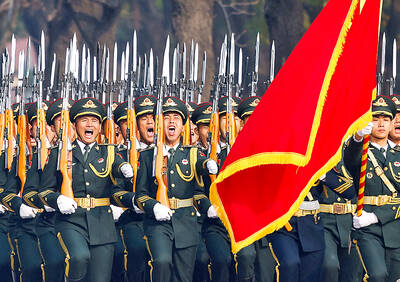
Conflict with Taiwan could leave China with “massive economic disruption, catastrophic military losses, significant social unrest, and devastating sanctions,” a US think tank said in a report released on Monday. The German Marshall Fund released a report titled If China Attacks Taiwan: The Consequences for China of “Minor Conflict” and “Major War” Scenarios. The report details the “massive” economic, military, social and international costs to China in the event of a minor conflict or major war with Taiwan, estimating that the Chinese People’s Liberation Army (PLA) could sustain losses of more than half of its active-duty ground forces, including 100,000 troops. Understanding Chinese
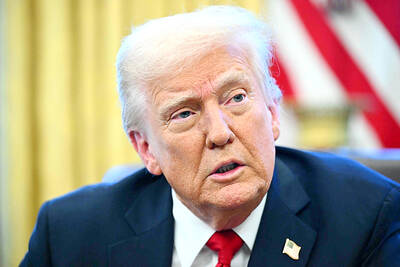
US President Donald Trump in an interview with the New York Times published on Thursday said that “it’s up to” Chinese President Xi Jinping (習近平) what China does on Taiwan, but that he would be “very unhappy” with a change in the “status quo.” “He [Xi] considers it to be a part of China, and that’s up to him what he’s going to be doing, but I’ve expressed to him that I would be very unhappy if he did that, and I don’t think he’ll do that. I hope he doesn’t do that,” Trump said. Trump made the comments in the context
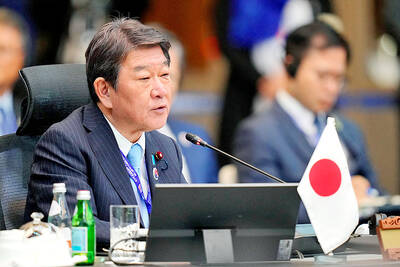
SELF-DEFENSE: Tokyo has accelerated its spending goal and its defense minister said the nation needs to discuss whether it should develop nuclear-powered submarines China is ramping up objections to what it sees as Japan’s desire to acquire nuclear weapons, despite Tokyo’s longstanding renunciation of such arms, deepening another fissure in the two neighbors’ increasingly tense ties. In what appears to be a concerted effort, China’s foreign and defense ministries issued statements on Thursday condemning alleged remilitarism efforts by Tokyo. The remarks came as two of the country’s top think tanks jointly issued a 29-page report framing actions by “right-wing forces” in Japan as posing a “serious threat” to world peace. While that report did not define “right-wing forces,” the Chinese Ministry of Foreign Affairs was


 RSS
RSS