


Orsted A/S yesterday said it plans to establish a NT$60 million (US$1.94 million) trust fund in Taiwan, in partnership with other wind power developers, to provide local suppliers with further training and qualifications, after the Danish firm’s board made its final investment decision on Tuesday.
The trust fund would be operated by a third party, such as the Metal Industries Research and Development Center (金工中心), while the firm would also create a platform where smaller suppliers would be encouraged to engage in the local supply chain, Orsted president for Asia-Pacific Matthias Bausenwein told a news conference in Taipei.
The company said that it would further cooperate with local companies in the areas of power facilities and maritime engineering through various projects involving onshore substations, power transmission systems, maritime engineering counseling, environmental monitoring and energy storage systems.

Photo: Huang Pei-chun, Taipei Times
The news came as a relief for many, as Orsted had earlier announced that it would suspend activities in Taiwan due to local supply chain complications and the Ministry of Economic Affairs’ decision to lower a feed-in tariff to NT$5.516 per kilowatt-hour.
While expressing his relief about the final investment decision, Bausenwein said that the wind power industry needs a stable framework as the company plans to operate its wind farm in Taiwan for at least 25 years.
Orsted offices would be set up in Kaohsiung and Taichung, and the number of employees would be increased to 100, Orsted said, adding that the number of direct and indirect job opportunities related to its wind farm projects in Changhua County is estimated to be 12,000.
The ministry two weeks ago approved the company’s supply chain localization solutions, and on Monday last week Orsed signed a power purchase agreement (PPA) with Taiwan Power Co (台電) concerning feed-in tariffs.
“We are nevertheless keen to amend the PPA in order to give more certainty to investors,” Bausenwein said, adding that he hopes to obtain more specifics on curtailment and risks.
Orsted would consider signing corporate PPAs, due to recent amendments to the Renewable Energy Development Act (再生能源發展條例) that make it possible to allocate renewable energy to local businesses, Bausenwein said.
The company’s southeast and southwest offshore wind farms would have a total capital expenditure of NT$165 billion, Orsted said.
The two sites are 37km to 50km off the coast of Changhua, and once completed in 2021 or 2022, they would generate 900 megawatts — enough electricity for up to 1 million Taiwanese households, the company said.
Star Energy Corp (星能) is to start onshore construction of two substations this month, creating an estimated 800 to 1,000 jobs, it said.
Orsted said that other companies, such as SinDa Marine Structure Co (興達海基), CSCB Corp, Taiwan (台灣國際造船), Formosa Heavy Industries Corp (台塑重工), China Engineering Consultants Inc (中華顧問工程), Taiwan Cogeneration Corp (台灣汽電) and Taiwan International Ports Corp (台灣港務), are already involved in the local supply chain, and the company is still in talks with Century Iron & Steel Industrial Co (世紀鋼構).
Siemens Gamesa Renewable Energy is to establish a wind turbine assembly site, the first in Asia, at the Port of Taichung, Orsted added.
The company has issued invitations to local banks for a five-year NT$25 billion revolving credit facility led by Bank Of Taiwan (台灣銀行), Cathay Union Bank (國泰世華銀行) and BNP Paribas, it added.

The Tourism Administration yesterday announced that it would reward repeat international visitors with incentives of up to NT$8,000 to boost inbound tourism. The incentives are available to all international tourists, it said, adding that repeat visitors would be rewarded with NT$5,000 and would receive an additional NT$3,000 if they bring travel companions. The nation received 2,990,657 inbound visitors during the first quarter, marking a 3.8 percent increase from the same period last year, agency data showed. Japanese nationals are among groups visiting Taiwan the most. About 1.48 million Japanese tourists arrived last year, a year-on-year increase of more than 12
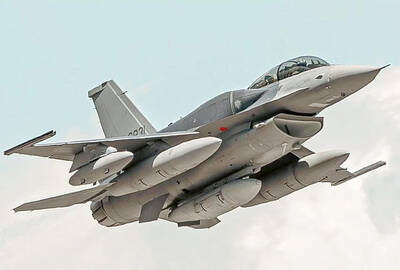
66 FIGHTER JETS: The aircraft is likely undergoing preparations for its transfer to Taiwan — a significant step forward in the nation’s modernization program, a lawmaker said The first of Taiwan’s order of F-16V Block 70 aircraft has been sighted in Texas ahead of delivery, Democratic Progressive Party (DPP) Legislator Wang Ting-yu (王定宇) said. Taiwan’s first F-16V Block 70 two-seat aircraft, tail number 6831, was seen flying from Lockheed Martin’s production facility in Greenville, South Carolina, to Naval Air Station Joint Reserve Base Fort Worth in Texas, Wang wrote on Facebook yesterday. The plane is likely undergoing preparations for its transfer to Taiwan, marking a significant step forward in the Republic of China Air Force’s modernization program, Wang said, citing military analysts. The F-16V Block 70 is a new-build version
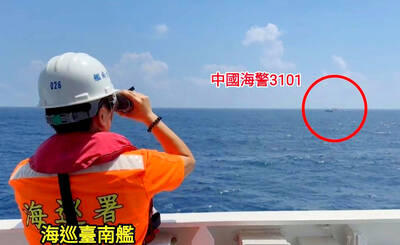
‘BRAZEN’: The holiday did not stop China from activities that infringe on Taiwan’s maritime jurisdiction, but the CGA is ready to defend the nation, Kuan Bi-ling said Beijing is intensifying maritime pressure on Taiwan, but the nation will never yield, Ocean Affairs Council Deputy Minister Sung Chen-en (宋承恩) said. The Coast Guard Administration (CGA) has adopted a “shadowing and monitoring” approach to avoid falling into a Chinese trap to escalate tensions and deepen the conflict, Sung said in an interview published yesterday in the Chinese-language Liberty Times (the Taipei Times’ sister newspaper). China Coast Guard formations patrolling waters east of Taiwan, as well as official Chinese vessels entering areas around Itu Aba Island (Taiping Island, 太平島) and Pratas Islands (Dongsha Islands, 東沙群島) show Beijing’s attempts to significantly step up
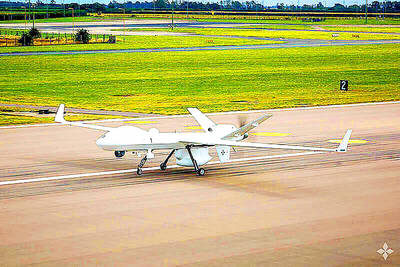
BOOST: By operating the same advanced systems as the US military, Taiwan would be better positioned to share and integrate intelligence with partners, an expert said The first batch of MQ-9B SkyGuardian drones has arrived in Taiwan, and is being assembled and tested by drone manufacturer General Atomics and the military ahead of flight trials as part of the air force’s acquisition to bolster its aerial surveillance capabilities, a source said yesterday. The air force allocated a budget of NT$21.7 billion (US$687 million) from 2022 to 2029 to procure four MQ-9B uncrewed aerial vehicles (UAVs) manufactured by General Atomics along with associated equipment such as ground control stations. The US has agreed to deliver the four MQ-9Bs to Taiwan in two batches this year and next


 RSS
RSS