


CtiTV News (中天新聞) has been fined a total of NT$1 million (US$32,409) for failing to adhere to the fact-verification mechanism stipulated in the Satellite Broadcasting Act (衛星廣播電視法), the National Communications Commission (NCC) said yesterday.
The decision to penalize the TV station was first reached by a content review committee made up of independent experts from a variety of academic backgrounds. NCC commissioners yesterday confirmed the decision at their weekly meeting.
The station on Feb. 28 broadcast a report about Kaohsiung Mayor Han Kuo-yu’s (韓國瑜) visit in Singapore saying that Representative to Singapore Francis Liang (梁國新) was monitoring Han’s whereabouts and reporting them to Taipei, the commission said.

Photo: Chang Ching-ya, Taipei Times
That was a contravention of Article 27 of the act, which bans news stations from producing and broadcasting content that breaches the principle of fact verification, resulting in a NT$600,000 fine, it said.
The Ministry of Foreign Affairs had issued a statement refuting the report, but the station did not issue a correction afterward, it added.
Citing the same article, the commission also fined the station NT$400,000 for airing a report on Feb. 18 saying that an “auspicious cloud” had appeared in the sky when Han, Taichung Mayor Lu Shiow-yen (盧秀燕) and New Taipei City Mayor Hou You-yi (侯友宜) campaigned together at a rally last year.
The commission said that it had launched an administrative investigation into CtiTV’s operations following complaints from viewers, who said the station has been devoting an excessively high percentage of coverage to Han.
The results of the investigation were also deliberated by the committee, whose members ruled unanimously that CtiTV has covered and broadcast news about Han in a way that has hindered people from accessing other types of news, the commission said, adding that this exposed the station’s failure to follow its own code of conduct.
Citing Article 43 of the act, the commission said that it has ordered CtiTV to undertake several steps to improve its operations.
The station must fill senior management vacancies at its news department within one month after receiving the commission’s official ruling, the NCC said.
The station must explain when it will recruit a qualified ombudsman to oversee its operations, as it had promised to do so when renewing its license in 2015, the commission said, adding that CtiTV must also offer an official explanation of the division of labor in its news department.
CtiTV has been instructed to evaluate its operations and propose improvements, the commission said, adding that it must submit a report on those aspects within a month of receiving the ruling.
Specifically, the report must include the station’s guidelines for covering, editing and broadcasting news and commentary, as well as how it plans to adhere to the principle of fact verification, and fair and balanced news coverage, the NCC added.
A plan to provide training to employees must also be included in the report, it said.
CtiTV must review the qualifications of its ethics committee members and explain how it would implement their suggestions, the commission said, adding that if the station fails to carry out the tasks, it would receive an additional fine and be asked to remove the management of its news department.
The commission said that it analyzed the station’s news broadcasts at 1pm, 7pm and 8pm from Feb. 11 to Feb. 17, and found that on Feb. 16, coverage of Han constituted 56.7 percent of the total content, higher than any other day in the period.
On Feb. 14, 50 percent of the station’s news headlines included Han’s name, the highest in the period, it said.
Overall, Han’s name appeared in more than 30 percent of CtiTV’s evening news stories, it added.
“We are not saying that CtiTV cannot report on Han, but it must follow its code of conduct and self-discipline guidelines when covering him,” NCC spokesman Wong Po-tsung (翁柏宗) said.
CtiTV said the punishment was unacceptable and would seek administrative remedies.
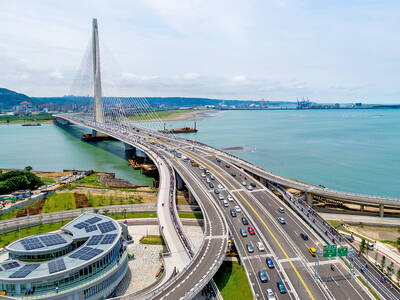
The Ministry of Transportation and Communications yesterday inaugurated the Danjiang Bridge across the Tamsui River in New Taipei City, saying that the structure would be an architectural icon and traffic artery for Taiwan. Feted as a major engineering achievement, the Danjiang Bridge is 920m long, 211m tall at the top of its pylon, and is the longest single-pylon asymmetric cable-stayed bridge in the world, the government’s Web site for the structure said. It was designed by late Iraqi-British architect Zaha Hadid. The structure, with a maximum deck of 70m, accommodates road and light rail traffic, and affords a 200m navigation channel for boats,
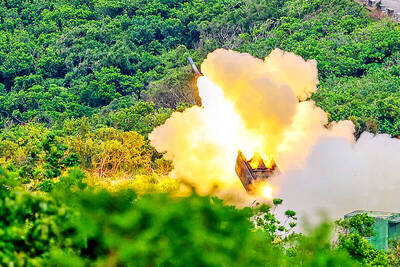
PRECISION STRIKES: The most significant reason to deploy HIMARS to outlying islands is to establish a ‘dead zone’ that the PLA would not dare enter, a source said A High Mobility Artillery Rocket System (HIMARS) would be deployed to Penghu County and Dongyin Island (東引) in Lienchiang County (Matsu) to force the Chinese military to retreat at least 100km from the coastline, a military source said yesterday. Taiwan has been procuring HIMARS and Army Tactical Missile Systems (ATACMS) from the US in batches. Once all batches have been delivered, Taiwan would possess 111 HIMARS units and 504 ATACMS, which have a range of 300km. Considering that “offense is the best defense,” the military plans to forward-deploy the systems to outlying islands such as Penghu and Dongyin so that
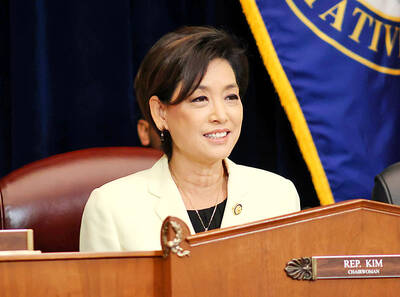
‘CLEAR MESSAGE’: The bill would set up an interagency ‘tiger team’ to review sanctions tools and other economic options to help deter any Chinese aggression toward Taiwan US Representative Young Kim has introduced a bill to deter Chinese aggression against Taiwan, calling for an interagency “tiger team” to preplan coordinated sanctions and economic measures in response to possible Chinese military or political action against Taiwan. “[Chinese President] Xi Jinping [習近平] has directed the People’s Liberation Army to be ready to invade Taiwan by 2027. China has a plan. America should have one too,” Kim said in a news release on Thursday last week. She introduced the “Deter PRC [People’s Republic of China] aggression against Taiwan act” to “ensure the US has a coordinated sanctions strategy ready should
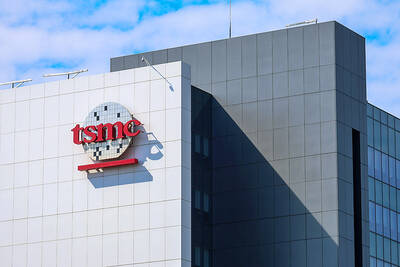
Taiwan Semiconductor Manufacturing Co (TSMC, 台積電), the world’s largest foundry service provider, yesterday said that global semiconductor revenue is projected to hit US$1.5 trillion in 2030, after the figure exceeds US$1 trillion this year, as artificial intelligence (AI) demand boosts consumption of token and compute power. “We are still at the beginning of the AI revolution, but we already see a significant impact across the whole semiconductor ecosystem,” TSMC deputy cochief operating officer Kevin Zhang (張曉強) said at the company’s annual technology symposium in Hsinchu City. “It is fair to say that in the past decade, smartphones and other mobile devices were


 RSS
RSS