


A pothole on Taiwan Taoyuan International Airport’s south runway delayed 121 flights on Saturday night, the Taoyuan International Airport Corp (TIAC, 桃園國際機場公司) said yesterday.
Budget airline Scoot Tigerair Pte had one of its flights from Hokkaido to Singapore via Taiwan delayed for more than nine hours, the longest among all delayed flights, the airport company said.
The flight was scheduled to land at the airport in Taoyuan at 9:20pm on Saturday and depart for Singapore at 10:20pm, it said.
Due to the pothole, the flight was redirected to Kaohsiung International Airport instead, it said, adding that it landed in Taoyuan at 1:43am yesterday and left for Singapore at 8am.
The pothole, which was found on the south runway during a routine inspection at about 6pm on Saturday, was about 45cm long, 30cm wide and 3cm deep, TIAC said.
Due to heavy rainfall, the repair work did not finish until 10:15pm, the company said, adding that the runway reopened at midnight after the pavement had cooled down.
The repair work delayed the arrival of 85 flights, with eight of them being diverted to Kaohsiung, it said.
The average delay time was 55 minutes, which did not include the waiting time in Kaohsiung, TIAC said.
Airlines that diverted flights to Kaohsiung included China Airlines Ltd (中華航空, four flights), EVA Airways Corp (長榮航空, two flights), Scoot Tigerair (one flight) and Tigerair Taiwan Ltd (台灣虎航, one flight).
Another 36 departing flights were delayed, with an average delay time of 49 minutes.
Taoyuan International Airport’s south and north runways were closed for one-year renovations in 2014 and 2015 respectively, and construction of the south runway was completed in January 2015.
Problems with the south runway first surfaced in October 2015, when an EVA Air aircraft’s vertical stabilizer was hit by a piece of asphalt as it was taxiing down the runway for take off.
The airport company also closed the runway for 16 hours in 2017 to repair a crack.
Wang Ming-teh (王明德), who became the airport company’s chairman at the end of last year, said that he would identify problems facing the nation’s most important gateway.
On Friday last week, three months after Wang took office, the airport also experienced a power outage for 30 minutes, disrupting the operations of two airport terminals.
The pothole was not an isolated event, particularly as the runway underwent a major renovation a few years ago, he said.
Wang said that the company would have to find the source of the problem.
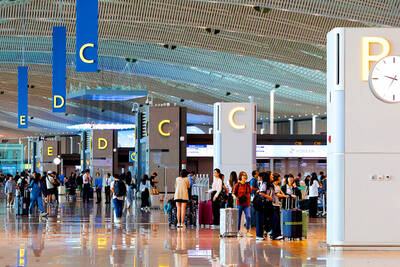
South Korea has adjusted its electronic arrival card system to no longer list Taiwan as a part of China, a move that the Ministry of Foreign Affairs said would help facilitate exchanges between the two sides. South Korea previously listed “Taiwan” as “Taiwan (China)” in the drop-down menus of its online arrival card system, where people had to fill out where they came from and their next destination. The ministry had requested South Korea make a revision and said it would change South Korea’s name on Taiwan’s online immigration system from “Republic of Korea” to “Korea (South),” should the issue not be

Tainan, Taipei and New Taipei City recorded the highest fines nationwide for illegal accommodations in the first quarter of this year, with fines issued in the three cities each exceeding NT$7 million (US$220,639), Tourism Administration data showed. Among them, Taipei had the highest number of illegal short-term rental units, with 410. There were 3,280 legally registered hotels nationwide in the first quarter, down by 14 properties, or 0.43 percent, from a year earlier, likely indicating operators exiting the market, the agency said. However, the number of unregistered properties rose to 1,174, including 314 illegal hotels and 860 illegal short-term rental
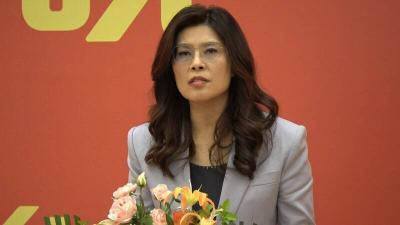
Both sides of the Taiwan Strait share a political foundation based on the “1992 consensus” and opposition to Taiwanese independence, Chinese Nationalist Party (KMT) Chairwoman Cheng Li-wun (鄭麗文) today said during her meeting with Chinese President Xi Jinping (習近平). Both sides of the Strait should plan and build institutionalized and sustainable mechanisms for dialogue and cooperation based on that foundation to make peaceful development across the Strait irreversible, she said. Peace is a shared moral value across the Strait, and both sides should move beyond political confrontation to seek institutionalized solutions to prevent war, she said. Mutually beneficial cross-strait relations are what the
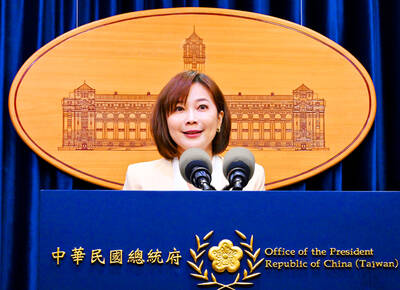
ECONOMIC COERCION: Such actions are often inconsistently applied, sometimes resumed, and sometimes just halted, the Presidential Office spokeswoman said The government backs healthy and orderly cross-strait exchanges, but such arrangements should not be made with political conditions attached and never be used as leverage for political maneuvering or partisan agendas, Presidential Office spokeswoman Karen Kuo (郭雅慧) said yesterday. Kuo made the remarks after China earlier in the day announced 10 new “incentive measures” for Taiwan, following a landmark meeting between Chinese President Xi Jinping (習近平) and Chinese Nationalist Party (KMT) Chairwoman Cheng Li-wun (鄭麗文) in Beijing on Friday. The measures, unveiled by China’s Xinhua news agency, include plans to resume individual travel by residents of Shanghai and China’s Fujian


 RSS
RSS