


A veteran entertainer yesterday slapped Minister of Culture Cheng Li-chiun (鄭麗君) in the face, saying she was upset with the minister’s attempts to “discredit” Chiang Kai-shek (蔣介石) and his son, former president Chiang Ching-kuo (蔣經國).
The incident occurred at a lunar year-end banquet in Taipei attended by veteran entertainers to mark the end of the Year of the Dog, the Chinese-language Mirror Media magazine reported.
The minister was going from table to table toasting the attendees when Lisa Cheng (鄭心儀), 67, slapped her in the face and then returned to her seat, footage taken at the event showed.

Photo: Pan Shao-tang, Taipei Times
Cheng Li-chiun gasped and put her hand on her cheek, looking surprised and confused.
Asked why she hit Cheng Li-chiun, Lisa Cheng, who is also known as Cheng Hui-chung (鄭惠中), said: “I had intended to slap her twice. I had been thinking about this for months... I went easy on her by slapping her just once.”
Lisa Cheng said that she “had to do it,” because meeting the minister was a “rare occasion.”
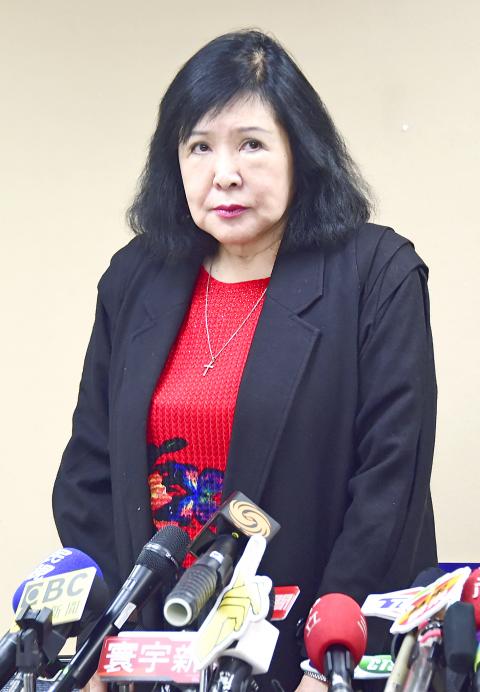
Photo: Pan Shao-tang, Taipei Times
The minister has been “ungrateful” by pushing policies to abolish Taipei’s Chiang Kai-shek Memorial Hall and ignoring the Chiangs’ contributions to the nation, she said, adding that Cheng Li-chiun “had it coming.”
The minister declined to comment on the attack when leaving the venue, but later wrote on Facebook that she did not personally know Lisa Cheng.
While Taiwanese society embraces diversity and freedom of speech, people should not use violence to express their opinion, she wrote.
Her personal humiliation was insignificant next to safeguarding Taiwanese democracy, Cheng Li-chiun wrote, urging the public not to resort to violence when discussing public issues.
Accompanied by Chinese Nationalist Party (KMT) Taipei City Councilor Angela Ying (應曉薇), Lisa Cheng later told a news conference at the Taipei City Council that she had lost control of her emotions because of the ruling Democratic Progressive Party’s policies aimed at “discrediting the Chiangs.”
She said she would apologize to the minister, but would not apologize for her position on the memorial.
Leo Chuang (莊豐嘉), general manager of Chinese Television System (CTS, 華視), which hosted the banquet, said at a separate news conference that the network would sue Lisa Cheng on behalf of the minister, adding that it denounces any form of violence.
The Ministry of Culture last year held a series of workshops to discuss transforming the memorial, but has not said whether it would demolish or abolish it.
Last month, the ministry said that it had drafted two options for repurposing the memorial, which would be submitted to the Executive Yuan for interdepartmental discussions before they are made public.

LEVERAGE: China did not ‘need to fire a shot’ to deny Taiwan airspace over Africa when it owns ‘half the continent’s debt,’ a US official said, calling it economic warfare The EU has raised concerns about overflight rights following the delay of President William Lai’s (賴清德) planned state visit to the Kingdom of Eswatini after three African nations denied overflight clearance for his charter at the last minute. Taiwanese allies Paraguay and Saint Kitts and Nevis, as well as several US lawmakers and the Inter-Parliamentary Alliance on China (IPAC) condemned China for allegedly pressuring the countries. Lai was scheduled to fly directly to Taiwan’s only African ally from yesterday to Sunday to celebrate the 40th anniversary of King Mswati III’s accession and his 58th birthday, but Seychelles, Mauritius and Madagascar suddenly revoked
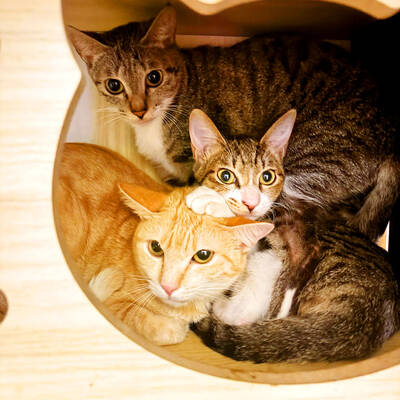
The number of pet cats in Taiwan surpassed that of pet dogs for the first time last year, reaching 1,742,033, a 32.8 percent increase from 2023, the Ministry of Agriculture said yesterday, citing a survey. By contrast, the number of pet dogs declined slightly by 1.2 percent over the same period to 1,462,528, the ministry said. Despite the shift, households with dogs still slightly outnumber those with cats by 1.2 percent. However, while the number of households with multiple dogs has remained relatively stable, households keeping more than two cats have increased, contributing to the overall rise in the feline population. The trend

China on Wednesday teased in a video an aircraft carrier that could be its fourth, and the first using nuclear power, while making an allusion to Taiwan and vowing to further build up its islands, as it looks to boost maritime power, secure resources and bolster territorial claims. The video, issued on the eve of the 77th founding anniversary of the Chinese People’s Liberation Army Navy, featured fictional officers with names that are homophones of three commissioned aircraft carriers, the Liaoning (遼寧), Shandong (山東) and Fujian (福建). Titled Into the Deep, it showed a 19-year-old named “Hejian” (何劍) joining the group, sparking
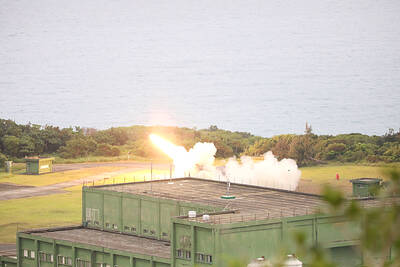
Taiwan has signed six arms procurement offers from the US totaling more than NT$208 billion (US$6.59 billion) covering long-range precision strike systems, missile stockpile replenishment and joint production of large-caliber ammunition, the Ministry of National Defense said yesterday. The government’s proposed NT$1.25 trillion special defense budget has been stalled in the Legislative Yuan as opposition lawmakers question the amount and procurement items, while the Presidential Office and defense ministry say that the full amount is necessary to safeguard Taiwan. Minister of National Defense Wellington Koo (顧立雄) on Monday briefed the legislature’s Foreign Affairs and National Defense Committee on the defense budget for


 RSS
RSS