


A Coast Guard Administration task force has been set up after a Taiwanese man said that he paid smugglers to transport him back to Taiwan from China late last year and that others on the boat were carrying pork and other meat products.
A businessman, surnamed Lee (李), on Saturday posted on Baoliao Gongshe (爆料公社), a Facebook page for sharing revelations, that he had smuggled himself out of China after running afoul of Chinese authorities, but had decided to turn himself in to police because he realized that illegal immigration and smuggling are the biggest loopholes in the government’s efforts to prevent the spread of African swine fever to Taiwan.
He had a business in China, but was jailed in Guangdong Province for 67 days before being released pending trial and had paid smugglers NT$1.5 million (US$48,635) to transport him to Penghu County, he wrote.

Photo: CNA
He traveled by boat from Quanzhou in China’s Fujian Province to Penghu, and then flew from Penghu Airport in Makong to Taipei International Airport (Songshan airport), which meant he did not have to go through immigration, Lee wrote.
Three other Taiwanese who traveled with him on the boat had a lot of Chinese-made meat products, including sausage and pork jerky, but he only realized such products posed a threat once he was back home and read about African swine fever, as China has blocked information about outbreaks of the disease there, he wrote.
He would surrender to police even though he might face punishment for smuggling himself home, he wrote.
Lee, 46, yesterday made good on his promise, surrendering to police in New Taipei City’s Sansia District (三峽), who referred him to prosecutors for allegedly contravening the Immigration Act (入出國及移民法) and forwarded information about him to the city government, the coast guard and the National Immigration Agency.
The coast guard is collecting information about Lee’s case and has set up a task force, Kinmen-Matsu-Penghu Branch Director Liao Te-cheng (廖德成) said in response to media inquiries.
It would ask Lee to help identify the brokers who arranged his passage, the boat owner and the other passengers, the coast guard said.
As cross-strait travel surges ahead of the Lunar New Year holiday, the coast guard would boost its patrols, targeting fishing boats that are not actually fishing, Liao said.
The coast guard is more active near Kinmen, as it is closer to China, but patrols around Penghu and other areas are strict as well, he said.
It would use coastal radar systems to monitor vessels and prevent illegal immigrants from boarding smaller shuttle boats offshore, he added.
Meanwhile, the Council of Agriculture said more sausage products from China’s Jiangsu Province that were dumped in the quarantine amnesty bin at Songshan airport have tested positive for the African swine flu virus.
As of yesterday, of the 813 Chinese pork products seized at customs and sampled for tests, 14 tested positive for the disease, council data showed.
Additional reporting by CNA
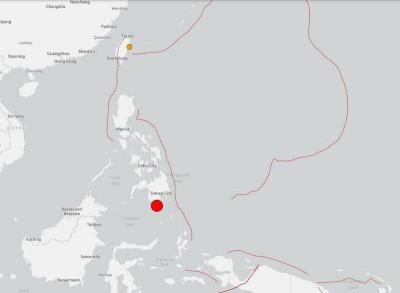
A magnitude 7.8 earthquake struck off the southern coast of Mindanao in the Philippines at 7:38am today, prompting the US Tsunami Warning System to issue an alert for neighboring countries, including Taiwan. The system issued a purple alert indicating a "tsunami threat." The potential threat zone includes Taiwan, the Philippines, Papua New Guinea, Yap and Palau. Philippine authorities were assessing the damage from the quake, with the office of civil defense seeking to verifying initial reports that 15 people had been killed and 129 injured in the region, mostly from falling debris. Arlene Hollero, disaster chief of Maasim town in the Philippines' Sarangani Province,
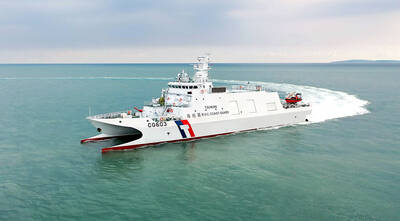
‘GRAY ZONE’ PRESSURE: Beijing’s activities are intended to create the deceitful impression that China has jurisdiction over the area around Taiwan, the CGA said Taiwan’s rights over its territorial waters and exclusive economic zone must not be violated by any country, the Mainland Affairs Council said yesterday, adding that it will not accept any unprovoked actions. The council issued the remarks in response to the China Coast Guard conducting maritime enforcement drills near eastern Taiwan and claiming to fully exercise China’s maritime administrative law enforcement authority. The Coast Guard Administration (CGA) has been closely monitoring the situation and is taking concrete steps to defend the nation’s sovereignty and secure its waters, the council said. China has no sovereign rights over the waters off eastern

RESILIENCE: Taiwan plays a key role in semiconductors, energy, information infrastructure and advanced manufacturing, AIT Director Raymond Greene said Taiwan’s continued investment in deterrence and resilience remains vital, especially in uncrewed systems and other emerging technologies, American Institute in Taiwan (AIT) Director Raymond Greene said yesterday. Greene made the remarks at the annual National Strategic Summit on Supply Chain Resilience held by the Research Institute for Democracy, Society and Emerging Technology (DSET), a government-backed think tank. As Taiwan last year became the US’ fourth-largest trading partner and supply chain security is becoming more important, cooperation in emerging technologies continues to deepen between the two countries, he said. The US is committed to accelerating innovation, building key infrastructure, strengthening cooperation

The National Chungshan Institute of Science and Technology yesterday showcased its locally developed variants of the Vision 60 robotic patrol dog, which it plans to deploy on the nation’s outlying territories in the South China Sea. The variants were produced under the Joint Lab project — created by the institute and domestic companies — and assembled with domestically produced motors, lenses and artificial intelligence (AI) systems alongside licensed tech from the US, Missile and Rocket Systems Research Division deputy director Jen Kuo-kang (任國光) told the media event at a military base in Taipei’s Dazhi (大直) area. Taiwan has built up its strengths


 RSS
RSS