


The Taipei High Administrative Court should be held responsible if the National Women’s League (NWL) disposes of its assets, the Ill-gotten Party Assets Settlement Committee said yesterday in response to the court’s decision on Tuesday to unfreeze the league’s assets.
The committee in February declared the league to be an affiliate of the Chinese Nationalist Party (KMT) and froze its assets totaling about NT$38.5 billion (US$1.25 billion).
During the KMT authoritarian period, the league used the party-state system to ask the public for “military donations” and distributed the money through the KMT’s social work committee, the committee said, adding that there is clear evidence of its affiliation.
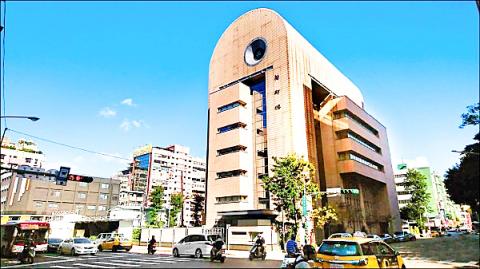
Photo: Chen Yu-fu, Taipei Times
Judges Chen Chin-wei (陳金圍), Pi Nai-chun (畢乃俊) and Chen Hsin-hung (陳心弘) completely disregarded the evidence and the league can now use the funds as it pleases, it said.
The league applied to unfreeze its assets because it was dissatisfied with the committee’s decision to file an administrative suit, sources said.
The decision greatly damages fair competition among political parties and the nation’s transitional justice project, makes the sorting and retrieval of ill-gotten party assets more complicated and harms the public interest, the committee said.
The court in its press release disregarded the fact that transitional justice projects must always race against time and said that lifting the penalty would merely postpone the realization of transitional justice, the committee said.
The court is ignorant of the damage that would be done to the public interest and is essentially telling Taiwanese that there is no need to pursue transitional justice, it said.
Central Investment Co (中央投資公司) and Hsinyutai Co (欣裕台) had also applied to end the administrative penalties placed against them, but the Supreme Administrative Court rejected their requests, the committee added.
Tuesday’s ruling contradicts the Supreme Administrative Court’s ruling, it said.
The Taipei High Administrative Court only urged the league to consider the potential legal risks it might face and to handle its assets in a reasonable manner, it said.
The judges did not put any measure in place to prevent the league from using this opportunity to dispose of its assets, it added.
The league had illegally used about NT$2.4 million of its assets after it had already been declared a KMT affiliate, for which it was later fined, the committee said.
If the league uses large amounts of its assets and in doing so harms the public interest, the Taipei High Administrative Court should be held responsible, it added.
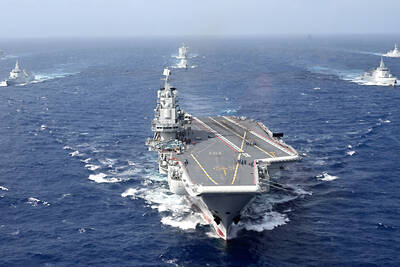
PROVOCATIVE: Chinese Deputy Ambassador to the UN Sun Lei accused Japan of sending military vessels to deliberately provoke tensions in the Taiwan Strait China denounced remarks by Japan and the EU about the South China Sea at a UN Security Council meeting on Monday, and accused Tokyo of provocative behavior in the Taiwan Strait and planning military expansion. Ayano Kunimitsu, a Japanese vice foreign minister, told the Council meeting on maritime security that Tokyo was seriously concerned about the situation in the East China and South China seas, and reiterated Japan’s opposition to any attempt to change the “status quo” by force, and obstruction of freedom of navigation and overflight. Stavros Lambrinidis, head of the EU delegation to the UN, also highlighted South China Sea
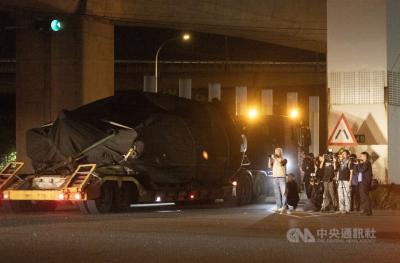
The final batch of 28 M1A2T Abrams tanks purchased from the US arrived at Taipei Port last night and were transported to the Armor Training Command in Hsinchu County’s Hukou Township (湖口), completing the military’s multi-year procurement of 108 of the tanks. Starting at 12:10am today, reporters observed more than a dozen civilian flatbed trailers departing from Taipei Port, each carrying an M1A2T tank covered with black waterproof tarps. Escorted by military vehicles, the convoy traveled via the West Coast Expressway to the Armor Training Command, with police implementing traffic control. The army operates about 1,000 tanks, including CM-11 Brave Tiger
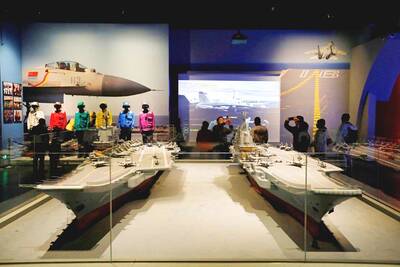
China on Wednesday teased in a video an aircraft carrier that could be its fourth, and the first using nuclear power, while making an allusion to Taiwan and vowing to further build up its islands, as it looks to boost maritime power, secure resources and bolster territorial claims. The video, issued on the eve of the 77th founding anniversary of the Chinese People’s Liberation Army Navy, featured fictional officers with names that are homophones of three commissioned aircraft carriers, the Liaoning (遼寧), Shandong (山東) and Fujian (福建). Titled Into the Deep, it showed a 19-year-old named “Hejian” (何劍) joining the group, sparking
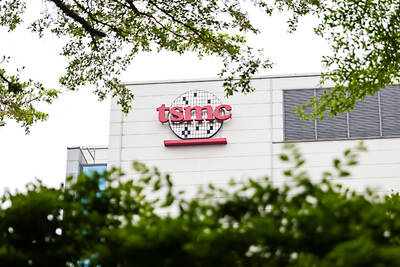
Taiwan Semiconductor Manufacturing Co (TSMC, 台積電), the world’s largest contract chipmaker, said it expects its 2-nanometer (2nm) chip capacity to grow at a compound annual rate of 70 percent from this year to 2028. The projection comes as five fabs begin volume production of 2-nanometer chips this year — two in Hsinchu and three in Kaohsiung — TSMC senior vice president and deputy cochief operating officer Cliff Hou (侯永清) said at the company’s annual technology symposium in Silicon Valley, California, last week. Output in the first year of 2-nanometer production, which began in the fourth quarter of last year, is expected to


 RSS
RSS