


The Criminal Investigation Bureau (CIB) and police have arrested at least 100 suspected gangsters in a nationwide crackdown, with the bureau touting the result as “boding well” for public security and curtailing criminal elements’ involvement in vote-buying, violence and social disturbances in the run-up to the elections on Saturday next week.
Among the targets were members of three major organized crime syndicates: the Bamboo Union, the Heavenly Way Alliance and the Four Seas Gang, CIB 4th Investigation Corp Deputy Chief Wang Chih-cheng (王志成) said.
One major figure under arrest was a 35-year-old man surnamed Tsai (蔡), reputedly head of a Four Seas Gang chapter in New Taipei City, who allegedly used violence to collect debts, and was at the center of several disputes over money and control of territory.

Photo: Huang Chieh, Taipei Times
“Tsai’s arrest helps to halt violence and public disturbances, while illegal firearms, bullets, knives, cash and checks have been seized. This is part of efforts to prevent organized crime syndicates from interfering in the nine-in-one elections,” Wang said.
Police have arrested three alleged Four Seas Gang members, including Tsai, 22 alleged members of the Bamboo Union and 17 from the Heavenly Way Alliance, along with 15 wanted criminals and 84 individuals with various alleged gang affiliations, CIB data showed.
Among those arrested were two Bamboo Union members who are ranking officials in the Chinese Unity Promotion Party (CUPP), the pro-Beijing organization long suspected of receiving financial support from China, and seven other gangsters who are also affiliated with political parties, Wang said.
The three crime syndicates have a largely pro-China ideology, and many of their leaders have business operations in China or have fled to China after being prosecuted, CIB officials said.
One clear example is CUPP founder Chang An-le (張安樂), whose Taolue Group (韜略集團) has offices in Hong Kong and Dongguang, China, officials said.
It is suspected that organized crime syndicates are a primary conduit for the Chinese government to funnel an estimated NT$35 billion (US$1.13 billion) in financial support to pro-China organizations and political parties to run propaganda campaigns in an attempt to subvert the nine-in-one elections, they said.
Meanwhile, Concentric Patriotism Association (CPA) chairman Zhou Qinjun (周慶峻) and Chinese Democratic Progressive Party Taipei City councilor candidate Zhang Xiuye (張秀葉) have been barred from leaving the nation and confined to their residences for allegedly contravening the Political Donations Act (政治獻金法).
The office said they received an anonymous tip-off that the CPA on Oct. 1 held a feast at Ichilong Restaurant in Taipei’s Zhongshan District (中山) to “celebrate the National Day of the People’s Republic of China.”
The CPA had reserved 60 tables at NT$7,000 per table and Zhang was allegedly seen canvassing for votes for her campaign, prosecutors said.
Zhou invited nearly 20 members of the CPA to visit Guizhou Province between July and August for what was called a “landing treat” event, they said.
Zhou oftens visits underground currency exchange dealers, to allegedly exchange yuan that he brings back from China into New Taiwan dollars, they said.
The funds are suspected to be from the Chinese government and are backing Zhang’s campaign, they said.
Zhou has denied the allegations that the CPA and Zhang’s campaign are being subsidized by China.
Additional reporting by Yao Yueh-hung

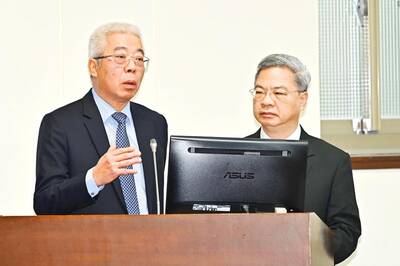
Taiwan has arranged for about 8 million barrels of crude oil, or about one-third of its monthly needs, to be shipped from the Red Sea this month to bypass the Strait of Hormuz and ease domestic supply pressures, CPC Corp, Taiwan (CPC, 台灣中油) said yesterday. The state-run oil company has worked with Middle Eastern suppliers to secure routes other than the Strait of Hormuz, through which about 20 percent of the world’s oil and liquefied natural gas typically passes, CPC chairman Fang Jeng-zen (方振仁) said at a meeting of the legislature’s Economics Committee in Taipei. Suppliers in Saudi Arabia have indicated they
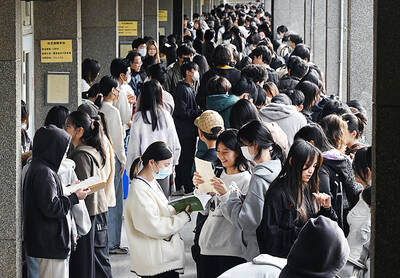
A global survey showed that 60 percent of Taiwanese had attained higher education, second only to Canada, the Ministry of the Interior said. Taiwan easily surpassed the global average of 43 percent and ranked ahead of major economies, including Japan, South Korea and the US, data from the Organisation for Economic Co-operation and Development (OECD) for 2024 showed. Taiwan has a high literacy rate, data released by the ministry showed. As of the end of last year, Taiwan had 20.617 million people aged 15 or older, accounting for 88.5 percent of the total population, with a literacy rate of 99.4 percent, the data
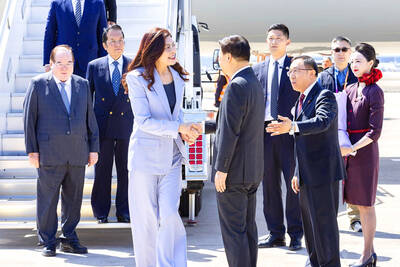
CCP ‘PAWN’? Beijing could use the KMT chairwoman’s visit to signal to the world that many people in Taiwan support the ‘one China’ principle, an academic said Chinese Nationalist Party (KMT) Chairwoman Cheng Li-wun (鄭麗文) yesterday arrived in China for a “peace” mission and potential meeting with Chinese President Xi Jinping (習近平), while a Taiwanese minister detailed the number of Chinese warships currently deployed around the nation. Cheng is visiting at a time of increased Chinese military pressure on Taiwan, as the opposition-dominated Legislative Yuan stalls a government plan for US$40 billion in extra defense spending. Speaking to reporters before going to the airport, Cheng said she was going on a “historic journey for peace,” but added that some people felt uneasy about her trip. “If you truly love Taiwan,

NEW LOW: The council in 2024 based predictions on a pessimistic estimate for the nation’s total fertility rate of 0.84, but last year that rate was 0.69, 17 percent lower An expected National Development Council (NDC) report expects the nation’s population to drop below 12 million by 2065, with the old-age dependency ratio to top 100 percent sooner than 2070, sources said yesterday. The council is slated to release its latest population projections in August, using an ultra-low fertility model, the sources said. The previous report projected that Taiwan’s population would fall to 14.37 million by 2070, but based on a new estimate of the total fertility rate (TFR) — the average number of children born to a woman over her lifetime — the population is expected to reach 12 million by


 RSS
RSS