

Under the Formosa Alliance’s rallying call, tens of thousands of people yesterday gathered in front of the Democratic Progressive Party’s (DPP) headquarters in Taipei, demanding an amendment to the Referendum Act (公民投票法) to allow for a poll promoting Taiwanese independence and rejecting Chinese annexation.
Amendments to the act promulgated in January have lowered the thresholds for proposing and passing referendums, but proposals about changing the national territory, flag and name are still not allowed.
Shouting slogans such as “Taiwan yes, China no” and “[we] want a referendum,” nearly 130,000 people rallied outside the DPP’s headquarters, according to the alliance’s estimate at 3:30pm.
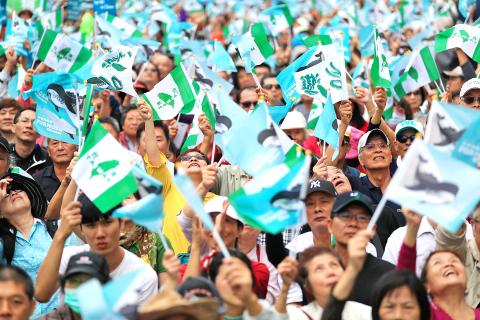
Photo: EPA / Ritchie B. Tongo
“We should tell the world that we want to establish an independent country,” alliance convener and Formosa TV (民視) chairman Kuo Bei-hung (郭倍宏) said, encouraging people to press the ruling party to amend the law again.
Former Presidential Office adviser Peng Ming-min (彭明敏) said that many of his friends had asked him not to attend the rally, but he still went, even though he might lose friends.
To strive for a better future, Taiwanese should fight Beijing’s attempts to swallow the nation, otherwise China might eliminate Taiwanese, as it is doing to Uighurs in Xinjiang, Peng said.
There should be no limit to referendum proposals, given that initiating referendums is a basic democratic right, he said, adding that Taiwanese independence should be achieved through a referendum.
“Long live the Republic of Taiwan,” Peng shouted at the end of his speech.
The act has evolved from a “bird cage” to an “iron cage,” because it does not even allow people to decide on the name of their own country, former Presidential Office adviser Wu Li-pei (吳澧培) said, urging people not to let Taiwan become “another Hong Kong.”
“We are at a critical juncture of history,” Wu said. “There might be a long way to go to achieve Taiwanese independence, but everyone should play his or her own part to realize the goal.”
It has been more than 50 years since Peng initiated the Declaration of Formosan Self-Salvation in 1964, but Taiwan has not yet become a “normal” country, because Taiwanese did not fight for their rights bravely enough, Social Democratic Party convener Fan Yun (范雲) said.
The nation should be named “Taiwan” instead of the “Republic of China,” otherwise other countries would continue confusing the nation with China and rejecting Taiwan’s international presence, Taoyuan resident Teng Pang-yuan (鄧邦圓), 32, said.
Teng said that seeing Beijing’s bullying and the insistence of using the name “Chinese Taipei” at sports events makes him more inclined toward independence.
Taiwanese should make the nation independent, even if other countries refuse to admit this status, Teng added.
Yesterday’s event might be the biggest rally trumpeting independence in recent decades, event host Dennis Peng (彭文正) said, adding that the DPP’s march in Kaohsiung yesterday was not serious, because it averted the independence issue and only copied the alliance’s call to oppose Chinese annexation.
While the DPP has forbidden party members from joining the alliance’s activities, many still showed up at the rally, including Wu and former minister of foreign affairs Mark Chen (陳唐山).
Asked if the party would punish those who attended, DPP Deputy Secretary-General Hsu Chia-ching (徐佳青) said the order was to protect candidates running in the Nov. 24 elections, and that Wu and Chen would not be affected, because they are not candidates.
Additional reporting by Su Fun-her

Taiwan, which accounts for more than half of the global outsourced semiconductor assembly and testing market, is well-positioned to develop copackaged optics (CPO) and manufacture precision silicon photonics chips, the Ministry of Economic Affairs said yesterday. Silicon photonics are emerging as a mainstream optical communications technology and is seen as key to overcoming bottlenecks in AI computing power. The technology is a key project under the government’s New 10 Major AI Infrastructure Projects, with industry, government, academia and research institutions working to overcome critical technological hurdles and build a self-reliant silicon photonics supply chain, the ministry said. Nvidia Corp in March invested US$4
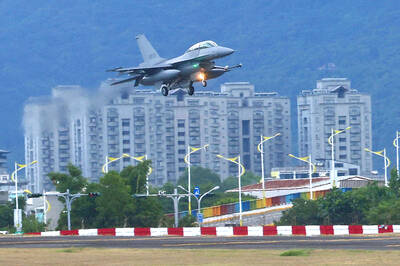
The air force plans to build 26 more hardened aircraft shelters as the number of F-16Vs stationed along Taiwan’s east coast is expected to reach 120 when the final shipment of 66 jets procured from the US arrives. The incoming jets would be stationed at Chihhang Air Base in Taitung County, augmenting the F-16V Block 20s operated by the 5th Tactical Fighter Wing in Hualien County, officials said yesterday. The air force plans to allocate more than NT$6.88 billion (US$218.1 million) from next year to 2031 to build the shelters in Hualien and Taitung as part of the implementation of a “one
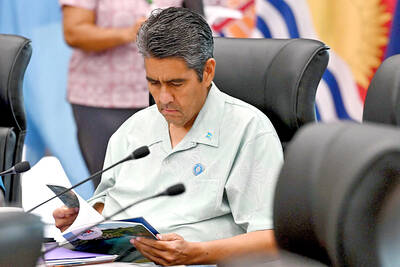
Palau’s president yesterday called for a “unified” Pacific response to a missile test by China in July, while Taiwan and its Pacific allies a day earlier at the Pacific Islands Forum (PIF) reaffirmed their commitment to peace, stability and prosperity. China gave only a handful of nations short notice before test-firing an intercontinental ballistic missile in July, sparking condemnation from several Pacific leaders. The 18-member PIF being held in Palau was expected to release a communique after press time last night, with a formal response to the test possibly included. Palau, which invited Taiwan to attend sideline events as an aid partner, urged
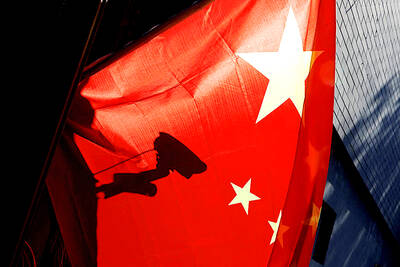
NO LIMITS: More legislation expanding Beijing’s control over the movement of people, money and information raises risks for Taiwanese travelers and businesses, officials said China is set to implement several laws in the coming months that expand the definition of national security, creating greater risks for Taiwanese traveling to or doing business in China, Taiwanese officials said yesterday. Beijing’s Ethnic Unity and Progress Promotion Law took effect on July 1, while a draft “Internet Information Service Management Measures” finished its public consultation on Aug. 2, but has yet to be adopted. China’s Regulations of the State Council on Exit and Entry Administration are to take effect on Tuesday next week, while amendments to its National Defense Mobilization Law and the Ministry of Public Security’s Measures


 RSS
RSS