


Premier William Lai (賴清德) yesterday said the Executive Yuan backs the Ministry of Economic Affairs’ decision to halt the construction of a new coal-fired Shenao Power Plant (深澳電廠) in New Taipei City.
Lai made the announcement during a question-and-answer session when fielding a question from Democratic Progressive Party (DPP) Legislator Chiang Yung-chang (江永昌) at the Legislative Yuan in Taipei.
Chiang asked Lai and Minister of Economic Affairs Shen Jong-chin (沈榮津) for the Cabinet’s decision on the future of the proposed plant.
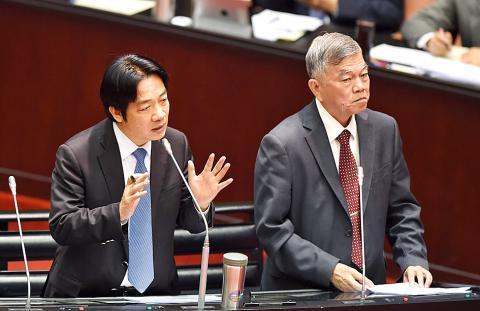
Photo: Liu Hsin-de, Taipei Times
The Environmental Protection Administration (EPA) on Monday approved a project to build the nation’s third liquefied natural gas (LNG) terminal in Taoyuan’s Guantang Industrial Park (觀塘工業區).
The planned terminal — which the government considers to be a key step in its national energy security policy and its plans to phase out nuclear power by 2025 — could begin operating by the first quarter of 2023 after passing the assessment on Monday.
The ministry, following days of intensive review, has decided to shelve the proposed Shenao plant, as its output capacity would be covered by the LNG terminal, Shen said.
The LNG terminal would have a total output capacity of 4.28 million kilowatts, which is more than enough to cover the 3 million kilowatts of the eighth and ninth gas-fired units at Taoyuan’s Datan Power Plant (大潭), he said, adding that the remaining output of 1.28 million kilowatts would offset the absence of output from the Shenao plant — 1.2 million kilowatts — rendering it unnecessary.
The Executive Yuan had given its consent to the ministry’s decision, Lai said.
Chiang asked Lai to promise that the government would ensure stable energy supply, while making sure that the terminal project would not damage the environment, to which the premier replied that the government would strive toward that goal.
Fielding a question from DPP Legislator Chang Liao Wan-chien (張廖萬堅), Lai said that the Taichung Power Plant (台中火力發電廠) would retire its four oldest steam generators in 2023, which are set be replaced by two gas-fired counterparts.
The first gas-fired generator is scheduled to be inaugurated at the Taichung Power Plant in September 2023, with the second to follow in 2024, Shen said.
The four steam generators, which have been in operation since 1992, would be decommissioned, but would be kept for emergency use, he said.
The Taichung plant — which is the world’s largest coal-fired power plant — produces 720 tonnes of airborne particulates, 5,600 tonnes of sulfur oxides and 7,501 tonnes of nitrogen oxides each year, Chang Liao said.
Citing research by National Chung Hsing University environmental engineering professor Tsuang Ben-jei (莊秉潔), Chang Liao said the first two figures would be reduced to almost zero, while the third figure would be cut by 6,100 tonnes a year.
The Taichung plant renewal plan, coupled with the EPA’s efforts to limit mobile and stationary sources of emissions, are guarantees that Taichung’s air quality would only improve each year, Lai said.
He also gave credit to Taichung Mayor Lin Chia-lung (林佳龍) for tackling the air pollution problem, saying that Taichung ranks No. 1 among the six special municipalities on a list published by the EPA that gauged efforts to improve air quality.
Additional reporting by CNA

PROVOCATIVE: Chinese Deputy Ambassador to the UN Sun Lei accused Japan of sending military vessels to deliberately provoke tensions in the Taiwan Strait China denounced remarks by Japan and the EU about the South China Sea at a UN Security Council meeting on Monday, and accused Tokyo of provocative behavior in the Taiwan Strait and planning military expansion. Ayano Kunimitsu, a Japanese vice foreign minister, told the Council meeting on maritime security that Tokyo was seriously concerned about the situation in the East China and South China seas, and reiterated Japan’s opposition to any attempt to change the “status quo” by force, and obstruction of freedom of navigation and overflight. Stavros Lambrinidis, head of the EU delegation to the UN, also highlighted South China Sea
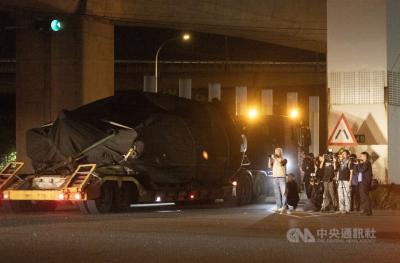
The final batch of 28 M1A2T Abrams tanks purchased from the US arrived at Taipei Port last night and were transported to the Armor Training Command in Hsinchu County’s Hukou Township (湖口), completing the military’s multi-year procurement of 108 of the tanks. Starting at 12:10am today, reporters observed more than a dozen civilian flatbed trailers departing from Taipei Port, each carrying an M1A2T tank covered with black waterproof tarps. Escorted by military vehicles, the convoy traveled via the West Coast Expressway to the Armor Training Command, with police implementing traffic control. The army operates about 1,000 tanks, including CM-11 Brave Tiger

Taiwan Semiconductor Manufacturing Co (TSMC, 台積電), the world’s largest contract chipmaker, said it expects its 2-nanometer (2nm) chip capacity to grow at a compound annual rate of 70 percent from this year to 2028. The projection comes as five fabs begin volume production of 2-nanometer chips this year — two in Hsinchu and three in Kaohsiung — TSMC senior vice president and deputy cochief operating officer Cliff Hou (侯永清) said at the company’s annual technology symposium in Silicon Valley, California, last week. Output in the first year of 2-nanometer production, which began in the fourth quarter of last year, is expected to
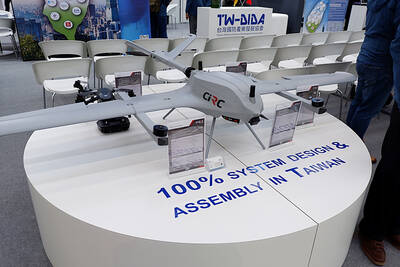
Taiwan’s drone exports surged past US$100 million in the first quarter, exceeding last year’s full-year total, with the Czech Republic emerging as the largest buyer, the Ministry of Economic Affairs said. Exports of complete drones reached US$115.85 million in the period, about 1.2 times the total recorded for all of last year, the ministry said in a report. Exports to the Czech Republic accounted for about US$100 million, far outpacing other markets. Poland, last year’s top destination, recorded about US$11.75 million in the first quarter. Taiwan’s drone exports have expanded rapidly in the past few years, with last year’s total


 RSS
RSS