

China yesterday rejected US President Donald Trump’s accusations that Beijing is trying to interfere with US congressional elections, a move that further raises tensions as the world’s biggest economies fight a trade war.
“We urge the US to stop smearing and accusing China,” Chinese Ministry of Foreign Affairs spokesman Geng Shuang (耿爽) said at a regular briefing in Beijing. “China has all along followed the principle of non-interference and refuses to accept any groundless accusations.”
Trump on Wednesday said that Beijing was meddling in November’s midterms because it opposes his tough trade policies, and said in response to a question that he and Chinese President Xi Jinping (習近平) might not be friends anymore as a result.
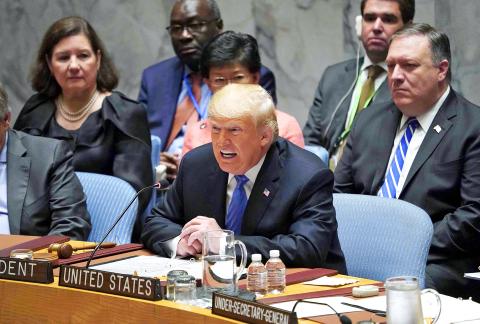
Photo: AFP
“They do not want me or us to win because I am the first president ever to challenge China on trade,” Trump said as he chaired the UN Security Council for the first time.
Asked later what evidence he had, Trump said there was “plenty,” but did not immediately provide details, suggesting that some of the material was classified.
Instead, Trump zeroed in on China’s propaganda efforts to flood the heartland with advertisements and statements against his billions of dollars in punishing tariffs.
Trump’s comments came three days after China placed an advertising supplement in Iowa’s largest newspaper attacking his trade policies.
“I don’t like it when they attack our farmers and I don’t like it when they put out false messages. But beside that, we learned that they are trying to meddle in our elections and we’re not going to let that happen just as we’re not going to let that happen with Russia,” he said.
A senior Trump administration official who briefed reporters about Trump’s comments said that China was stepping up covert and overt activities to punish those who support Trump’s tough trade stance and interfere in the political system.
The only specifics given by the official, who spoke on condition of anonymity, were that China is hurting farmers and workers in states and districts that voted for Trump.
China stifles free speech on US campuses and punishes or rewards businesses, think tanks, movie studios and political candidates for criticizing or supporting Chinese politics, the official said.
More information would be declassified in coming days and that US Vice President Mike Pence was expected to speak on the issue next week, he said.
Chinese Minister of Foreign Affairs Wang Yi (王毅) shrugged when he heard Trump’s statement via translation at the Security Council.
“We do not and will not interfere in any countries’ domestic affairs,” he later said. “We refuse to accept any unwarranted accusations against China, and we call on other countries to also observe the purposes of the UN charter and not interfere in other countries’ internal affairs.”
The ad had been in accordance with US law that allows the cooperation of foreign and US media, Geng told the briefing in Beijing.
He said that categorizing the action as Chinese interference in the US election was “far-fetched and false.”
With the elections less than two months away, US intelligence and election-protection officials have not cited any specific, credible Chinese efforts.
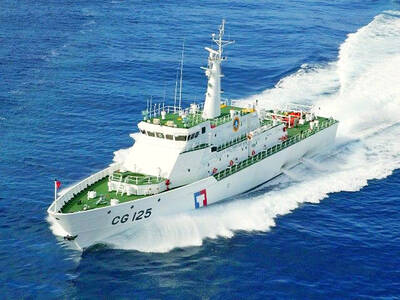
GEOPOLITICAL SIGNIFICANCE: The CGA’s nonmilitary role makes it a tool to avert diplomatic issues, an official said, while confirming the donation of a ship to Manila Coast Guard Administration (CGA) ships are scheduled to sail to the Philippines bearing the words “Taiwan Coast Guard” in a high-profile visit in October next year, the first such visit by a Taiwanese maritime law enforcement vessel to the Southeast Asian nation, the agency said yesterday. The CGA also confirmed that it had donated one of its decommissioned patrol vessels to the Philippines in a rare transfer of a retired ship to a nondiplomatic ally. The Republic of China (ROC) Navy last made such a visit in 1974, shortly before the Philippines switched diplomatic recognition to the People’s Republic of China in

‘GLOBAL WARNING’: The infiltration is not just a local problem, as Beijing has been deploying the same tactics worldwide against Western democracies, a report said Between 50,000 and 100,000 Chinese spies are operating in Taiwan, far more than the National Security Bureau’s previous estimate of 5,000, German journalist and author Jurgen Kremb said on Monday. Kremb presented his research, titled “The War of Spies: How China’s Intelligence Services Are Infiltrating Taiwan — and What Europe Must Learn from It,” at a joint event held by the Taiwan offices of the Friedrich Naumann Foundation and the European Values Center for Security Policy. The report was published in June in the Ministry of Justice Investigation Bureau’s Prospect & Exploration Monthly (展望與探索月刊). By spies, he said he was referring to informants,

PRICE STABILIZATION: The Ministry of Economic Affairs has urged the legislature to support the Cabinet’s supplementary budget for state-owned energy companies State-owned oil supplier CPC Corp, Taiwan (CPC, 台灣中油) on Saturday announced that it would raise domestic gasoline prices by NT$0.7 (US$0.02) per liter and diesel prices by NT$0.6 per liter this week after international crude oil prices rose above US$100 per barrel last week. Formosa Petrochemical Corp (台塑石化) yesterday said that it matched CPC’s price adjustments for this week. The decisions end a six-week period during which CPC and Formosa kept fuel prices in Taiwan unchanged. Retail gasoline prices this week would rise to NT$31.2, NT$32.7 and NT$34.7 per liter for 92, 95 and 98-octane unleaded gasoline respectively at CPC
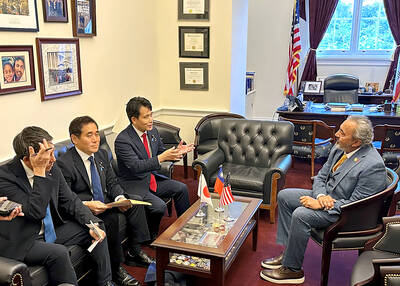
WASHINGTON MEETING: Japan’s Hirofumi Takinami said participants rejected the idea that the US should limit its defensive perimeter to the Second Island Chain US and Japanese lawmakers agree that the US must defend the First Island Chain, including Taiwan, and should not fall back to the Second Island Chain, while “a Taiwan contingency is a Japan contingency and therefore a US-Japan alliance contingency,” media reported after a meeting between officials of the two nations in Washington on Tuesday. A delegation of Japanese lawmakers from the Liberal Democratic Party met with US Senator Thom Tillis, co-chair of the Senate Taiwan Caucus, and US Representative Ami Bera, co-chair of the US Congressional Taiwan caucus, to discuss issues concerning East Asia and the Taiwan Strait. The Japanese and


 RSS
RSS