

China has refused requests from the US and other fellow WHO members for more than a year to provide lab samples from its outbreak of H7N9 avian influenza last year, in contravention of the organization’s regulations, while non-member Taiwan has shared its sole mutated strain of the H7N9 virus with researchers in the US.
WHO regulations stipulate that member states should provide samples and information about diseases that could become pandemic, but media reports say Beijing has been refusing repeated requests made by the US and others, even though this particular strain has killed 40 percent of the people who contracted it, the New York Times reported on Monday last week.
The Times said some US scientists are worried that US-China trade tensions could slow the exchange of medical supplies and information, thereby impeding efforts to prepare for potential biological threats.
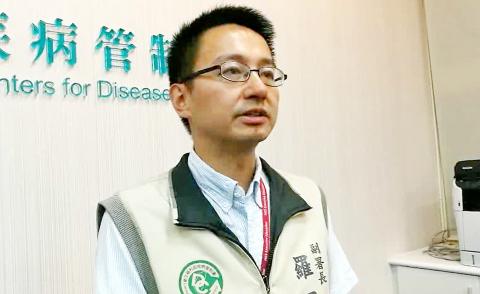
Photo: Lin Hui-chin, Taipei Times
At least four US research institutions have been relying on a small group of H7N9 samples from cases in Taiwan and Hong Kong, the newspaper said.
The H7N9 avian influenza “had not previously been seen in either animals or people until it was found in March 2013 in China,” the WHO says on its Web site.
Since then there have been at least six epidemic waves of human infection and hundreds of deaths.
The samples that the Centers for Disease Control (CDC) have been sharing with the US come from a 69-year-old Taiwanese businessman who in February last year was diagnosed with H7N9 after returning from China and later died.
What made his case different was that an analysis of the H7N9 strain he had contracted showed that a mutation had developed, the CDC said at the time.
The mutated virus was highly pathogenic in birds, and resistant to oseltamivir, zanamivir and other antiviral medications, it said.
“We believe that providing this information to the world is very important, thus [we] released it on the Global Initiative on Sharing All Influenza Data Web site,” CDC Deputy Director-General Philip Lo (羅一鈞) said on Saturday.
A sample of the virus strain is still stored at the agency’s biological material storage facility, Lo added.
This was a good example of cooperation between Taiwan and the US, Lo said.
However, the sample Taiwan provided was not enough to develop a vaccine, so more samples are needed to create a vaccine suitable for humans, he said.
The mutated H7N9 virus is a level-three biohazard, the same level as SARS, anthrax and mycobacterium tuberculosis, and second only to level four biohazards such as the Ebola virus, Lo said.
In related news, the Council of Agriculture on Friday said that it has intercepted pork being smuggled in from China 292 times over the past month.
The Statute for Prevention and Control of Infectious Animal Disease (動物傳染病防治條例) stipulates that those convicted of smuggling pork can face fines from NT$3,000 to NT$15,000, Bureau of Animal and Plant Health Inspection and Quarantine Deputy Director-General Shih Tai-hua (施泰華) said yesterday.
The bureau has tested 24 samples from the confiscated pork for the African swine fever virus, and the results would be known this week, Shih said.
If any of the samples test positive for the virus, the bureau might seek heavier penalties for smugglers, but it is still in discussions with judicial authorities about which article of the law would apply for such cases, Shih said.
For example, people who smuggled living birds into the nation were prosecuted under Article 33 of the law, which bans the smuggling of animals or other living creatures that need to undergo quarantine measures, and sentenced to two years in prison, even if the birds were free of disease, he said.
However, the article could not be applied to the smuggling of pork meat, because it is no longer a living creature, he said.
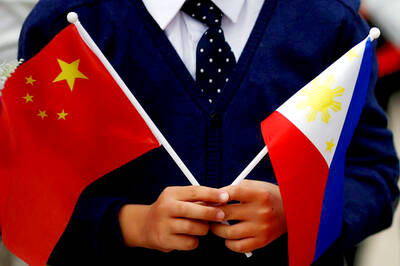
The Philippine Coast Guard yesterday said it has deployed its largest vessel and an aircraft to challenge a Chinese research ship operating off northern Batanes near Taiwan, adding that a Chinese coast guard vessel had also moved in. The Philippine operation “disrupted the vessel’s unauthorized marine scientific research and compelled it to leave its loitering position,” said Jay Tarriela, Philippine Coast Guard spokesperson on South China Sea issues. The Philippine Coast Guard said the BRP Teresa Magbanua and an aircraft were deployed to counter the Chinese vessel, which it said had remained about 37 nautical miles northwest of Itbayat Island since Monday. The
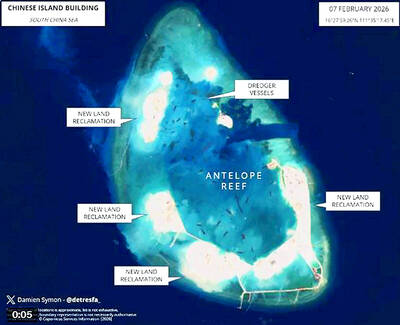
RUNWAY: Analysts said the first aircraft landing is expected by the middle of next year, while Chinese state media said it would serve civilian needs Chinese construction of a runway on Antelope Reef (Lingyang Reef, 羚羊礁) in the Paracel Islands (Xisha Islands, 西沙群島), is well under way with analysts estimating it could be completed by the middle of next year, strengthening Beijing’s military control over the disputed South China Sea. Satellite images reviewed by Reuters show grading work, piles of gravel and concrete, and compaction cranes in operation to build a full-scale runway that military attaches and security analysts say could be one of China’s most important offshore bases in the region. The images, taken on Friday last week by commercial satellite imagery provider Vantor, also show

SHIFTING COOPERATION: With the new arrangement, US representatives would be able to participate directly in defense discussions, including weapons procurement Taiwan-US military cooperation is deepening, with the Pentagon expected to station personnel at the Ministry of National Defense (MND), sources said. The NT$470 million (US$14.77 million) joint program is scheduled to run from this year through 2028, under which the Pentagon would dispatch representatives from the Office of the Under Secretary of Defense for Policy and the Institute for Defense Analyses, a senior military official said on condition of anonymity, adding that one representative from each organization would be stationed at the ministry’s headquarters. The Office of the Under Secretary of Defense for Policy is one of the US’ bodies responsible for

The Presidential Office today condemned China's transnational repression after an alleged Chinese foreign agent was arrested in California yesterday on suspicion of surveilling President William Lai's (賴清德) son, Lai Ting-yu (賴廷與), the FBI said. The 34-year-old woman, named Wanying Heather Zhang (張婉瑩), was arrested on suspicion of acting as an unregistered foreign agent, US news agency CBS reported. She was apprehended at Los Angeles International Airport yesterday attempting to fly to Shanghai, it said. This represents a “typical case” of China’s transnational repression, Presidential Office spokeswoman Karen Kuo (郭雅慧) said today. "Our country expresses the strongest condemnation of such barbaric conduct that


 RSS
RSS