


American Institute in Taiwan (AIT) Director Brent Christensen yesterday pledged the US’ support for Taiwan’s global contributions and participation, and denounced China’s interference in the domestic politics of Western nations.
Christensen made the remarks in his first meeting with President Tsai Ing-wen (蔡英文) at the Presidential Office Building in Taipei since assuming the helm of the institute’s Taipei office on Aug. 11.
The meeting, which was streamed live on Tsai’s Facebook page, came just two days after Taiwan severed diplomatic ties with El Salvador after learning of its decision to switch allegiance to China.
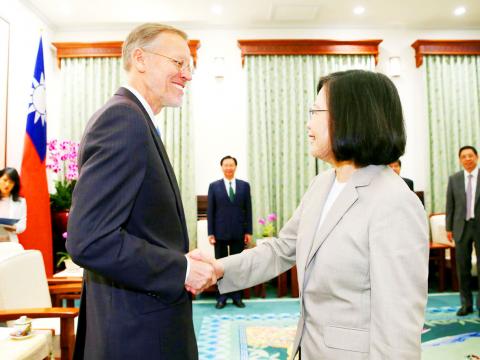
Photo: CNA
Some political commentators have said that Beijing orchestrated El Salvador’s switch of recognition to vent its grievance over warming Taiwan-US ties, the latest evidence of which being Tsai’s high-profile transit stops in Los Angeles and Houston, Texas.
“El Salvador’s receptiveness to China’s apparent interference in the domestic politics of the Western Hemisphere country is of grave concern to the US,” Christensen said, adding that El Salvador’s decision has prompted Washington to reassess its relationship with the Central American nation.
Beijing’s unilateral effort to alter the cross-strait “status quo” is unhelpful and could undermine the framework that has enabled peace, stability and development in the region for decades, he said.
The US would continue to support Taiwan as it expands its significant global contributions and resists efforts to constrain its appropriate participation on the world stage, he added.
Calling Taiwan a reliable partner and an important player in the Indo-Pacific region, Christensen said that Taipei shares Washington’s interests and values, and the US relies on Taiwan to promote regional peace and stability.
“The US and Taiwan stand together to protect what we hold most dear: our freedom, our democracy and our future,” he said, expressing the hope of bringing Taiwan-US ties to a new level of friendship and cooperation during his three-year tenure.
At a time when China is resorting to every conceivable means to increase pressure on Taiwan, the nation needs the help of like-minded nations to express concern over Beijing’s behavior, Tsai said.
“Washington’s statement that Taiwan is a democratic success story, a reliable partner and a force for good in the world is the kind of voice of justice Taiwanese need,” Tsai said.
Taiwan has always highly valued its relationship with the US, with both sides increasing the quality and quantity of visits by officials, as well as bilateral cooperation and exchanges in security matters, she said.
She thanked the US for its support and expressed the hope of reaching more milestones under Christensen’s leadership.
Tsai and Christensen discussed a wide range of issues during their meeting, including bilateral trade, cooperation aimed at expanding Taiwan’s international space and cross-strait relations, the AIT said.

‘NO SECURITY RISK’: The Railway Bureau reassured the public that the technicians’ activities were limited to technical guidance and did not involve sensitive systems The Railway Bureau yesterday said it had invited eight Chinese technicians to assist with an airport MRT construction project. The bureau issued the confirmation after an Internet user said Chinese nationals had entered the construction zone of Taiwan Taoyuan International Airport’s Terminal 3 project. They asked why “individuals from an enemy state” were allowed access to such a major national infrastructure project, which raised serious concerns over Taiwan’s industrial safety, sensitive systems and information security. The bureau’s Northern Region Engineering Branch Office said subcontractor Taiwan Handle Industrial Co (台灣手把工業) of the Taoyuan airport MRT’s “Contract No. CU05 Project A14 Station Civil, MEP &

The National Chungshan Institute of Science and Technology yesterday showcased its locally developed variants of the Vision 60 robotic patrol dog, which it plans to deploy on the nation’s outlying territories in the South China Sea. The variants were produced under the Joint Lab project — created by the institute and domestic companies — and assembled with domestically produced motors, lenses and artificial intelligence (AI) systems alongside licensed tech from the US, Missile and Rocket Systems Research Division deputy director Jen Kuo-kang (任國光) told the media event at a military base in Taipei’s Dazhi (大直) area. Taiwan has built up its strengths

NOT IMMEDIATE: Taiwan has a chance to appeal the proposed 10 percent tariff before it starts, while other countries face a 12.5 percent tariff from the trade office Taiwan is among 60 economies determined by the US to have failed to impose or enforce a ban on the importation of goods produced with forced labor, according to a notice released on Tuesday by the Office of the US Trade Representative (USTR), which proposed imposing an additional 10 percent or more tariff on them. The USTR in a statement said that following an investigation, it had determined under Section 301 of the Trade Act of 1974 that the failure of the 60 economies to impose and effectively enforce a prohibition on the importation of goods produced with forced labor is

RIGHT DIRECTION: Taiwan’s efforts to prevent forced labor include a proposal to ‘fully prohibit’ employers from withholding workers’ documents, an official said Taiwan is to establish a mechanism to restrict imports of goods linked to forced labor, the Executive Yuan said yesterday, after the US proposed imposing additional tariffs on Taiwanese goods over labor concerns. “The Ministry of Labor and the Ministry of Economic Affairs are to establish an interministerial review procedure,” Executive Yuan spokesperson Michelle Lee (李慧芝) said at a news briefing in Taipei. “The government is to use the Foreign Trade Act [貿易法] as the legal basis to restrict imports of goods produced with forced labor” and bring its supply chain governance more in line with international standards on human rights, resilience


 RSS
RSS