


The Taoyuan Union of Pilots yesterday said it has secured the vote to organize a labor strike, adding that it would announce on Aug. 20 when the strike would take place if China Airlines (CAL, 中華航空) and EVA Airways (EVA,長榮航空) continue to refuse to negotiate with it.
The union held a vote from July 16 to Monday, with 1,212 of its 1,426 members participating. A total of 1,187 members voted to go on strike: 731 China Airlines pilots, 454 EVA Airways pilots and 2 from other airlines.
“We hope that this [vote for a strike] would encourage the airlines to improve the work environment for their employees, such as making a definite promise that pilots would not have to risk their lives by flying on typhoon days,” union chairwoman Lee Hsin-yen (李信燕) said. “We are open for negotiations with the airlines before the end of this month.”
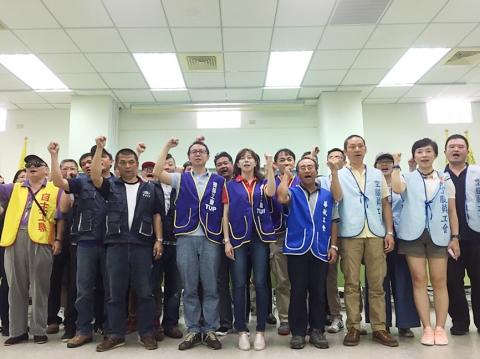
Photo: Lee Ya-wen, Taipei Times
The union will resort to a strike if the two carriers continue to ignore and slander the pilots, as well as disregard the safety of passengers, she added.
CAL last week filed an injunction with a district court seeking to ban the union from holding a strike. This shows that the company is playing a two-faced strategy, claiming that it is willing to negotiate with the union while arguing that the union does have not the right to strike, the union said.
The union has the right to hold strikes in accordance with regulations in the Labor Union Act (工會法), it said, adding that the injunction would not affect its plan.
Asked whether the labor strike would disrupt President Tsai Ing-wen’s (蔡英文) visit to Paraguay next week, as well as people planning to travel during the Mid-Autumn Festival holiday next month, Lee said it would depend on whether the airlines are willing to engage in negotiations.
Lee reiterated that members of the public would have sufficient time to react to a strike, but did not specify how many days in advance the public would be given warning.
The union has not decided if CAL and EVA pilots would hold simultaneous strikes or on different days, union board director Chen Hsiang-lin (陳祥麟) said, adding that it would depend on the progress of labor negotiations.
Minister of Transportation and Communications Wu Hong-mo (吳宏謀) expressed hope that the dispute would end peacefully.
“We hope that airlines can expedite communication with their employees on the condition of preserving consumers’ interests and aviation safety to ensure a peaceful end to this dispute,” Wu told a news conference.
China Airlines had been told to refrain from using measures such as court injunctions, which only poison its relations with union members, he added.
Deputy Minister of Transportation and Communications Wang Kwo-tsai (王國材) said that both airlines, as well as Taoyuan International Airport Corp (桃園國際機場公司), have stipulated contingency plans to cope with the possible impact of a strike during the Mid-Autumn Festival holiday from Sept. 22 to Sept. 24.
Negotiations between the airlines and union members in the past few months have helped winnow down the union’s demands to a few unresolved issues, he said, adding that it is the Ministry of Transportation and Communications’ hope that it would not have to implement the plans.
CAL said the union has presented 28 requests to the company, adding that both sides have reached a consensus on some of them.
EVA said the union has presented 16 requests for negotiations.
One of the union’s major complaints was that both airlines have overworked their pilots, particularly those operating long-haul flights.
CAL and EVA follow Aircraft Flight Operation Regulations (航空器飛航作業管理規則) in regulating the flight hours of their pilots, the Civil Aeronautics Administration said.

‘NO SECURITY RISK’: The Railway Bureau reassured the public that the technicians’ activities were limited to technical guidance and did not involve sensitive systems The Railway Bureau yesterday said it had invited eight Chinese technicians to assist with an airport MRT construction project. The bureau issued the confirmation after an Internet user said Chinese nationals had entered the construction zone of Taiwan Taoyuan International Airport’s Terminal 3 project. They asked why “individuals from an enemy state” were allowed access to such a major national infrastructure project, which raised serious concerns over Taiwan’s industrial safety, sensitive systems and information security. The bureau’s Northern Region Engineering Branch Office said subcontractor Taiwan Handle Industrial Co (台灣手把工業) of the Taoyuan airport MRT’s “Contract No. CU05 Project A14 Station Civil, MEP &

A US uncrewed surface vessel (USV) encountered multiple Chinese warships during an autonomous transit of the Taiwan Strait, US defense company Seasats said in a statement on Wednesday. Seasats announced that a Lightfish USV had completed the first autonomous transit of the Taiwan Strait. Over five days, the USV traversed the entire length of the Strait while constantly monitoring surface vessel traffic, the company said. The Lightfish encountered multiple Chinese warships, one of which was a Chinese People’s Liberation Army Navy (PLAN) Type 056 corvette, it said. The Chinese vessels were operating “well within Taiwan’s exclusive economic zone without transmitting their identity via the
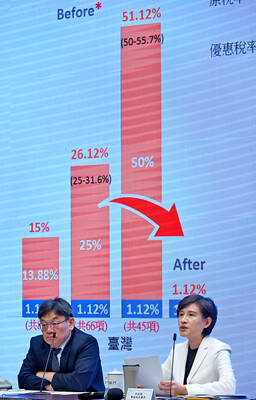
GREATER REACH? Auto parts and wood products would face tariffs of up to 15%, matching those targeting the EU, Japan and South Korea, Vice Premier said The US has announced that preferential tariff treatment for Taiwan’s non-semiconductor Section 232 goods would take effect retroactively from May 1, the Executive Yuan said yesterday. The US government yesterday posted a notice on the Federal Register’s public inspection Web site previewing tariff concessions for Taiwan under a memorandum of understanding (MOU) on Taiwan-US investment after two months of negotiations. The MOU signed on Jan. 15 stipulated three major preferential tariff arrangements: a 15 percent “reciprocal” tariff rate for Taiwan without stacking most-favored nation (MFN) rates; preferential Section 232 treatment for semiconductors and related products; and preferential Section 232 treatment for non-semiconductor

The National Chungshan Institute of Science and Technology yesterday showcased its locally developed variants of the Vision 60 robotic patrol dog, which it plans to deploy on the nation’s outlying territories in the South China Sea. The variants were produced under the Joint Lab project — created by the institute and domestic companies — and assembled with domestically produced motors, lenses and artificial intelligence (AI) systems alongside licensed tech from the US, Missile and Rocket Systems Research Division deputy director Jen Kuo-kang (任國光) told the media event at a military base in Taipei’s Dazhi (大直) area. Taiwan has built up its strengths


 RSS
RSS