


The Executive Yuan has agreed to allocate a budget of NT$25.9 billion (US$843.48 million) to a third space program proposed by the Ministry of Science and Technology, Premier William Lai (賴清德) said yesterday, adding that he expects the nation to become increasingly independent in developing space technology.
Over the next decade, the ministry should work toward enhancing its research of space technology and apply the results to assist in industrial development, as well as improving different aspects of life, he said.
Lai made the remarks at the ministry’s National Space Organization (NSPO) in the Hsinchu Science Park while examining the agency’s preparations to transport the Formosat-7 satellite constellation to the US.
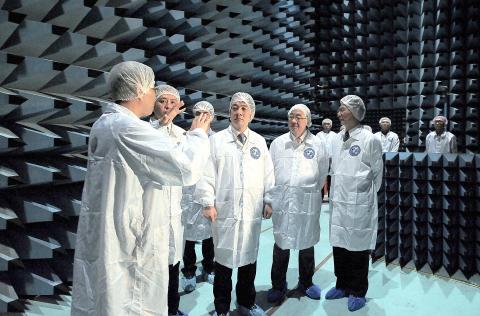
Photo: CNA
Formosat-7 — which is part of the ministry’s second space program and developed in collaboration with the US — is comprised of six microsatellites and was designed to take over the mission of collecting weather data from the Formosat-3 constellation, which has been in operation for 12 years, the agency said.
Formosat-7 is expected to collect two to three times more data than Formosat-3, while its data downloads would be six times faster, NSPO Director-General Lin Chun-liang (林俊良) said.
While Lai said that Formosat-7 would be delivered to the US at the end of next month, agency officials appeared more reserved about its launch schedule, which has been postponed several times.
The satellite cluster will most likely be launched next year, Lin said, adding that the actual date has yet to be determined.
As Formosat-7’s launch is managed by the US Air Force and US company SpaceX, the NSPO can only wait for notification two months prior to launch, he said.
The US has been willing to work with Taiwan to develop the Formosat-3 and Formosat-7 programs because Taiwanese scientists have demonstrated their competence in integrating various systems to control satellites, Minister of Science and Technology Chen Liang-gee (陳良基) said, adding that Formosat-7 would be operated by the NSPO.
Following the first two space programs — the first running from 1991 to 2006 and the second from 2004 to the end of this year — the nation has proved its preliminary ability to design a satellite, he said.
The third space program, which is scheduled to start next year and run until 2028, is to focus on satellite development by Taiwanese scientists, with the NSPO planning to launch nine satellites over the next decade, Lin said, but added that the initial development process might take more time.
While the Executive Yuan has approved funding for the third space program, the details of the program have not been finalized, Chen said, adding that the entire program would be announced before the end of the year.

The nation’s fastest supercomputer, Nano 4 (晶創26), is scheduled to be launched in the third quarter, and would be used to train large language models in finance and national defense sectors, the National Center for High-Performance Computing (NCHC) said. The supercomputer, which would operate at about 86.05 petaflops, is being tested at a new cloud computing center in the Southern Taiwan Science Park in Tainan. The exterior of the server cabinet features chip circuitry patterns overlaid with a map of Taiwan, highlighting the nation’s central position in the semiconductor industry. The center also houses Taiwania 2, Taiwania 3, Forerunner 1 and
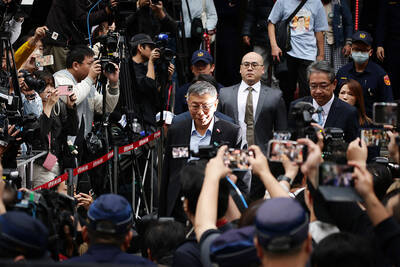
FIRST TRIAL: Ko’s lawyers sought reduced bail and other concessions, as did other defendants, but the bail judge denied their requests, citing the severity of the sentences Former Taipei mayor Ko Wen-je (柯文哲) was yesterday sentenced to 17 years in prison and had his civil rights suspended for six years over corruption, embezzlement and other charges. Taipei prosecutors in December last year asked the Taipei District Court for a combined 28-year, six-month sentence for the four cases against Ko, who founded the Taiwan People’s Party (TPP). The cases were linked to the Core Pacific City (京華城購物中心) redevelopment project and the mismanagement of political donations. Other defendants convicted on separate charges included Chinese Nationalist Party (KMT) Taipei City Councilor Angela Ying (應曉薇), who was handed a 15-year, six-month sentence; Core Pacific
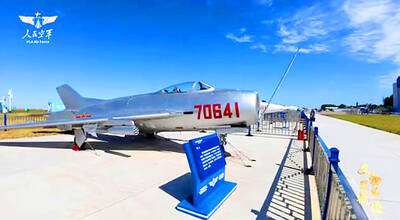
J-6 REMODEL: The converted drones are part of Beijing’s expanding mix of airpower weapons, including bombers with stand-off missiles and UAV swarms, the report said China has stationed obsolete supersonic fighters converted to attack drones at six air bases close to the Taiwan Strait, a report published this month by the Arlington, Virginia-based Mitchell Institute for Aerospace Studies said. Satellite imagery of the airfields from the institute’s “China Airpower Tracker” shows what appear to be lines of stubby, swept-winged aircraft matching the shape of J-6 fighters that first flew with the Chinese People’s Liberation Army (PLA) Air Force in the 1960s. Since their conversion to drones, the aircraft have been identified at five bases in China’s Fujian Province and one in Guangdong Province, the report said. J.
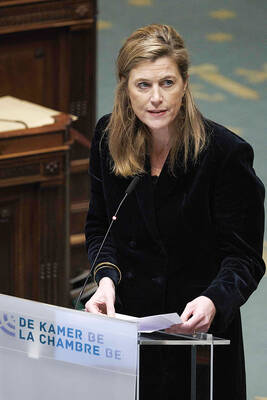
China used fake LinkedIn profiles to harvest sensitive data from NATO and EU institutions by soliciting information from staff, a European security source said on Friday. The operation, allegedly orchestrated by the Chinese Ministry of State Security, targeted dozens of employees at the military alliance or EU organizations through fictitious accounts, the source said, confirming reports in French and Belgian media. Posing as recruiters on the online professional networking platform, Chinese spies would initially request paid reports before later soliciting non-public or even classified information. One particularly active fake profile used the name “Kevin Zhang,” claiming to be the head


 RSS
RSS