


The Mainland Affairs Council (MAC) will continue to push for a meeting between President Tsai Ing-wen (蔡英文) and Chinese President Xi Jinping (習近平) “without preconditions,” council Minister Chen Ming-tong (陳明通) said yesterday.
“The two should sit down and have a face-to-face talk,” Chen said.
“It is better not to spin the wheels, as it could lead to some misjudgement if the two are far apart,” Chen said prior to a legislative hearing. “The MAC will continue to work toward that goal with no conditions attached.”
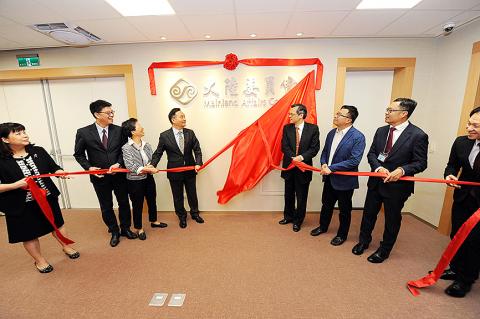
Photo: CNA
In response to media queries on whether Beijing had responded to the council’s call, Chen said “they are probably aware of our wish,” but “they also have their own way of thinking.”
Commenting on Tsai’s interview last week with Agence France-Presse in which she called on other nations to join with Taiwan to constrain China, Chen said Tsai’s aim is to unite nations that share the same values in an effort to protect the world amid China’s expansion.
In the interview on Monday last week, Tsai urged other nations to stand up with Taiwan to guard against China’s expansion, and protect the world’s liberal and democratic values.
Some of China’s recent actions have been very disturbing to other nations, Chen said.
China has been using its hegemonic influence to force foreign airlines to list Taiwan as “part of China” on their Web sites, Chen said, adding that such coercion should be condemned.
In other developments, the government would welcome a Chinese reporter who has been denied an entry permit to reapply for one, as long as he cools down and refrains from making emotional remarks, Chen said, referring to China Southeast TV reporter Ye Qinglin (葉青林) and comments from China’s Taiwan Affairs Office (TAO)
TAO spokesman Ma Xiaoguang (馬曉光) told a regular news conference on Wednesday in Beijing that Taiwan had set a bad precedent in cross-strait journalist exchanges by refusing to issue an entry permit to Ye.
Ye was denied an entry permit because a report he made about February’s Hualien earthquake, which was posted on Facebook, was “quite twisted,” Chen said.
Yu claimed that “a Japanese research and rescue team refused to enter the disaster area out of fear of danger,” which was not true; Taiwan had declined the team’s offer of help since there was sufficient manpower at the time, Chen said.
Ye’s report was a far cry from the truth and was contradictory to Taiwan’s goals in terms of cross-strait news exchanges, he said.
To boost mutual understanding and reach a compromise is the main purpose when it comes to cross-strait news exchanges, but Ye’s report had triggered many disputes, Chen added.
Many Chinese tourists were affected by the Hualien quake and it is important to provide non-biased reports with compassion, Chen said.
Ye’s response on Facebook was also too emotional, he added
“The denial of his entry permit is to allow him to cool down for a while. He is still welcome to reapply for a permit,” Chen said.
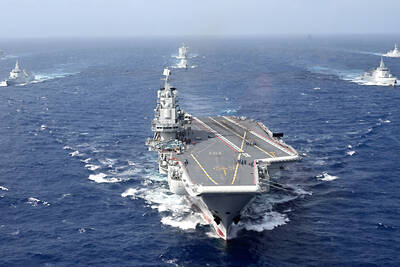
PROVOCATIVE: Chinese Deputy Ambassador to the UN Sun Lei accused Japan of sending military vessels to deliberately provoke tensions in the Taiwan Strait China denounced remarks by Japan and the EU about the South China Sea at a UN Security Council meeting on Monday, and accused Tokyo of provocative behavior in the Taiwan Strait and planning military expansion. Ayano Kunimitsu, a Japanese vice foreign minister, told the Council meeting on maritime security that Tokyo was seriously concerned about the situation in the East China and South China seas, and reiterated Japan’s opposition to any attempt to change the “status quo” by force, and obstruction of freedom of navigation and overflight. Stavros Lambrinidis, head of the EU delegation to the UN, also highlighted South China Sea
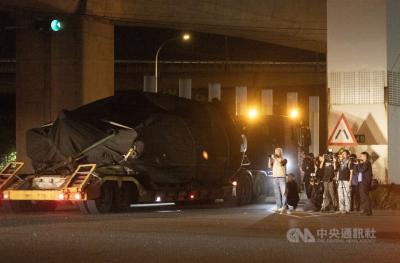
The final batch of 28 M1A2T Abrams tanks purchased from the US arrived at Taipei Port last night and were transported to the Armor Training Command in Hsinchu County’s Hukou Township (湖口), completing the military’s multi-year procurement of 108 of the tanks. Starting at 12:10am today, reporters observed more than a dozen civilian flatbed trailers departing from Taipei Port, each carrying an M1A2T tank covered with black waterproof tarps. Escorted by military vehicles, the convoy traveled via the West Coast Expressway to the Armor Training Command, with police implementing traffic control. The army operates about 1,000 tanks, including CM-11 Brave Tiger
Taiwan Semiconductor Manufacturing Co (TSMC, 台積電), the world’s largest contract chipmaker, said it expects its 2-nanometer (2nm) chip capacity to grow at a compound annual rate of 70 percent from this year to 2028. The projection comes as five fabs begin volume production of 2-nanometer chips this year — two in Hsinchu and three in Kaohsiung — TSMC senior vice president and deputy cochief operating officer Cliff Hou (侯永清) said at the company’s annual technology symposium in Silicon Valley, California, last week. Output in the first year of 2-nanometer production, which began in the fourth quarter of last year, is expected to

Taiwan’s drone exports surged past US$100 million in the first quarter, exceeding last year’s full-year total, with the Czech Republic emerging as the largest buyer, the Ministry of Economic Affairs said. Exports of complete drones reached US$115.85 million in the period, about 1.2 times the total recorded for all of last year, the ministry said in a report. Exports to the Czech Republic accounted for about US$100 million, far outpacing other markets. Poland, last year’s top destination, recorded about US$11.75 million in the first quarter. Taiwan’s drone exports have expanded rapidly in the past few years, with last year’s total


 RSS
RSS