


Pension reforms involving retired civil servants, public-school teachers and military officers are to take effect today, and are expected to affect 333,000 people.
Government agencies have been inundated with appeals and requests for constitutional interpretations for pension cuts to be scrapped.
The deductions are to be implemented under amendments that were passed in June last year to the Act Governing Civil Servants’ Retirement, Discharge and Pensions (公務人員退休資遣撫卹法) and the Act Governing Retirement, Severance and Bereavement Compensation for the Teaching and Other Staff Members of Public Schools (公立學校教職員退休資遣撫卹條例).
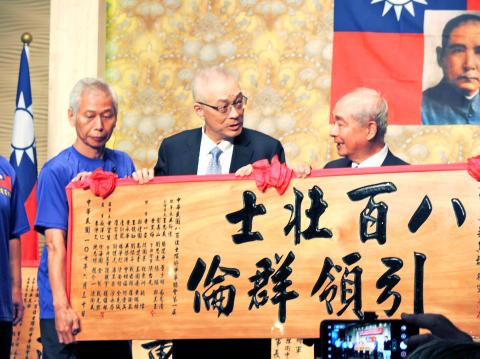
Photo: Weng Yu-huang, Taipei Times
Amendments to the Act of Military Service for Officers and Noncommissioned Officers of the Armed Forces (陸海空軍軍官士官服役條例), which cleared the legislative floor last month, are to also come into effect.
The pension floor for retired civil servants and public-school teachers is NT$32,160, according to the amendments.
The controversial 18 percent preferential interest rate for savings accounts of civil servants and public-school teachers hired before July 1995 is to be reduced to 12 percent this month and gradually phased out over 30 months.
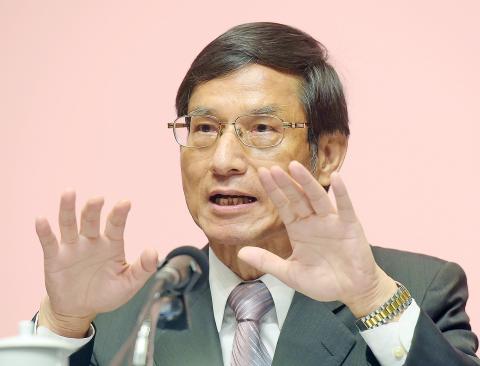
Photo: Huang Yao-cheng, Taipei Times
As for retirees who claimed their pension as a lump sum payment, the interest rate is to be reduced to 12 percent this month and to 6 percent by 2025.
The income replacement ratio for people who worked for at least 15 years is to be reduced from 45 to 30 percent over 10 years, while those who worked for at least 35 years are to see the ratio reduced from 75 to 60 percent during the period.
The pension floor is NT$38,990 for retired military officials.
Military officers hired before July 1995 who had claimed their pension as a lump-sum payment are to see the preferential interest rate reduced to 6 percent by 2025, while those who receive monthly pensions payments are to see the interest rate eliminated in 10 years.
About 400 military officers who became disabled in the line of duty and those who are 85 or older would keep the 18 percent interest rate.
The pension reductions would affect 63,000 of 208,000 retired military officers, Veterans Affairs Council data showed.
The cuts would affect about 130,000 retired civil servants and 140,000 retired public-school teachers, Ministry of Civil Service and Ministry of Education data showed.
The two ministries and the Ministry of National Defense last month sent notices to retirees informing them of the pension cuts, prompting many to file appeals and requests for constitutional interpretations in a bid to have the amendments overturned.
New Taipei City Government Department of Education said it received 3,500 appeals between June 15 and Thursday from 14,680 teachers who have retired over the past year.
Chinese Nationalist Party (KMT) chapters have been providing legal counsel to retired military personnel who are seeking legal remedies, while a coalition of teacher groups is working with lawyers to apply for a constitutional interpretation.
While time-consuming, appeals, administrative lawsuits and constitutional interpretations are the only legal channels that could undo the pension cuts, National Federation of Teachers’ Unions president Chang Hsu-cheng (張旭政) said.
The federation would focus on requesting a constitutional interpretation, as one favorable interpretation by the Council of Grand Justices would repeal the pension cuts for all three groups of public employees, Chang said.
The government is steadfast in its resolve to push for pension reform, which cannot satisfy everyone, but has the approval of a majority of the public, said Minister Without Portfolio Lin Wan-i (林萬億), who is tasked with the implementation of the reforms.
The reforms would keep the pension systems for civil servants, public-school teachers and military personnel afloat for the next 30 years, Lin said.
The reforms are meant to reassure younger people in the three professions and allow them to focus on their work without having to worry about their pension, he said.
Additional reporting by Lee Hsin-fang

SILENCING CRITICS: In addition to blocking Taiwan, China aimed to prevent rights activists from speaking out against authoritarian states, a Cabinet department said The Ministry of Foreign Affairs (MOFA) yesterday condemned transnational repression by Beijing after RightsCon, a major digital human rights conference scheduled to be held in Zambia this week, was abruptly canceled due to Chinese pressure over Taiwanese participation. This year’s RightsCon, the world’s largest conference discussing issues “at the intersection of human rights and technology,” was scheduled to take place from tomorrow to Friday in Lusaka, and expected to draw 2,600 in-person attendees from 150 countries, along with 1,100 online participants. However, organizers were forced to cancel the event due to behind-the-scenes pressure from China, the ministry said, expressing its “strongest condemnation”
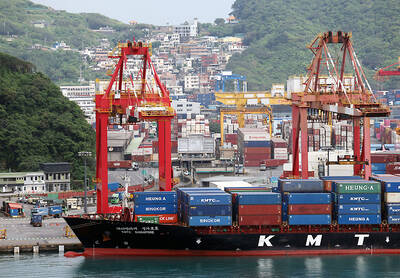
Taiwan’s economy grew far faster than expected in the first quarter, as booming demand for artificial intelligence (AI) applications drove a surge in exports, spilling over into investment and consumption, the Directorate-General of Budget, Accounting and Statistics (DGBAS) said yesterday. GDP growth was 13.69 percent year-on-year during the January-to-March period, beating the DGBAS’ February forecast by 2.23 percentage points and marking the most robust growth in nearly four decades, DGBAS senior official Chiang Hsin-yi (江心怡) told a news conference in Taipei. The result was powered by exports, which remain the backbone of Taiwan’s economy, Chiang said. Outbound shipments jumped 51.12 percent year-on-year to
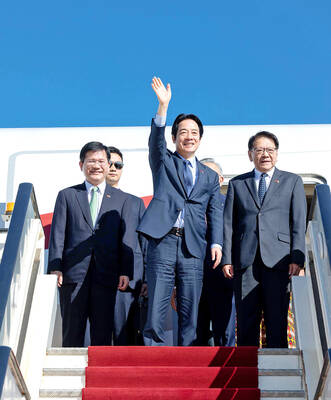
DELAYED BUT DETERMINED: The president’s visit highlights Taiwan’s right to international engagement amid regional pressure from China President Willaim Lai (賴清德) yesterday arrived in Eswatini, more than a week after his planned visit to Taiwan’s sole African ally was suspended because of revoked overflight permits. “The visit, originally scheduled for April 22, was postponed due to unforeseen external factors,” Lai wrote on social media. “After several days of careful arrangements by our diplomatic and national security teams, we successfully arrived today.” Lai said he looked forward to further deepening Taiwan-Eswatini relations through closer cooperation in the economy, agriculture, culture and education, as well as advancing the nation’s international partnerships. The president was initially scheduled to arrive in time to celebrate
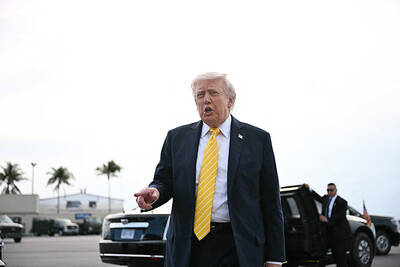
Iran’s Islamic Revolutionary Guard Corp (IRGC) yesterday said the US faced a choice between an “impossible” military operation or a “bad deal” with Tehran, after US President Donald Trump disparaged Iran’s latest peace proposal. Negotiations between the two countries have been deadlocked since a ceasefire came into effect on April 8, with only one round of direct peace talks held so far. Iran’s Tasnim and Fars news agencies reported that Tehran had submitted a 14-point proposal to mediator Pakistan, but Trump was quick to cast doubt on it. “I will soon be reviewing the plan that Iran has just sent to us, but


 RSS
RSS