


Beijing’s “one China” principle is part of the Chinese government’s disinformation campaign directed at harming Taiwan, Open Culture Foundation deputy executive Wu Ming-hsuan (吳銘軒) said yesterday.
Calling China’s official line on Taiwan “fake news,” Wu said Beijing’s assertion that “there is only one China and Taiwan is a part of China” is factually wrong, adding that China is deliberately spreading the false narrative to misguide the international community.
Wu made the remarks at the Taiwan Foundation for Democracy’s East Asia Democracy Forum, a symposium that this year is focused on “preventing democratic backsliding.”
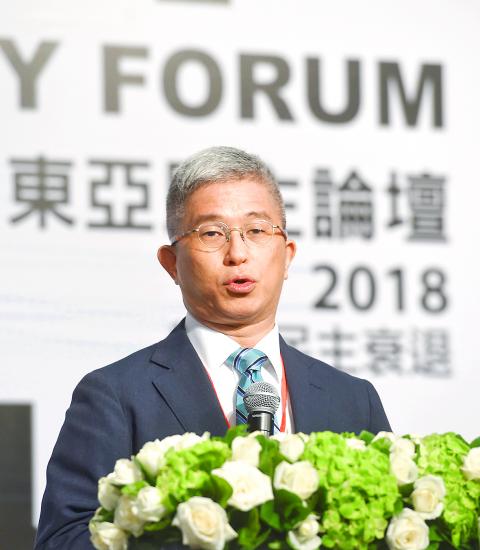
Photo: Fang Pin-chao, Taipei Times
Participants include democracy advocates from the Philippines, Indonesia, Malaysia, Japan and South Korea, among other Asian nations.
In his speech on fighting fake news and protecting democracy, Wu said that disinformation and fake news is defined as the deliberate manufacture and propagation of erroneous information.
Disinformation is an effective tool for authoritarian regimes to create self-serving narratives, and it is also utilized to stigmatize dissidents by undermining their reputation and legacy, he said.
Fake news saturation is a disease that democracies must resist, and the fake news that is doing the most harm to Taiwan is Beijing’s “one China” principle, Wu said.
The reality is that there are two extant Chinese governments, those of the Republic of China and the People’s Republic of China, he said.
Ploys to spread the “one China” principle, including Beijing’s ongoing effort to force international airlines to list Taiwan as part of China on their Web sites, are part of a systematic project to mislead the public to harm Taiwan, he said.
Speaking from the perspective of the Indonesian experience, authoritarian regimes hijack traditional culture and values to rationalize anti-democratic policies, which exacerbates societal intolerance, paranoia, xenophobia, extremism and ethnic divisions, Gusdurian Network Indonesia national head Alissa Wahid said.
Islam is not incompatible with democracy, but Indonesia’s democratic transition has neglected to develop a commensurate educational message that promotes the compatibility of democracy and faith, she said.
Separately yesterday, President Tsai Ing-wen (蔡英文) met with academics and activists to mark the foundation’s 15th anniversary and expressed her wish that Taiwan would develop stronger ties with democracy advocates from other nations.
The foreign guests are visiting Taiwan for the forum and the foundation’s anniversary, and she hopes they will see the vitality and strength of Taiwanese society, Tsai said.
She said she is pleased that the attendees have shared their observations and recommendations for resisting democratic backsliding and combating fake news.
Taiwan’s democratic achievements are internationally heralded, including the establishment last year of Reporters Without Borders’ first Asian regional office in Taipei and the nation’s high and still improving ranking in a Freedom House report this year, Tsai added.

‘NO SECURITY RISK’: The Railway Bureau reassured the public that the technicians’ activities were limited to technical guidance and did not involve sensitive systems The Railway Bureau yesterday said it had invited eight Chinese technicians to assist with an airport MRT construction project. The bureau issued the confirmation after an Internet user said Chinese nationals had entered the construction zone of Taiwan Taoyuan International Airport’s Terminal 3 project. They asked why “individuals from an enemy state” were allowed access to such a major national infrastructure project, which raised serious concerns over Taiwan’s industrial safety, sensitive systems and information security. The bureau’s Northern Region Engineering Branch Office said subcontractor Taiwan Handle Industrial Co (台灣手把工業) of the Taoyuan airport MRT’s “Contract No. CU05 Project A14 Station Civil, MEP &

The National Chungshan Institute of Science and Technology yesterday showcased its locally developed variants of the Vision 60 robotic patrol dog, which it plans to deploy on the nation’s outlying territories in the South China Sea. The variants were produced under the Joint Lab project — created by the institute and domestic companies — and assembled with domestically produced motors, lenses and artificial intelligence (AI) systems alongside licensed tech from the US, Missile and Rocket Systems Research Division deputy director Jen Kuo-kang (任國光) told the media event at a military base in Taipei’s Dazhi (大直) area. Taiwan has built up its strengths

NOT IMMEDIATE: Taiwan has a chance to appeal the proposed 10 percent tariff before it starts, while other countries face a 12.5 percent tariff from the trade office Taiwan is among 60 economies determined by the US to have failed to impose or enforce a ban on the importation of goods produced with forced labor, according to a notice released on Tuesday by the Office of the US Trade Representative (USTR), which proposed imposing an additional 10 percent or more tariff on them. The USTR in a statement said that following an investigation, it had determined under Section 301 of the Trade Act of 1974 that the failure of the 60 economies to impose and effectively enforce a prohibition on the importation of goods produced with forced labor is
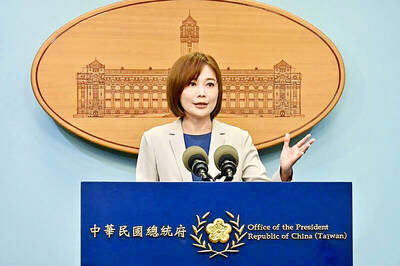
TIT-FOR-TAT: The US allegedly revoked the visa of a Chinese national working at Xinhua News Agency in the US in response to Beijing’s expulsion of Vivian Wang The Presidential Office yesterday condemned China for expelling a New York Times correspondent from Beijing following the newspaper’s interview with President William Lai (賴清德), saying the move highlighted Beijing’s suppression of press freedom and its threat to international news media. Taiwan has noted a series of recent incidents in which Beijing used similar tactics to “threaten and pressure international media outlets and journalists,” Presidential Office spokeswoman Karen Kuo (郭雅慧) said in a statement. “This concerns not only press freedom and freedom of expression, but also the safety of journalists, and Taiwan and relevant partners are paying close attention to the situation,” she


 RSS
RSS