


Minister of Foreign Affairs Joseph Wu (吳釗燮) yesterday expressed gratitude to the US Congress for its support after the US House Armed Services Committee passed a National Defense Authorization Act (NDAA).
“[We] have noted the bill that is being deliberated in the US Congress, which includes many elements friendly toward Taiwan,” Wu said.
Wu said he is extremely grateful for the US Congress’ support for Taiwan, especially in the areas of national security and defense cooperation.
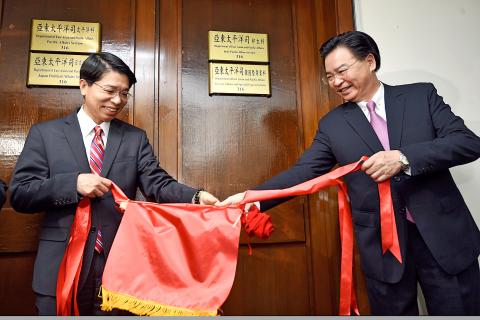
Photo: Chien Jung-fong, Taipei Times
The US House Armed Services Committee on Thursday passed the latest version of the annual NDAA with a bipartisan vote of 60 to 1.
The bill still requires the approval of the US House of Representatives and the US Senate before it can be signed into law.
Under Section 1243 of the draft, the US secretary of defense is required to consult with Taiwanese officials to conduct a comprehensive assessment on ways to enhance and reform Taiwan’s military forces.
The section requests that the US secretary of defense, after consulting with the US secretary of state, submit a report to the appropriate US congressional committees within a year of the NDAA’s enactment, detailing a summary of the assessment and a list of recommendations and planned actions.
The report should also include a plan for the US to “expand senior military-to-military engagement and joint training by US Armed Forces with the military of Taiwan” and “support US foreign military sales and other equipment transfers to Taiwan, particularly for developing asymmetric warfare capabilities,” it says.
Ministry spokesman Andrew Lee (李憲章) said in a statement that the wording of the bill serves as the latest example of the US’ bipartisan emphasis on and support for the Taiwan-US security partnership.
The ministry would closely watch deliberations on the bill, Lee said.
The Ministry of National Defense yesterday said the bill would serve to stabilize regional security by expanding military exchanges between the US and Taiwan.
Ministry of National Defense spokesman Major General Chen Chung-chi (陳中吉) said the ministry is delighted to see measures that would boost the nation’s self-defense capabilities.
He also expressed gratitude to US representatives who are seeking to maintain stable bilateral ties based on the Taiwan Relation Act and the six assurances, which are the cornerstones of US-Taiwan relations in the absence of formal diplomatic relations.
Meanwhile, Wu, on the sidelines of a ceremony to open the foreign ministry’s new Indo-Pacific Affairs Section in Taipei yesterday, said Taiwan would endeavor to improve its defensive capabilities, adding that efforts would also be made to further Taiwan-US cooperation on security to maintain peace and stability in the Asia-Pacific region.
The new Indo-Pacific Affairs Section is part of the foreign ministry’s Department of East Asian and Pacific Affairs.
Wu said some like-minded nations, such as the US, Australia and Japan, have proposed the idea of a “free and open Indo-Pacific” region.
“They are all exploring ways to facilitate cooperation on trade and the value of freedom in the Indo-Pacific region. Taiwan must head in the same direction, which will be the focus of the new section,” Wu said.
Wu said the new section would guide the government’s New Southbound Policy and the Indo-Pacific global strategy, handling affairs concerning major actors in the region, including India, Australia and New Zealand.
Additional reporting by CNA
LEVERAGE: China did not ‘need to fire a shot’ to deny Taiwan airspace over Africa when it owns ‘half the continent’s debt,’ a US official said, calling it economic warfare The EU has raised concerns about overflight rights following the delay of President William Lai’s (賴清德) planned state visit to the Kingdom of Eswatini after three African nations denied overflight clearance for his charter at the last minute. Taiwanese allies Paraguay and Saint Kitts and Nevis, as well as several US lawmakers and the Inter-Parliamentary Alliance on China (IPAC) condemned China for allegedly pressuring the countries. Lai was scheduled to fly directly to Taiwan’s only African ally from yesterday to Sunday to celebrate the 40th anniversary of King Mswati III’s accession and his 58th birthday, but Seychelles, Mauritius and Madagascar suddenly revoked
PROVOCATIVE: Chinese Deputy Ambassador to the UN Sun Lei accused Japan of sending military vessels to deliberately provoke tensions in the Taiwan Strait China denounced remarks by Japan and the EU about the South China Sea at a UN Security Council meeting on Monday, and accused Tokyo of provocative behavior in the Taiwan Strait and planning military expansion. Ayano Kunimitsu, a Japanese vice foreign minister, told the Council meeting on maritime security that Tokyo was seriously concerned about the situation in the East China and South China seas, and reiterated Japan’s opposition to any attempt to change the “status quo” by force, and obstruction of freedom of navigation and overflight. Stavros Lambrinidis, head of the EU delegation to the UN, also highlighted South China Sea
The final batch of 28 M1A2T Abrams tanks purchased from the US arrived at Taipei Port last night and were transported to the Armor Training Command in Hsinchu County’s Hukou Township (湖口), completing the military’s multi-year procurement of 108 of the tanks. Starting at 12:10am today, reporters observed more than a dozen civilian flatbed trailers departing from Taipei Port, each carrying an M1A2T tank covered with black waterproof tarps. Escorted by military vehicles, the convoy traveled via the West Coast Expressway to the Armor Training Command, with police implementing traffic control. The army operates about 1,000 tanks, including CM-11 Brave Tiger
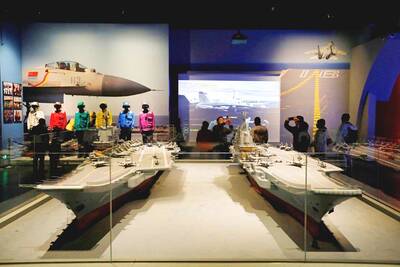
China on Wednesday teased in a video an aircraft carrier that could be its fourth, and the first using nuclear power, while making an allusion to Taiwan and vowing to further build up its islands, as it looks to boost maritime power, secure resources and bolster territorial claims. The video, issued on the eve of the 77th founding anniversary of the Chinese People’s Liberation Army Navy, featured fictional officers with names that are homophones of three commissioned aircraft carriers, the Liaoning (遼寧), Shandong (山東) and Fujian (福建). Titled Into the Deep, it showed a 19-year-old named “Hejian” (何劍) joining the group, sparking


 RSS
RSS