


Former President Ma Ying-jeou (馬英九) yesterday exercised his right to remain silent during questioning at the Taipei District Prosecutors’ Office as part of an ongoing inquiry into an alleged breach of financial regulations during the sale of three media companies formerly run by the Chinese Nationalist Party (KMT).
The KMT in 2005 sold Central Motion Picture Corp (CMPC, 中影), China Television Co (CTV, 中視) and Broadcasting Corp of China (BCC, 中廣), after an amendment to the Broadcasting and Television Act (廣播電視法) in 2003 barred political parties, the military and politicians from owning media outlets.
Ma, who was then-KMT chairman, is accused of illegally facilitating the sales of the media outlets below market value, which would be a breach of the Securities and Exchange Act (證券交易法).
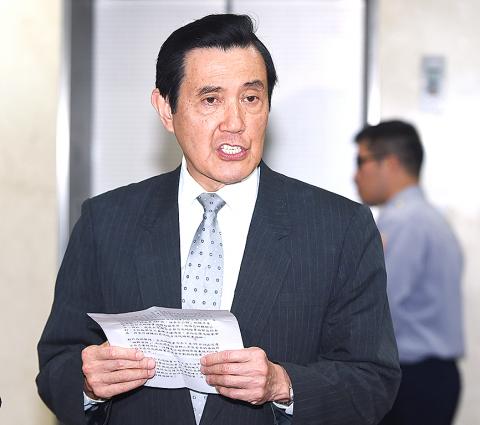
Photo: Liao Chen-huei, Taipei Times
Ma left the office after four hours of questioning and immediately issued a statement, saying the prosecution is procedurally unjust and that he exercised his right to silence.
“Any neutral, objective and full examination of evidence will acquit me from allegations of criminality. Should the office have concerns other than these, I am not a pugnacious man, but I do not run from a fight,” he said.
Ma said the allegations leveled against him are “groundless accusations” and accused the prosecution of engaging a smear campaign through the media against his character and reputation.
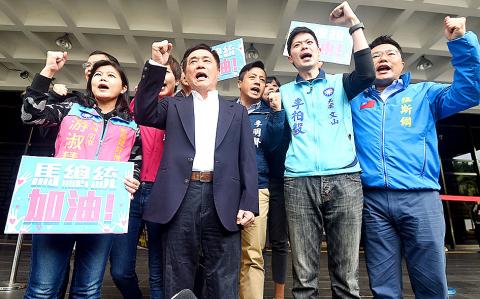
Photo: Liao Chen-huei, Taipei Times
“It is my opinion that the office has breached the principles of objectivity and confidentiality under articles 2 and 245 of the Code of Criminal Procedure (刑事訴訟法),” he said.
The prosecutors have dismissed charges of breaching investigative confidentiality that Ma had filed against Chief Prosecutor Shing Tai-chao (邢泰釗) and Lead Prosecutor Wang Hsin-chien (王鑫健), and his request for remanding the case to another jurisdiction was also rejected, Ma said.
That the decision was made by a Taipei prosecutor surnamed Huang (黃), who is also investigating the sale of the media outlets, raises doubts over procedural correctness, Ma said.
Shing and Wang called a news conference on Dec. 13 last year to deny allegations of leaking information about their investigation before the case was registered formally, and attributed the leak to the media, Ma said, calling the move “rash.”
Ma vowed to continue exercising his right to silence during questioning until the legality of the investigation is affirmed and the office can prove itself to be unbiased.
Sources previously told the Chinese-language Liberty Times (sister paper of the Taipei Times) on condition of anonymity that Taipei prosecutors are in possession of an allegedly incriminating recording.
It is purportedly a recording of Ma’s conversation with former KMT-controlled Central Investment Co (CIC, 中央投資公司) general manager Wang Hai-ching (汪海清) over a dispute with CTV’s eventual buyer, Yu Chien-hsin (余建新).
Ma allegedly told Wang to concede to Yu’s demands and refrain from actions that would “jeopardize the deal,” sources said.

A signaling system malfunction disrupted high-speed rail (HSR) services beginning at 8am today, with trains temporarily reduced to three northbound and three southbound trains per hour as authorities conduct inspections. The malfunction occurred on a section of track in Miaoli County during pre-operation checks early this morning, forcing northbound and southbound trains to use a single track, the HSR operator said. The regular schedule has been replaced with three hourly trains offering only nonreserved seating in each direction, stopping at every station, it said, adding that business class cars would still have reserved seating. Departures from terminal stations are scheduled at the top
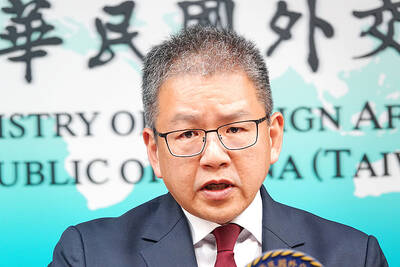
Taiwan is still in the process of assessing the possibility of recruiting workers from Eswatini, the Ministry of Foreign Affairs said yesterday, adding that its goal is to help Eswatini upgrade its vocational training centers. If there are plans to recruit workers from Eswatini, safeguarding national security, protecting public health and ensuring the employment rights of Taiwanese would be prerequisites, Department of West Asian and African Affairs Director-General Yen Chia-liang (顏嘉良) told a news conference. Key considerations would also include filling labor shortages in specific industries, and fostering bilateral professional and technical exchanges, he said. Yen was asked about the progress of labor

A US uncrewed surface vessel (USV) encountered multiple Chinese warships during an autonomous transit of the Taiwan Strait, US defense company Seasats said in a statement on Wednesday. Seasats announced that a Lightfish USV had completed the first autonomous transit of the Taiwan Strait. Over five days, the USV traversed the entire length of the Strait while constantly monitoring surface vessel traffic, the company said. The Lightfish encountered multiple Chinese warships, one of which was a Chinese People’s Liberation Army Navy (PLAN) Type 056 corvette, it said. The Chinese vessels were operating “well within Taiwan’s exclusive economic zone without transmitting their identity via the

‘NO SECURITY RISK’: The Railway Bureau reassured the public that the technicians’ activities were limited to technical guidance and did not involve sensitive systems The Railway Bureau yesterday said it had invited eight Chinese technicians to assist with an airport MRT construction project. The bureau issued the confirmation after an Internet user said Chinese nationals had entered the construction zone of Taiwan Taoyuan International Airport’s Terminal 3 project. They asked why “individuals from an enemy state” were allowed access to such a major national infrastructure project, which raised serious concerns over Taiwan’s industrial safety, sensitive systems and information security. The bureau’s Northern Region Engineering Branch Office said subcontractor Taiwan Handle Industrial Co (台灣手把工業) of the Taoyuan airport MRT’s “Contract No. CU05 Project A14 Station Civil, MEP &


 RSS
RSS