


A group of human rights advocates yesterday bicycled around Taipei to back calls for the release of democracy advocate Lee Ming-che (李明哲) and Chinese human rights lawyer Wang Quanzhang (王全璋), and raise awareness of free speech.
About 10 people representing the Taiwan Association for Human Rights (TAHR), Covenants Watch, the Youth Synergy Taiwan Foundation, the Judicial Reform Foundation, the Legal Initiative for Vietnam and other groups gathered at Liberty Square at 10am before setting off on their ride.
They held placards and banners that read “Lee Ming-che not guilty” and “release Wang Quanzhang.”
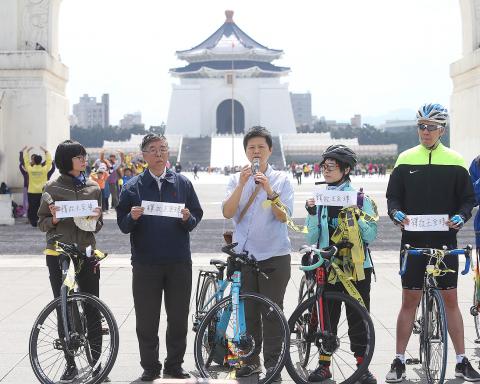
Photo: CNA
A Chinese court in November last year found Lee guilty of state subversion for offering online lectures about Taiwan’s democratization. He was sentenced on Nov. 28 to five years in prison.
“Up until now, Lee has not been able to send out any letters and most of the letters sent to him from Taiwan could not reach him. Although his wife, Lee Ching-yu (李凈瑜), was finally able to visit him in prison on March 27, it is unknown if the Chinese government will ever allow another visit,” TAHR secretary-general Chiu Ee-ling (邱伊翎) said.
Wang was also accused of subversion and has been held incommunicado, she said.
Wang was arrested during the “709” crackdown in 2015 in China that rounded up more than 200 human rights lawyers and activists.
He had defended numerous Falun Gong practitioners and minority groups against government persecution.
Wang’s wife, Li Wenzu (李文足), their two children and a small group of activists on Wednesday last week embarked on a walk of more than 100km from a Beijing court to Tianjin, where Li believes her husband is being detained, to demand the right to see him, Chiu said.
“It has been more than 1,000 days since Wang was arrested and up until today the family and their lawyer have been unable to contact him. No one knows his whereabouts or whether he is healthy,” Chiu said.
“Today we are cycling in this free nation to show our support for Li and to demand the release of Lee and Wang,” she said.
The majority of Taiwanese do not want to be ruled by a government that disregards human rights and democracy, she said.
“The ‘709’ crackdown was the most serious violation of human rights in China in recent years,” said Chinese academic Wu Renhua (吳仁華), who has lived in exile since the Tiananmen Square Massacre in 1989.
“The crackdown was worse than those [in 2012 and 2013] targeting activists involved in the New Citizens Movement. Many human rights lawyers were subjected to torture, which caused them physical and psychological trauma,” Wu said.
That Wang has been secretly held incommunicado for more than 1,000 days is shocking as it was unheard of since 1949, he added.
After talking with the media, the group set off toward Huashan 1914 Creative Park on bikes decorated with yellow ribbons, shouting “release Lee Ming-che and Wang Quanzhang” along the way.


RESILIENCE: Taiwan plays a key role in semiconductors, energy, information infrastructure and advanced manufacturing, AIT Director Raymond Greene said Taiwan’s continued investment in deterrence and resilience remains vital, especially in uncrewed systems and other emerging technologies, American Institute in Taiwan (AIT) Director Raymond Greene said yesterday. Greene made the remarks at the annual National Strategic Summit on Supply Chain Resilience held by the Research Institute for Democracy, Society and Emerging Technology (DSET), a government-backed think tank. As Taiwan last year became the US’ fourth-largest trading partner and supply chain security is becoming more important, cooperation in emerging technologies continues to deepen between the two countries, he said. The US is committed to accelerating innovation, building key infrastructure, strengthening cooperation

The National Chungshan Institute of Science and Technology yesterday showcased its locally developed variants of the Vision 60 robotic patrol dog, which it plans to deploy on the nation’s outlying territories in the South China Sea. The variants were produced under the Joint Lab project — created by the institute and domestic companies — and assembled with domestically produced motors, lenses and artificial intelligence (AI) systems alongside licensed tech from the US, Missile and Rocket Systems Research Division deputy director Jen Kuo-kang (任國光) told the media event at a military base in Taipei’s Dazhi (大直) area. Taiwan has built up its strengths

RIGHT DIRECTION: Taiwan’s efforts to prevent forced labor include a proposal to ‘fully prohibit’ employers from withholding workers’ documents, an official said Taiwan is to establish a mechanism to restrict imports of goods linked to forced labor, the Executive Yuan said yesterday, after the US proposed imposing additional tariffs on Taiwanese goods over labor concerns. “The Ministry of Labor and the Ministry of Economic Affairs are to establish an interministerial review procedure,” Executive Yuan spokesperson Michelle Lee (李慧芝) said at a news briefing in Taipei. “The government is to use the Foreign Trade Act [貿易法] as the legal basis to restrict imports of goods produced with forced labor” and bring its supply chain governance more in line with international standards on human rights, resilience
NOT IMMEDIATE: Taiwan has a chance to appeal the proposed 10 percent tariff before it starts, while other countries face a 12.5 percent tariff from the trade office Taiwan is among 60 economies determined by the US to have failed to impose or enforce a ban on the importation of goods produced with forced labor, according to a notice released on Tuesday by the Office of the US Trade Representative (USTR), which proposed imposing an additional 10 percent or more tariff on them. The USTR in a statement said that following an investigation, it had determined under Section 301 of the Trade Act of 1974 that the failure of the 60 economies to impose and effectively enforce a prohibition on the importation of goods produced with forced labor is


 RSS
RSS