


The US was yesterday expected to sue China at the WTO over alleged trade law breaches as part of its planned trade announcement, the Wall Street Journal reported, citing a person with knowledge of the plans.
Planned US tariffs on China could also hit US$50 billion of Chinese imports, the Journal said, citing the individual.
US President Donald Trump was poised to unveil sanctions against China for what he called the theft of US intellectual property, fueling fears of a trade war as Beijing vowed to retaliate.
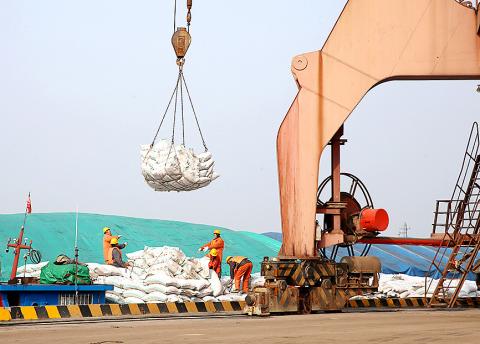
Photo:AFP
White House spokesman Raj Shah said that Trump would announce actions following an “investigation into China’s state-led, market-distorting efforts to force, pressure and steal US technologies and intellectual property.”
According to Trump’s schedule, released by the White House on Wednesday evening, he is to sign “a presidential memorandum targeting China’s economic aggression.”
The Chinese Ministry of Commerce issued a pre-emptive warning, saying in a statement yesterday that Beijing “will certainly take all necessary measures to resolutely defend its legitimate rights and interests.”
It is just weeks since Trump short-circuited White House deliberations and announced a raft of sanctions on foreign-produced steel and aluminum off the cuff.
That move prompted the resignation of White House chief economic adviser Gary Cohn, a global stock market sell-off, legal disputes and threats of retaliatory measures.
On Wednesday, US Federal Reserve Chairman Jerome Powell warned that the prospect of a trade war was a growing threat to the world’s largest economy.
Chinese Premier Li Keqiang (李克強) on Tuesday urged Trump to not act “emotionally,” but the impulsive president is showing no sign of backing down.
US Trade Representative Robert Lighthizer recently put a separate proposed package of US$30 billion in tariffs on Chinese imports on the president’s desk.
And Trump appears to have agreed to at least that amount, as he tries to fulfill campaign promises to get tough on “cheating” by US trade partners, which he has said have destroyed American jobs.
The US trade deficit with China ran to a record US$375 billion last year — but US exports to the country were also at a record.
Washington has long accused Beijing of forcing US companies to turn over proprietary commercial information and intellectual property as a condition of operating in China.
Trump claims to have built up a generally good relationship with Chinese President Xi Jinping (習近平), whom he has praised for his role in pressuring North Korea over its nuclear program.
However, the trade dispute threatens to cast a pall over those relations, especially given the recent warnings from Beijing.
A senior official in Lighthizer’s office said on Wednesday that the administrations of former US presidents Bill Clinton, George W. Bush and Barack Obama had attempted over the decades to coax China into respecting market economics and trade liberalization, but had all failed.
The Trump administration opened an investigation in August last year acting on a series of allegations against China, including that as a condition of doing business, Beijing forces US companies to enter joint ventures and transfer technology and trade secrets to domestic partners, and that US firms are not able to license intellectual property in China as freely as Chinese companies.
US officials have also alleged that China has hacked US networks and conducted industrial espionage to steal US intellectual property.
Xi sent his top economic advisor, Chinese Vice Premier Liu He (劉鶴), to Washington this month to discuss trade tensions, but a US official said that at no point had the Chinese made a constructive proposal.

‘NO SECURITY RISK’: The Railway Bureau reassured the public that the technicians’ activities were limited to technical guidance and did not involve sensitive systems The Railway Bureau yesterday said it had invited eight Chinese technicians to assist with an airport MRT construction project. The bureau issued the confirmation after an Internet user said Chinese nationals had entered the construction zone of Taiwan Taoyuan International Airport’s Terminal 3 project. They asked why “individuals from an enemy state” were allowed access to such a major national infrastructure project, which raised serious concerns over Taiwan’s industrial safety, sensitive systems and information security. The bureau’s Northern Region Engineering Branch Office said subcontractor Taiwan Handle Industrial Co (台灣手把工業) of the Taoyuan airport MRT’s “Contract No. CU05 Project A14 Station Civil, MEP &

The National Chungshan Institute of Science and Technology yesterday showcased its locally developed variants of the Vision 60 robotic patrol dog, which it plans to deploy on the nation’s outlying territories in the South China Sea. The variants were produced under the Joint Lab project — created by the institute and domestic companies — and assembled with domestically produced motors, lenses and artificial intelligence (AI) systems alongside licensed tech from the US, Missile and Rocket Systems Research Division deputy director Jen Kuo-kang (任國光) told the media event at a military base in Taipei’s Dazhi (大直) area. Taiwan has built up its strengths
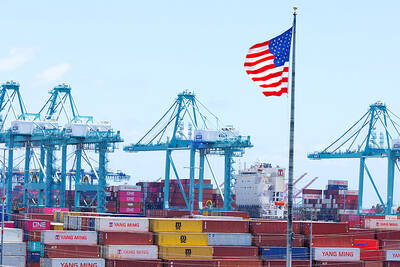
NOT IMMEDIATE: Taiwan has a chance to appeal the proposed 10 percent tariff before it starts, while other countries face a 12.5 percent tariff from the trade office Taiwan is among 60 economies determined by the US to have failed to impose or enforce a ban on the importation of goods produced with forced labor, according to a notice released on Tuesday by the Office of the US Trade Representative (USTR), which proposed imposing an additional 10 percent or more tariff on them. The USTR in a statement said that following an investigation, it had determined under Section 301 of the Trade Act of 1974 that the failure of the 60 economies to impose and effectively enforce a prohibition on the importation of goods produced with forced labor is
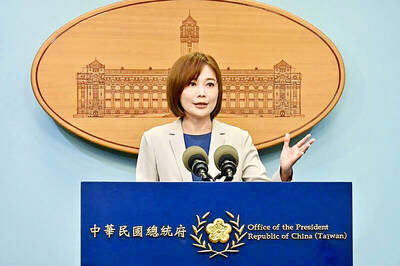
TIT-FOR-TAT: The US allegedly revoked the visa of a Chinese national working at Xinhua News Agency in the US in response to Beijing’s expulsion of Vivian Wang The Presidential Office yesterday condemned China for expelling a New York Times correspondent from Beijing following the newspaper’s interview with President William Lai (賴清德), saying the move highlighted Beijing’s suppression of press freedom and its threat to international news media. Taiwan has noted a series of recent incidents in which Beijing used similar tactics to “threaten and pressure international media outlets and journalists,” Presidential Office spokeswoman Karen Kuo (郭雅慧) said in a statement. “This concerns not only press freedom and freedom of expression, but also the safety of journalists, and Taiwan and relevant partners are paying close attention to the situation,” she


 RSS
RSS