


A National Airborne Services Corps (NASC) rescue helicopter that went missing minutes before midnight on Monday when evacuating a medical patient from Orchid Island (Lanyu, 蘭嶼) was still missing as of press time last night.
Although a search-and-rescue operation was being conducted, there was no sign of the helicopter and the six people on board — three crew, an emergency medical technician, the patient and a family member of the patient.
At about 11:50pm on Monday, the UH-60M Black Hawk helicopter with tail number NA-706 took off in poor weather, sources said, adding that it vanished from radar and radio contact and was lost within minutes.
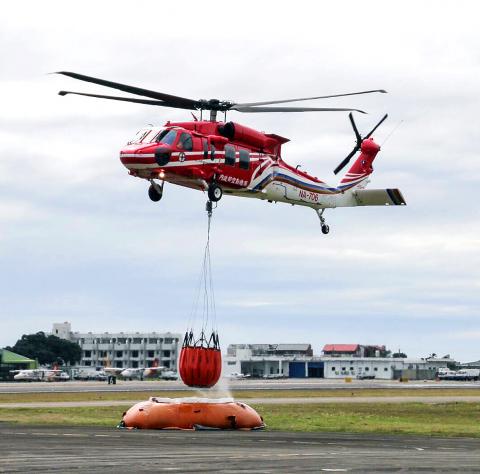
Photo: National Airborne Services Corps / CNA
Its last known location was 2 nautical miles (3.7km) southwest of Orchid Island, sources said.
At 1:26am yesterday, the National Rescue Command Center began moving helicopters and ships to the area, including NASC and air force helicopters, a Lafayette-class frigate and five coast guard vessels.
The coast guard along with Taitung police and firefighters initiated an overland search, focusing on Orchid Island’s hills and the coastline near Lanyu Airport.
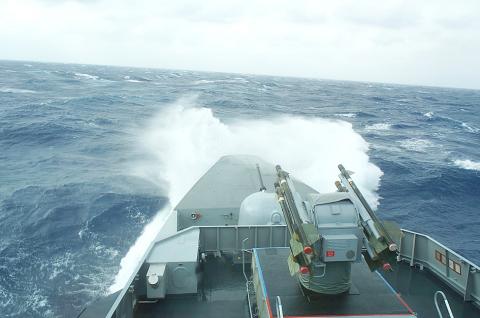
Photo: CNA, courtesy of Navy Command, ROC
However, an air force Sikorsky S-70C helicopter, launched at 6:56am to participate in the operation, was forced to land at Lanyu Airport at 7:40pm due to an instrument failure.
The precise cause of the failure was under investigation and another S-70C replaced the helicopter in the search, the air force said.
The Black Hawk’s transponder did not transmit signals, although it was designed to do so if the helicopter crashed at sea, NASC Second Squadron Third Brigade Commander Chu Shih-chuan (祝世全) said.
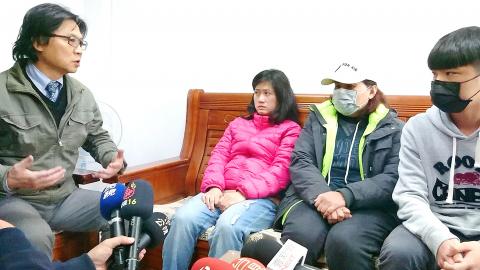
Photo: CNA
He also denied media allegations that NA-706 was flying in adverse conditions that exceeded operating parameters.
Black Hawk helicopters are fully capable of night operations over maritime environments and in powerful gusts, he said, adding that the visibility of 5,000m at the time of the incident was adequate.
He also dismissed as inaccurate a report in the Chinese-language United Daily News that quoted eyewitnesses as saying that the helicopter was malfunctioning immediately after take-off, because it was tilting forward during flight.
“Rotary-wing aircraft cannot accelerate from a horizontal position and must tilt forward to increase airspeed,” he said. “It is normal for a helicopter to dip forward after take-off. This is unrelated to mechanical failures.”
“No effort will be spared” in the operation to rescue the passengers, Minister of the Interior Yeh Jiunn-rong (葉俊榮) said yesterday morning.
Meanwhile, the Ministry of National Defense yesterday said that the armed forces have grounded all Black Hawks for inspection in response to the incident.
The army has also grounded its Boeing AH-64 Apache helicopter gunships following reports that a Japanese Self-Defense Forces Apache crashed on Monday, the ministry said.
In the past 16 years, there have been 11 NASC crashes with seven fatalities and three aircraft written off as total losses, excluding Monday’s incident, according to the Aviation Safety Council.
Additional reporting by CNA

NETWORK-MAPPING PROJECT: The database contains 170 detailed files of Taiwanese politicians and about 23 million records of household registration data in Taiwan China has developed a network-mapping project targeting political figures and parties in Taiwan to monitor public opinion during elections and to craft tailored influence campaigns aimed at dividing Taiwanese society, according to documents leaked by Chinese technology firm GoLaxy (中科天璣). The documents, collected by Taipei-based Doublethink Lab, showed a database was specifically created to gather detailed information on Taiwanese political figures, including their political affiliations, job histories, birthplaces, residences, education, religion and a brief biography about them. Several notable Taiwanese politicians are in the database, including President William Lai (賴清德), former president Tsai Ing-wen (蔡英文), Minister of Foreign Affairs Lin Chia-lung (林佳龍),

RECOGNITION: Former Fijian prime minister Mahendra Chaudhry said that Taiwan’s New Southbound Policy serves as a stabilizing force in the Indo-Pacific region Taiwan can lead the unification of the Chinese people, Nobel Peace Prize laureate and former Polish president Lech Walesa said in Taipei yesterday, adding that as the world order is changing, peaceful discussion would find good solutions, and that the use of force and coercion would always fail. Walesa made the remarks during his keynote address at a luncheon of the Yushan Forum in Taipei, titled “Indo-Pacific Partnership Prospects: Taiwan’s Values, Technology and Resilience,” organized by the Taiwan-Asia Exchange Foundation with the Ministry of Foreign Affairs. Walesa said that he had been at the forefront of a big peaceful revolution and “if
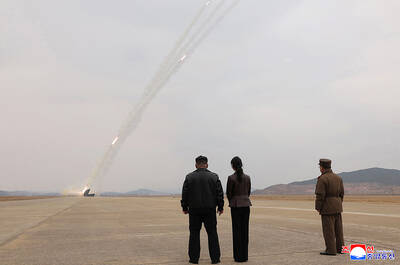
North Korea tested nuclear-capable rocket launchers, state media reported yesterday, a day after Seoul detected the launch of about 10 ballistic missiles. The test comes after South Korean and US forces launched their springtime military drills, due to run until Thursday. North Korean leader Kim Jong-un on Saturday oversaw the testing of the multiple rocket launcher system (MRLS), the Korean Central News Agency (KCNA) said. The test involved 12 600mm-caliber ultra-precision multiple rocket launchers and two artillery companies, it said. Kim said the drill gave Pyongyang’s enemies, within the 420km striking range, a sense of “uneasiness” and “a deep understanding

North Korea yesterday fired about 10 ballistic missiles to the sea toward Japan, the South Korean Joint Chiefs of Staff (JCS) said, days after Pyongyang warned of “terrible consequences” over ongoing South Korea-US military drills. Pyongyang recently dashed hopes of a diplomatic thaw with Seoul, Washington’s security ally, describing its latest peace efforts as a “clumsy, deceptive farce.” Seoul’s military detected “around 10 ballistic missiles launched from the Sunan area in North Korea toward the East Sea [Sea of Japan] at around 1:20pm,” JCS said in a statement, referring to South Korea’s name for the body of water. The missiles


 RSS
RSS