


The Ministry of Foreign Affairs helped communicate between the National Immigration Agency (NIA) and the American Institute in Taiwan (AIT) in the case of a Chinese dissident seeking political asylum in the US, an official said yesterday.
Radio Free Asia (RFA) reported on Friday last week that Chinese dissident Wang Rui (王睿) had arrived in the US seeking asylum after spending four years in Taiwan, while agencies from Taiwan and the US worked on his case.
Department of North American Affairs Director-General Remus Chen (陳立國) told a news conference yesterday that the ministry played a supporting role in the matter by helping the NIA work with the AIT on the case.
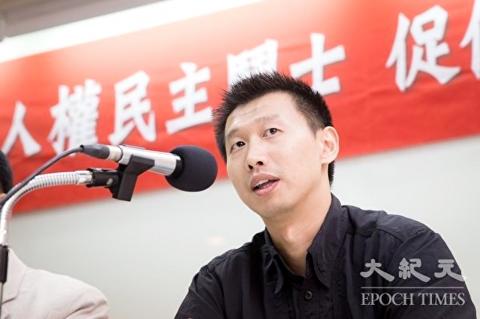
Photo: Internet screen grab
Neither the NIA nor AIT responded to questions for more information.
Wang arrived in Taiwan in August 2014 on a package tour, but planned to seek asylum.
However, he decided in September 2015 to try to go to the US because Taiwan does not have a refugee law.
He was part of a group of five Chinese, including his girlfriend Yang Luo Yini (楊羅旖旎), who reportedly planned to sail to Guam or the Mariana Islands to seek political asylum.
Su Qianlong (蘇黔龍), Lu Ning (陸寧) and Shi Jian (石堅) reportedly bought a small sailboat in China’s Shandong Province and sailed to a beach in Taoyuan’s Dayuan District (大園), landing on Sept. 10, 2015, to pick up Wang and Yang Luo, who had arrived the preceding June. The couple were staying at an apartment in Taipei.
The five set off for Guam, but reportedly lost their way several times over the course of 30 days and were finally rescued by Taiwanese authorities, according to a report by RFA at the time.
“They’re lucky to be alive, in such big waves and such high winds, you have no idea,” one rescue team member told RFA after the five were detained and their heavily damaged boat impounded.
Officials initially suspected the five of spying, but Taiwanese human rights groups said they were Chinese dissidents fleeing persecution and called on the government to grant them political asylum.
Yang Luo was deported to China by immigration authorities on Sept. 25, 2015, while Taoyuan prosecutors charged the four men with violating the Immigration Act (入出國及移民法) and acting as accomplices to criminal activities.
Wang told RFA that all five had been targeted by Chinese authorities for their human rights and political activism, including being held in detention and placed under surveillance by state security police.

PROVOCATIVE: Chinese Deputy Ambassador to the UN Sun Lei accused Japan of sending military vessels to deliberately provoke tensions in the Taiwan Strait China denounced remarks by Japan and the EU about the South China Sea at a UN Security Council meeting on Monday, and accused Tokyo of provocative behavior in the Taiwan Strait and planning military expansion. Ayano Kunimitsu, a Japanese vice foreign minister, told the Council meeting on maritime security that Tokyo was seriously concerned about the situation in the East China and South China seas, and reiterated Japan’s opposition to any attempt to change the “status quo” by force, and obstruction of freedom of navigation and overflight. Stavros Lambrinidis, head of the EU delegation to the UN, also highlighted South China Sea
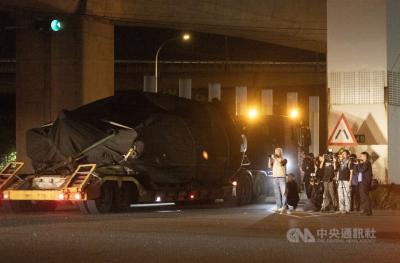
The final batch of 28 M1A2T Abrams tanks purchased from the US arrived at Taipei Port last night and were transported to the Armor Training Command in Hsinchu County’s Hukou Township (湖口), completing the military’s multi-year procurement of 108 of the tanks. Starting at 12:10am today, reporters observed more than a dozen civilian flatbed trailers departing from Taipei Port, each carrying an M1A2T tank covered with black waterproof tarps. Escorted by military vehicles, the convoy traveled via the West Coast Expressway to the Armor Training Command, with police implementing traffic control. The army operates about 1,000 tanks, including CM-11 Brave Tiger
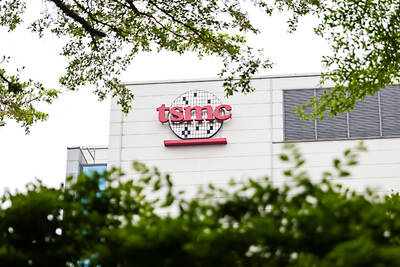
Taiwan Semiconductor Manufacturing Co (TSMC, 台積電), the world’s largest contract chipmaker, said it expects its 2-nanometer (2nm) chip capacity to grow at a compound annual rate of 70 percent from this year to 2028. The projection comes as five fabs begin volume production of 2-nanometer chips this year — two in Hsinchu and three in Kaohsiung — TSMC senior vice president and deputy cochief operating officer Cliff Hou (侯永清) said at the company’s annual technology symposium in Silicon Valley, California, last week. Output in the first year of 2-nanometer production, which began in the fourth quarter of last year, is expected to

Taiwan’s drone exports surged past US$100 million in the first quarter, exceeding last year’s full-year total, with the Czech Republic emerging as the largest buyer, the Ministry of Economic Affairs said. Exports of complete drones reached US$115.85 million in the period, about 1.2 times the total recorded for all of last year, the ministry said in a report. Exports to the Czech Republic accounted for about US$100 million, far outpacing other markets. Poland, last year’s top destination, recorded about US$11.75 million in the first quarter. Taiwan’s drone exports have expanded rapidly in the past few years, with last year’s total


 RSS
RSS