


The Ministry of Justice on Friday slapped sanctions on a local businessman suspected of selling oil to North Korea, banning all financial dealings with him and freezing his companies’ bank accounts.
Seoul last month said that it had in November last year detained a Hong Kong-registered ship suspected of transferring oil products to a North Korean vessel and breaching UN sanctions against the nuclear-armed regime.
Prosecutors last week said that a Taiwanese businessman surnamed Chen (陳) was under investigation for making a false declaration that a ship he chartered was bound for Hong Kong when it actually sailed to international waters to sell oil. He was released on bail and has not yet been formally charged.
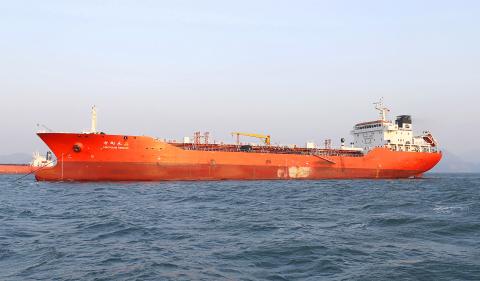
Photo: AFP
The ministry on Friday announced sanctions against Chen Shih-hsien (陳世憲) and his solely owned Bunker’s Taiwan Group Corp, as well as Billions Bunker Group Corp (比利恩油品集團), both of which are registered offshore.
Two other entities backed by Chen — Oceanic Enterprise Co Ltd and UMC Corp Peru SAC — were also sanctioned under terrorism financing prevention laws.
The sanctions mean the bank accounts and assets of Chen and his affiliated companies are frozen, a ministry document said.
“We share the international responsibility toward regional security and we cannot tolerate any provocation to international security,” the ministry said in a statement.
Seoul last month said that Billions Bunker Group had chartered the ship Lighthouse Winmore, which was in November impounded by South Korean authorities after it allegedly transferred 600 tonnes of oil to a North Korean vessel.
Billions Bunker Group is incorporated in the Marshall Islands and cannot be traced directly to Chen, but Taiwanese authorities found him to be the sole shareholder of Bunker’s Taiwan Group — incorporated in the British Virgin Islands.
Local media said Chen sold oil products through “a Chinese middleman” and had told prosecutors he did not know they were bound for a North Korean vessel.
The US had asked the UN Security Council to blacklist 10 ships — including the Lighthouse Winmore — for violating sanctions against North Korea.
Taiwan announced in September last year that it was banning all trade activities with North Korea.
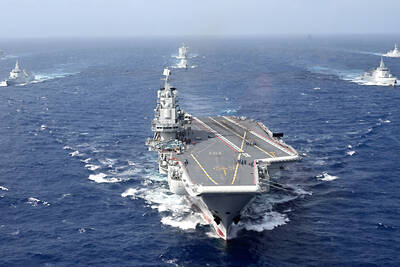
PROVOCATIVE: Chinese Deputy Ambassador to the UN Sun Lei accused Japan of sending military vessels to deliberately provoke tensions in the Taiwan Strait China denounced remarks by Japan and the EU about the South China Sea at a UN Security Council meeting on Monday, and accused Tokyo of provocative behavior in the Taiwan Strait and planning military expansion. Ayano Kunimitsu, a Japanese vice foreign minister, told the Council meeting on maritime security that Tokyo was seriously concerned about the situation in the East China and South China seas, and reiterated Japan’s opposition to any attempt to change the “status quo” by force, and obstruction of freedom of navigation and overflight. Stavros Lambrinidis, head of the EU delegation to the UN, also highlighted South China Sea
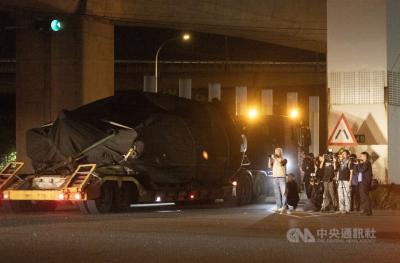
The final batch of 28 M1A2T Abrams tanks purchased from the US arrived at Taipei Port last night and were transported to the Armor Training Command in Hsinchu County’s Hukou Township (湖口), completing the military’s multi-year procurement of 108 of the tanks. Starting at 12:10am today, reporters observed more than a dozen civilian flatbed trailers departing from Taipei Port, each carrying an M1A2T tank covered with black waterproof tarps. Escorted by military vehicles, the convoy traveled via the West Coast Expressway to the Armor Training Command, with police implementing traffic control. The army operates about 1,000 tanks, including CM-11 Brave Tiger
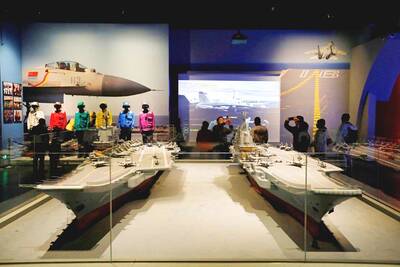
China on Wednesday teased in a video an aircraft carrier that could be its fourth, and the first using nuclear power, while making an allusion to Taiwan and vowing to further build up its islands, as it looks to boost maritime power, secure resources and bolster territorial claims. The video, issued on the eve of the 77th founding anniversary of the Chinese People’s Liberation Army Navy, featured fictional officers with names that are homophones of three commissioned aircraft carriers, the Liaoning (遼寧), Shandong (山東) and Fujian (福建). Titled Into the Deep, it showed a 19-year-old named “Hejian” (何劍) joining the group, sparking
Taiwan Semiconductor Manufacturing Co (TSMC, 台積電), the world’s largest contract chipmaker, said it expects its 2-nanometer (2nm) chip capacity to grow at a compound annual rate of 70 percent from this year to 2028. The projection comes as five fabs begin volume production of 2-nanometer chips this year — two in Hsinchu and three in Kaohsiung — TSMC senior vice president and deputy cochief operating officer Cliff Hou (侯永清) said at the company’s annual technology symposium in Silicon Valley, California, last week. Output in the first year of 2-nanometer production, which began in the fourth quarter of last year, is expected to


 RSS
RSS