


President Tsai Ing-wen (蔡英文) yesterday attended the New Year’s Day flag-raising ceremony in front of the Presidential Office Building.
After the ceremony, Tsai posted a message on Facebook wishing Taiwanese a happy New Year.
At about 6:20am, Tsai and Vice President Chen Chien-jen (陳建仁), accompanied by Taipei Mayor Ko Wen-je (柯文哲), stepped out of the building to attend the ceremony, which started 10 minutes later.
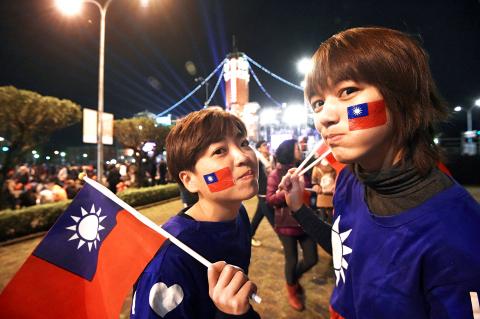
Photo: Fang Pin-chao, Taipei Times
It was the second time that Tsai attended the ceremony in her capacity as president since taking office in May 2016.
While the Republic of China (ROC) flag was being hoisted, Tsai sang the national anthem without skipping the part that says “the fundamentals of my party,” as she had done on previous occasions.
The words “the fundamentals of my party” are seen as pertaining to the Chinese Nationalist Party (KMT).
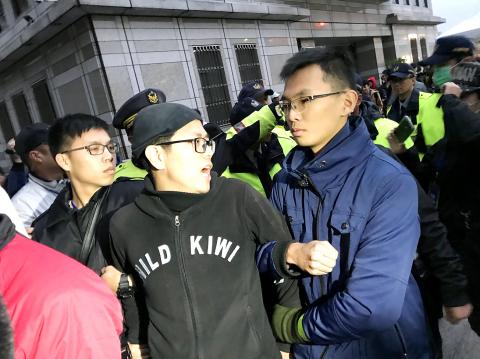
Photo: CNA
The singing of the national anthem was led by a group of soldiers from various branches of the armed forces who had been commended for their performance, as well as some Taiwanese athletes who participated in last year’s Taipei Summer Universiade and those from the nation’s soccer team.
The ceremony was also attended by members of the public, some of whom had gone there directly from New Year’s Eve countdown parties.
Some people sported national flag stickers on their face as they waved flags and took photographs.
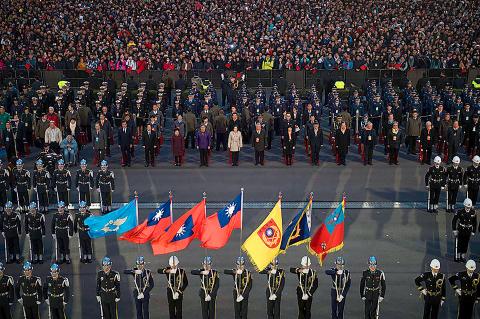
Photo: CNA, copied from President Tsai Ing-wen’s Facebook page
After singing the national anthem, Tsai took to the stage to greet the crowd and welcome the first day of the year.
A concert followed the ceremony, with performances by bands from Taipei Jianguo High School, Taipei First Girls’ High School and Zhongshan Girls’ Senior High School.
Several other bands, such as Wooden Glasses and Funky Brothers, also performed.
Scattered protests took place during the ceremony. Two pro-Taiwanese independence groups were removed by police after waving flags and shouting slogans saying that the ROC is an external regime.
A separate group of about 20 people gathered outside the Democratic Progressive Party headquarters to protest the proposed amendments to the Labor Standards Act (勞動基準法). The group later marched along Katagalan Boulevard toward the Presidential Office Building, where they held banners, shouted slogans and acted skits criticizing what they said was Tsai’s failure to fulfill her election promises.
The KMT yesterday held a separate New Year’s Day flag-raising ceremony in front of its headquarters in Taipei, where KMT Chairman Wu Den-yih (吳敦義) performed an exercise routine to music.
The KMT must unite and garner more support for this year’s local elections to return to power in 2020, Wu said.
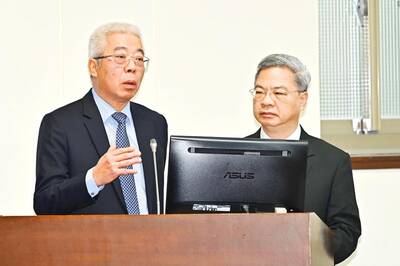
Taiwan has arranged for about 8 million barrels of crude oil, or about one-third of its monthly needs, to be shipped from the Red Sea this month to bypass the Strait of Hormuz and ease domestic supply pressures, CPC Corp, Taiwan (CPC, 台灣中油) said yesterday. The state-run oil company has worked with Middle Eastern suppliers to secure routes other than the Strait of Hormuz, through which about 20 percent of the world’s oil and liquefied natural gas typically passes, CPC chairman Fang Jeng-zen (方振仁) said at a meeting of the legislature’s Economics Committee in Taipei. Suppliers in Saudi Arabia have indicated they
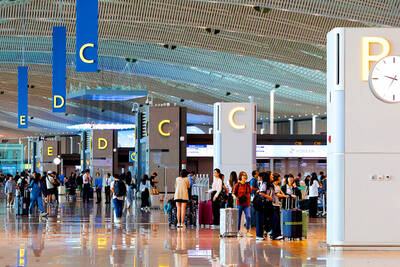
South Korea has adjusted its electronic arrival card system to no longer list Taiwan as a part of China, a move that the Ministry of Foreign Affairs said would help facilitate exchanges between the two sides. South Korea previously listed “Taiwan” as “Taiwan (China)” in the drop-down menus of its online arrival card system, where people had to fill out where they came from and their next destination. The ministry had requested South Korea make a revision and said it would change South Korea’s name on Taiwan’s online immigration system from “Republic of Korea” to “Korea (South),” should the issue not be
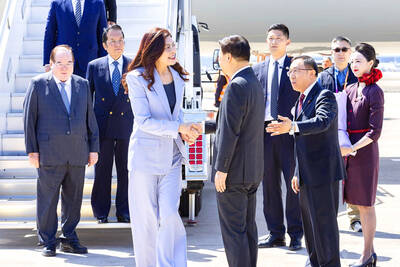
CCP ‘PAWN’? Beijing could use the KMT chairwoman’s visit to signal to the world that many people in Taiwan support the ‘one China’ principle, an academic said Chinese Nationalist Party (KMT) Chairwoman Cheng Li-wun (鄭麗文) yesterday arrived in China for a “peace” mission and potential meeting with Chinese President Xi Jinping (習近平), while a Taiwanese minister detailed the number of Chinese warships currently deployed around the nation. Cheng is visiting at a time of increased Chinese military pressure on Taiwan, as the opposition-dominated Legislative Yuan stalls a government plan for US$40 billion in extra defense spending. Speaking to reporters before going to the airport, Cheng said she was going on a “historic journey for peace,” but added that some people felt uneasy about her trip. “If you truly love Taiwan,

Tainan, Taipei and New Taipei City recorded the highest fines nationwide for illegal accommodations in the first quarter of this year, with fines issued in the three cities each exceeding NT$7 million (US$220,639), Tourism Administration data showed. Among them, Taipei had the highest number of illegal short-term rental units, with 410. There were 3,280 legally registered hotels nationwide in the first quarter, down by 14 properties, or 0.43 percent, from a year earlier, likely indicating operators exiting the market, the agency said. However, the number of unregistered properties rose to 1,174, including 314 illegal hotels and 860 illegal short-term rental


 RSS
RSS