


Minister of the Interior Yeh Jiunn-rong (葉俊榮) yesterday ordered the removal of the National Women’s League’s (NWL) leadership after the group refused to sign an administrative contract that would see it undergo a drastic structural reform.
The Ministry of the Interior issued an official document ordering the removal of league chairwoman Cecilia Koo (辜嚴倬雲) and league deputy chairwoman Yeh Chin-fong (葉金鳳) after it received a letter from the group stating its opposition to government-led public supervision and its decision not to sign the contract, Yeh said.
“This is not the result we had hoped for, but we have to face it with courage,” Yeh told a news conference at the ministry in Taipei, adding that negotiations proved that the power of a few reformists within the league was not enough to bring changes to an organization that has lived in the past and closed itself off from the outside world.
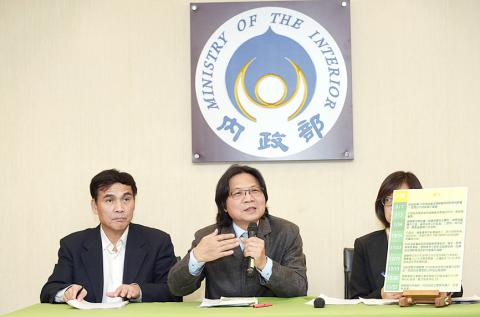
Photo: Chang Chia-ming, Taipei Times
The ministry — the government tasked with supervising civil associations — also instructed the league to hold a leadership election within 10 days and provide documentation on how funds from the Military Benefit Tax was used, he said.
If the election is not held, the ministry is entitled to appoint a representative instead, Yeh said, adding that he was not ruling out dissolving the league.
The Military Benefit Tax was a tariff levied on the US dollar value of all imported goods from 1955 to 1989, which provided most of the funding for the organization’s charity work, including construction of military dependents’ villages.

Photo: CNA
The league — founded in 1950 and run for decades by Soong Mayling (宋美齡), the last wife of Chiang Kai-shek (蔣介石) — is under investigation by the Executive Yuan’s Ill-gotten Party Assets Settlement Committee over its alleged links to the Chinese Nationalist Party (KMT).
The ministry had given the league a deadline of noon yesterday to sign the contract, which would have finalized an agreement reached by the league, ministry and the committee on July 24.
Under the agreement, the league would donate more than 80 percent of its assets, NT$31.2 billion (US$1.04 billion), to the government for charitable purposes; merge with its subsidiary, the Social Welfare Foundation; allow the government to appoint one-third of its board of directors; and give veto powers to an additional one-third of its directors.
Had the league honored the agreement, it would have ceased to exist as a political organization and would have been removed from the committee’s target list.
Later yesterday, the committee issued a statement expressing regret over the league’s decision, saying that the committee would convene on Tuesday next week to deliberate on whether to issue administrative penalties against the league and freeze its assets.
“There is no room for delays in achieving transitional justice in our society. We had hoped that the league would shoulder its share of historical responsibility ... and join us and the ministry in facing and dealing with the past,” the committee said.
“It is a pity that even to this day, the league continues to reject public supervision,” it added.

CREDIT-GRABBER: China said its coast guard rescued the crew of a fishing vessel that caught fire, who were actually rescued by a nearby Taiwanese boat and the CGA Maritime search and rescue operations do not have borders, and China should not use a shipwreck to infringe upon Taiwanese sovereignty, the Coast Guard Administration (CGA) said yesterday. The coast guard made the statement in response to the China Coast Guard (CCG) saying it saved a Taiwanese fishing boat. The Chuan Yu No. 6 (全漁6號), a fishing vessel registered in Keelung, on Thursday caught fire and sank in waters northeast of Diaoyutai Islands (釣魚台). The vessel left Keelung’s Badouzih Fishing Harbor (八斗子漁港) at 3:35pm on Sunday last week, with seven people on board — a 62-year-old Taiwanese captain surnamed Chang (張) and six
RISKY BUSINESS: The ‘incentives’ include initiatives that get suspended for no reason, creating uncertainty and resulting in considerable losses for Taiwanese, the MAC said China’s “incentives” failed to sway sentiment in Taiwan, as willingness to work in China hit a record low of 1.6 percent, a Ministry of Labor survey showed. The Directorate-General of Budget, Accounting and Statistics (DGBAS) also reported that the number of Taiwanese workers in China has nearly halved from a peak of 430,000 in 2012 to an estimated 231,000 in 2024. That marked a new low in the proportion of Taiwanese going abroad to work. The ministry’s annual survey on “Labor Life and Employment Status” includes questions respondents’ willingness to seek employment overseas. Willingness to work in China has steadily declined from

The Legislative Yuan’s Finance Committee yesterday approved proposed amendments to the Amusement Tax Act (娛樂稅法) that would abolish taxes on films, cultural activities and competitive sporting events, retaining the fee only for dance halls and golf courses. The proposed changes would set the maximum tax rate for dance halls and golf courses at 50 and 20 percent respectively, with local governments authorized to suspend the levies. Article 2 of the act says that “amusement tax shall be levied on tickets sold or fees charged by amusement places, facilities or activities” in six categories: “Cinema; professional singing, story-telling, dancing, circus, magic show, acrobatics

INFLATION UP? The IMF said CPI would increase to 1.5 percent this year, while the DGBAS projected it would rise to 1.68 percent, with GDP per capita of US$44,181 The IMF projected Taiwan’s real GDP would grow 5.2 percent this year, up from its 2.1 percent outlook in January, despite fears of global economic disruptions sparked by the US-Iran conflict. Taiwan’s consumer price index (CPI) is projected to increase to 1.5 percent, while unemployment would be 3.4 percent, roughly in line with estimates for Asia as a whole, the international body wrote in its Global Economic Outlook Report published in the US on Monday. The figures are comparatively better than the IMF outlook for the rest of the world, which pegged real GDP growth at 3.1 percent, down from 3.3 percent


 RSS
RSS