


Several Chinese People’s Liberation Army Air Force (PLAAF) aircraft passed near Taiwan at 4:40pm yesterday, with a number of Tu-154 surveillance aircraft taking a separate northbound route through Japan’s Miyako Strait, the Ministry of National Defense said.
The aircraft were part of a training mission over the Pacific Ocean that included Xian H-6K bombers, Sukhoi Su-30 fighter jets, Shaanxi Y-8 transport planes and Ilyushin Il-78 aerial refueling planes, in addition to the surveillance aircraft, the ministry said.
The formation flew over the Bashi Channel before turning back and passing through the Miyako Strait on the way back to China in what has been a recurring pattern for PLAAF training missions, the ministry said, adding that it would not be doing any follow-up reports.
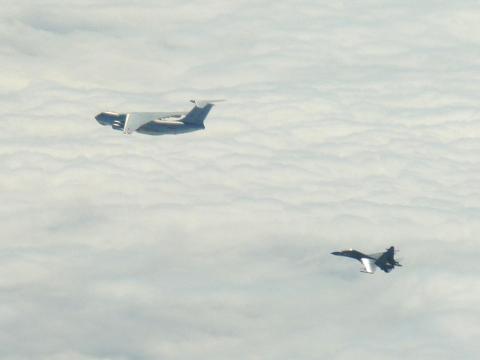
Photo courtesy of the Ministry of National Defense
Air force fighters and navy warships were dispatched in line with regular readiness procedures and to supervise the situation, it said.
There was no threat to national security, it added.
The exercise was the 10th by the PLAAF since the Chinese Communist Party held its 19th National Congress in October.
The Chinese-language Apple Daily reported that an amateur radio operator picked up an exchange between PLAAF and Taiwanese pilots, indicating a breach of Taiwanese air space by the Chinese forces.
Taiwanese fighters flew to intercept the PLAAF aircraft, which responded on an emergency frequency, saying: “This is the Chinese air force. We are conducting routine training exercises. Please do not interfere with our operations.”
“Turn back,” a Taiwanese pilot said.
The PLAAF pilot responded by repeating their original statement.
“This is a broadcast by the ROC [Republic of China] Air Force. This is a broadcast by the ROC Air Force,” the commanding officer replied. “Communist aircraft located 580km southeast over the ... sea on course 320 at altitude 8,100m, take notice: You have already entered the ROC air defense identification zone. Please immediately turn left onto course 380 and leave the area.”
The recording is the first since a PLAAF bomber pilot threatened a Taiwanese pilot on Dec. 7, telling him to “leave immediately or face the consequences.”

‘NO SECURITY RISK’: The Railway Bureau reassured the public that the technicians’ activities were limited to technical guidance and did not involve sensitive systems The Railway Bureau yesterday said it had invited eight Chinese technicians to assist with an airport MRT construction project. The bureau issued the confirmation after an Internet user said Chinese nationals had entered the construction zone of Taiwan Taoyuan International Airport’s Terminal 3 project. They asked why “individuals from an enemy state” were allowed access to such a major national infrastructure project, which raised serious concerns over Taiwan’s industrial safety, sensitive systems and information security. The bureau’s Northern Region Engineering Branch Office said subcontractor Taiwan Handle Industrial Co (台灣手把工業) of the Taoyuan airport MRT’s “Contract No. CU05 Project A14 Station Civil, MEP &

A US uncrewed surface vessel (USV) encountered multiple Chinese warships during an autonomous transit of the Taiwan Strait, US defense company Seasats said in a statement on Wednesday. Seasats announced that a Lightfish USV had completed the first autonomous transit of the Taiwan Strait. Over five days, the USV traversed the entire length of the Strait while constantly monitoring surface vessel traffic, the company said. The Lightfish encountered multiple Chinese warships, one of which was a Chinese People’s Liberation Army Navy (PLAN) Type 056 corvette, it said. The Chinese vessels were operating “well within Taiwan’s exclusive economic zone without transmitting their identity via the
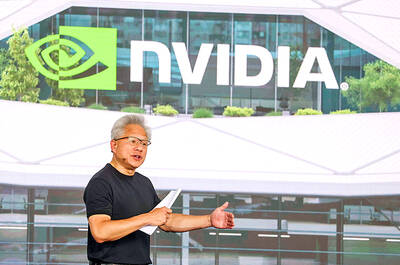
‘BOOMING’: ’ The number of partners we have here is incredible. You can see from their stock prices. They’re doing so well, they’re so happy,’ Jensen Huang said Nvidia Corp’s spending in Taiwan has ballooned to about US$150 billion a year, 10 times the US$10 billion to US$15 billion the company spent five years ago, Nvidia chief executive officer Jensen Huang (黃仁勳) said yesterday, suggesting Taiwan’s strategic importance in the global artificial intelligence (AI) supply chain. “Taiwan is the epicenter of the AI revolution. This is where the chips come, packaging comes. This is where the systems are made. This is where AI supercomputers were created,” Huang said at a meeting for the company’s employees in Beitou-Shilin Technology Park (北投士林科技園區) in Taipei, the planned site of Nvidia’s Taipei headquarters. “Taiwan
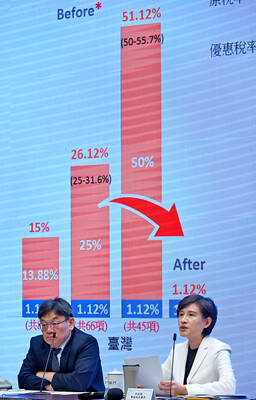
GREATER REACH? Auto parts and wood products would face tariffs of up to 15%, matching those targeting the EU, Japan and South Korea, Vice Premier said The US has announced that preferential tariff treatment for Taiwan’s non-semiconductor Section 232 goods would take effect retroactively from May 1, the Executive Yuan said yesterday. The US government yesterday posted a notice on the Federal Register’s public inspection Web site previewing tariff concessions for Taiwan under a memorandum of understanding (MOU) on Taiwan-US investment after two months of negotiations. The MOU signed on Jan. 15 stipulated three major preferential tariff arrangements: a 15 percent “reciprocal” tariff rate for Taiwan without stacking most-favored nation (MFN) rates; preferential Section 232 treatment for semiconductors and related products; and preferential Section 232 treatment for non-semiconductor


 RSS
RSS