


The legislature yesterday passed the Political Party Act (政黨法), which lawmakers said would enable fairer competition between political parties and prevent criminal gangs from meddling in politics.
One of the act’s major articles lowers the threshold for political parties to receive government subsidies from 3.5 percent to 3 percent of the number of votes cast in the latest legislative election.
The New Power Party (NPP) had proposed to lower the threshold to 2 percent, with NPP caucus convener Hsu Yung-ming (徐永明) saying it would make for a more pluralistic political environment in which small parties can survive, despite not winning any seats in legislative elections.
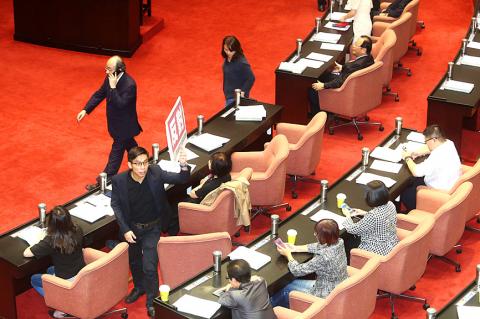
Photo: CNA
Hsu said the public should not worry about the Chinese Unity Promotion Party (CUPP) receiving subsidies as a result of the passage of the act, as it and another party advocating unification with China passed the threshold long ago and have been receiving subsidies.
“We should not miss the point, which is to promote diversity and consolidate democracy,” he said.
The Chinese Nationalist Party (KMT) and the People First Party (PFP) had jointly tendered the motion to set the threshold at 3 percent.
KMT caucus secretary-general Lin Wei-chou (林為洲), citing subsidy rules in other nations, said that the two caucuses believed that setting the threshold at 3 percent would be more proportionate, as it would indicate that a political party has received sizable public support and therefore is worthy of receiving subsidies.
As the subsidies are paid using taxpayers’ money, the subsidized parties must have a sizable public support base, Democratic Progressive Party (DPP) Legislator Tsai Yi-yu (蔡易餘) said, adding that the DPP caucus believed it was appropriate to set the threshold at 3 percent.
As the motions proposed by the KMT, PFP and DPP on the subsidies had identical content, they were simultaneously passed.
The act also included an article that prohibits individuals convicted of offenses associated with organized crime from serving as leaders of political parties.
The article was created following discussions on gangsters working with the CUPP — founded by former Bamboo Union leader Chang An-le (張安樂), also known as the “White Wolf” — in a violent attack on students and protesters at the Sing! China: Shanghai-Taipei Music Festival at National Taiwan University in September.
The act stipulates that parties whose leaders have been convicted of offenses linked to organized crime must report to the Ministry of the Interior and elect a new leader within three months.
It also stipulates that the ministry should proactively order such parties to elect new leaders within a given timeframe after learning of the situation.
The rule also applies to people who have been convicted of treason or compromising national security, as well as those who face potential prison terms of 10 years or longer, a life sentence or the death penalty.
Political parties are to declare their assets with the ministry before May 31 each year, including income from membership fees, cash donations and revenue from selling merchandise.
The act stipulates that parties that fail to declare their assets or provide false information would face a maximum fine of NT$5 million (US$165,717), which could be issued repeatedly.
Political parties are to be banned from running or investing in for-profit organizations and from buying real estate other than its headquarters.
Contravening the rule could result in a fine of between NT$5 million and NT$25 million.
A provision of the act governing the dissolution of political parties authorizes the ministry to disband a party if it has not held a general assembly or nominated candidates for elections in four years.
It also stipulates that political parties formed under the Civil Associations Act (人民團體法) are to revise their articles of association within two years after the act’s promulgation or be disqualified and disbanded.

‘NO SECURITY RISK’: The Railway Bureau reassured the public that the technicians’ activities were limited to technical guidance and did not involve sensitive systems The Railway Bureau yesterday said it had invited eight Chinese technicians to assist with an airport MRT construction project. The bureau issued the confirmation after an Internet user said Chinese nationals had entered the construction zone of Taiwan Taoyuan International Airport’s Terminal 3 project. They asked why “individuals from an enemy state” were allowed access to such a major national infrastructure project, which raised serious concerns over Taiwan’s industrial safety, sensitive systems and information security. The bureau’s Northern Region Engineering Branch Office said subcontractor Taiwan Handle Industrial Co (台灣手把工業) of the Taoyuan airport MRT’s “Contract No. CU05 Project A14 Station Civil, MEP &

Taiwan is still in the process of assessing the possibility of recruiting workers from Eswatini, the Ministry of Foreign Affairs said yesterday, adding that its goal is to help Eswatini upgrade its vocational training centers. If there are plans to recruit workers from Eswatini, safeguarding national security, protecting public health and ensuring the employment rights of Taiwanese would be prerequisites, Department of West Asian and African Affairs Director-General Yen Chia-liang (顏嘉良) told a news conference. Key considerations would also include filling labor shortages in specific industries, and fostering bilateral professional and technical exchanges, he said. Yen was asked about the progress of labor

A US uncrewed surface vessel (USV) encountered multiple Chinese warships during an autonomous transit of the Taiwan Strait, US defense company Seasats said in a statement on Wednesday. Seasats announced that a Lightfish USV had completed the first autonomous transit of the Taiwan Strait. Over five days, the USV traversed the entire length of the Strait while constantly monitoring surface vessel traffic, the company said. The Lightfish encountered multiple Chinese warships, one of which was a Chinese People’s Liberation Army Navy (PLAN) Type 056 corvette, it said. The Chinese vessels were operating “well within Taiwan’s exclusive economic zone without transmitting their identity via the
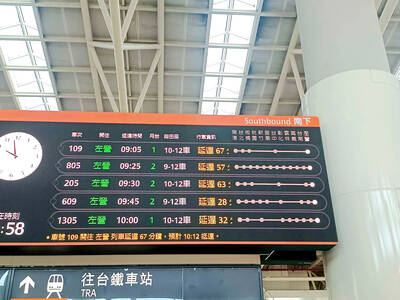
The nation’s usually punctual high-speed rail system yesterday was hit by major disruptions after all scheduled services were canceled and replaced with three hourly trains offering only non-reserved seating, affecting more than 200,000 passengers. Preliminary findings indicate the disruption was caused by a faulty power module in a track switch control cabinet, Taiwan High-Speed Rail Corp (THSRC) said, adding that as a full system inspection could only be conducted after operations end for the day, a decision on whether normal service would resume today would be announced before the first train departs. During a routine inspection early yesterday, a switch signal abnormality


 RSS
RSS