


The Taiwan High Court on Monday filed a request for a constitutional interpretation by the Council of Grand Justices on desecration of the flag, saying the Criminal Code penalizing such actions might infringe on freedom of speech, freedom of thought and proportionality.
The request was prompted by the case of independence advocates Chen Yi-ting (陳儀庭), Chen Miao-ting (陳妙婷) and three others, whose conviction for cutting up a dozen flags in 2015 was overturned on appeal by the New Taipei City District Court.
New Taipei City prosecutors appealed the overturned conviction.
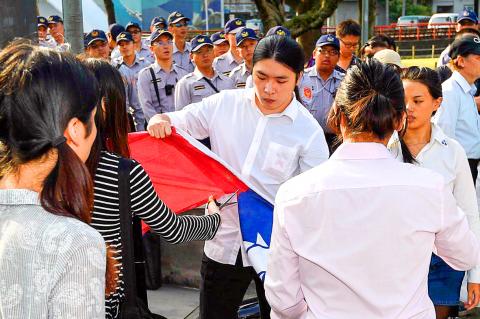
Photo: George Tsorng, Taipei Times
High Court judges Chou Ying-wen (周盈文), Lin Meng-huang (林孟皇) and Lin Hai-hsiang (林海祥) decided to suspend the appeal trial to allow time for a constitutional interpretation.
The Criminal Code’s prohibition of purposeful and public vandalism of the flag under Article 160 could be an infringement on the right to free speech and thought that is stipulated by Article 11 of the Constitution, the judges said.
The penalty of less than one year in prison might also clash with the principle of proportionality guaranteed by Article 23 of the Constitution, they said.
Although the flag should be honored as the nation’s symbol, its meaning to each citizen might vary and the spirit of liberty, equality and fraternity is better preserved via the toleration of dissent, not its punishment, they said.
On Oct. 10, 2015, the two Chens and three other members of the Taiwan Nationalist Party cut up flags that were displayed along Zhongzheng Bridge (中正橋) in New Taipei City. There were arrested and in their first trial were sentenced to 20 days imprisonment, commutable to a NT$20,000 fine.
The two Chens and fellow defendant Wu Hsin-en (吳馨恩) appealed the conviction, arguing that their action was a legitimate form of expression and damaging the flag was an expression of criticism on the Republic of China’s colonial repression of Taiwanese.
The New Taipei City District Court ruled in the defendants’ favor at the retrial, adding that political speech should be afforded the highest level of constitutional protection, prompting the prosecutors to appeal to the High Court.
Chen Yi-ting on Monday said that decriminalizing flag desecration would allow activists more freedom to criticize the political order.
National Taiwan University professor of law Chen Chih-lung (陳志龍) said that desecrating the flag was made a crime under the Republic of China’s Criminal Code during the 1930s due to the influence on China of Nazi Germany and other fascist states.
Most Western countries have decriminalized flag burning and other forms of protest targeting the national flag, he said.
Protesters who vandalize the flag do not cause real harm or damage and their actions are often motivated by deep and sincerely held convictions, which should be protected as a matter of conscience, he said.
“The Taiwan High Court did not need to suspend the trial or file for a constitutional interpretation, because it is already empowered to rule out the applicability of the Criminal Code to this case,” the professor said.
National Chengchi University associate professor of law Bruce Liao (廖元豪) said the US Supreme Court had struck down state laws penalizing flag desecration as violating free speech in the case Johnson v Texas.
For this reason, he would like to see the Council of Grand Justices rule on the issue, Liao said.
Charging protesters with damaging public property to the actual cash value of the flag would be more appropriate recompense for their actions, he added.
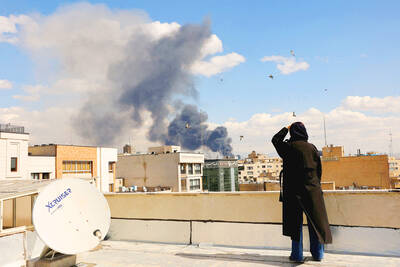
CHAOS: Iranians took to the streets playing celebratory music after reports of Khamenei’s death on Saturday, while mourners also gathered in Tehran yesterday Iranian Supreme Leader Ayatollah Ali Khamenei was killed in a major attack on Iran launched by Israel and the US, throwing the future of the Islamic republic into doubt and raising the risk of regional instability. Iranian state television and the state-run IRNA news agency announced the 86-year-old’s death early yesterday. US President Donald Trump said it gave Iranians their “greatest chance” to “take back” their country. The announcements came after a joint US and Israeli aerial bombardment that targeted Iranian military and governmental sites. Trump said the “heavy and pinpoint bombing” would continue through the week or as long

An Emirates flight from Dubai arrived at Taiwan Taoyuan International Airport yesterday afternoon, the first service of the airline since the US and Israel launched strikes against Iran on Saturday. Flight EK366 took off from the United Arab Emirates (UAE) at 3:51am yesterday and landed at 4:02pm before taxiing to the airport’s D6 gate at Terminal 2 at 4:08pm, data from the airport and FlightAware, a global flight tracking site, showed. Of the 501 passengers on the flight, 275 were Taiwanese, including 96 group tour travelers, the data showed. Tourism Administration Deputy Director-General Huang He-ting (黃荷婷) greeted Taiwanese passengers at the airport and
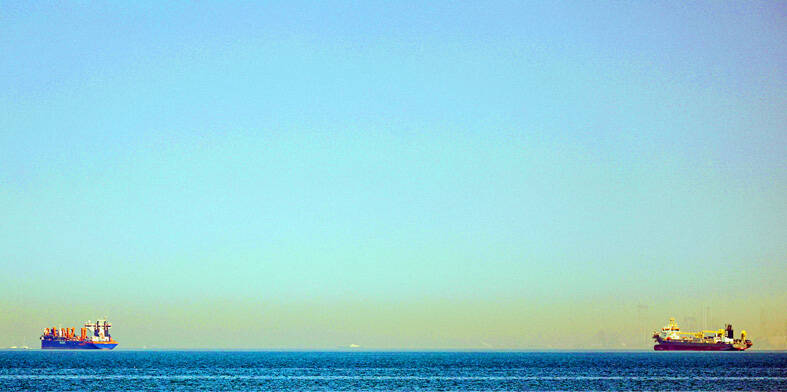
State-run CPC Corp, Taiwan (CPC, 台灣中油) yesterday said that it had confirmed on Saturday night with its liquefied natural gas (LNG) and crude oil suppliers that shipments are proceeding as scheduled and that domestic supplies remain unaffected. The CPC yesterday announced the gasoline and diesel prices will rise by NT$0.2 and NT$0.4 per liter, respectively, starting Monday, citing Middle East tensions and blizzards in the eastern United States. CPC also iterated it has been reducing the proportion of crude oil imports from the Middle East and diversifying its supply sources in the past few years in response to geopolitical risks, expanding
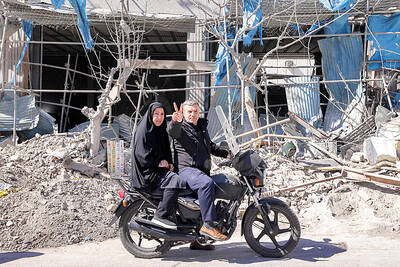
STRAIT OF HORMUZ: In the case of a prolonged blockade by Iran, Taiwan would look to sources of LNG outside the Middle East, including Australia and the US Taiwan would not have to ration power due to a shortage of natural gas, Minister of Economic Affairs Kung Ming-hsin (龔明鑫) said yesterday, after reports that the Strait of Hormuz was closed amid the conflict in the Middle East. The government has secured liquefied natural gas (LNG) supplies for this month and contingency measures are in place if the conflict extends into next month, Kung told lawmakers. Saying that 25 percent of Taiwan’s natural gas supplies are from Qatar, Chinese Nationalist Party (KMT) caucus secretary-general Lin Pei-hsiang (林沛祥) asked about the situation in light of the conflict. There would be “no problems” with


 RSS
RSS