


Taipei Chamber of Commerce director-general Wang Ying-chieh (王應傑) yesterday apologized for calling Taiwanese who have never been to China jianmin (賤民, “uneducated masses”), saying that he bore no ill intent and was only concerned about deteriorating cross-strait ties.
Wang, who is also chairman of real-estate broker Eastern Realty (東森房屋) and vice chairman of Kuo Kuang Motor Transportion Co Ltd (國光客運), made the controversial remarks at a Taiwan Competitiveness Forum event on Thursday, sparking criticism from the public, with some threatening to boycott his businesses.
The Taiwan Competitiveness Forum is a think tank established in 2007 by a group of academics concerned about the cross-strait stalemate and Taiwan’s international predicament.
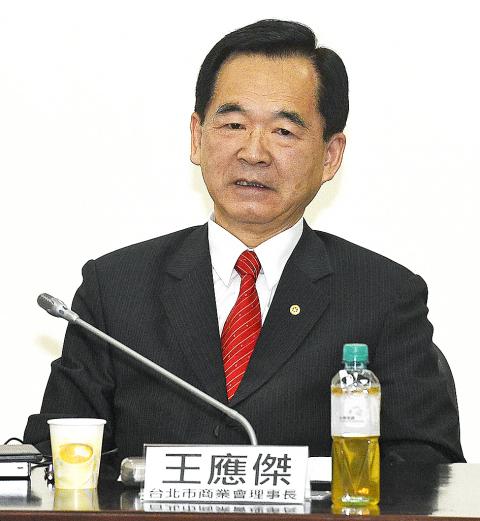
Photo: Chen Chih-chu, Taipei Times
“Why are Taiwanese gullible? Because only 7.5 million of them have been to China, while the remaining 15 million have not,” Wang reportedly said at the event.
Lamenting what he called the Taiwanese public’s ignorance of China’s remarkable progress over the past three decades, Wang said Taipei pales in comparison with many of China’s first-tier or even second-tier cities in terms of development.
“Many ignorant Taiwanese, or even those I call jianmin, do not even know which century they are living in,” Wang said, adding that the situation underscores the importance of engaging the younger generation when handling cross-strait ties.
He told reporters after the event that his use of the term jianmin was not directed at the general public, but rather at politicians who have demonized Beijing and fooled the electorate in a fashion similar to that of the Chinese Nationalist Party (KMT) regime’s irrational and undemocratic rule.
Democratic Progressive Party Legislator Lin Shu-feng (林淑芬) questioned whether Wang’s remarks were an attempt to expand his business in China, given that Eastern Realty opened its first directly owned branch in Jiangsu, China, in May.
Premier William Lai (賴清德) yesterday said in a legislative plenary session that such rhetoric, even revised, cannot be accepted by the public.
“After some soul-searching last night, I realized that my heartfelt remarks at the event, made due to my concerns about uncertainty in cross-strait exchanges, were too straightforward and a poor choice of words,” Wang said on Facebook yesterday.
Wang said that as an entrepreneur, he cares deeply about the nation and its democracy, adding that he hopes the government will prioritize the livelihood of 23 million Taiwanese and refrain from letting politics impede cross-strait economic exchanges.
“I bear no ill intent and hope the public can understand that the criticism came from a good place,” he said.

DRONE CENTRAL: Taiwan aims to become Asia’s democratic hub for drones, with most exports focused on high-quality military-grade models, an official said Taiwan’s drone industry is expected to expand significantly by 2030, producing 100,000 units per month and exporting half of them, the Ministry of Economic Affairs said yesterday. Current drone production capacity is about 15,000 units per month, but the industry can quickly scale up as demand increases, Industrial Development Administration Director-General Chiou Chyou-huey (邱求慧) told a news conference in Taipei. Taiwan’s drone output grew 2.5-fold last year to NT$12.9 billion (US$408.3 million) under a government program to develop the uncrewed vehicle sector, he said. The Executive Yuan in October last year approved plans to invest NT$44.2 billion into domestic production of uncrewed aerial
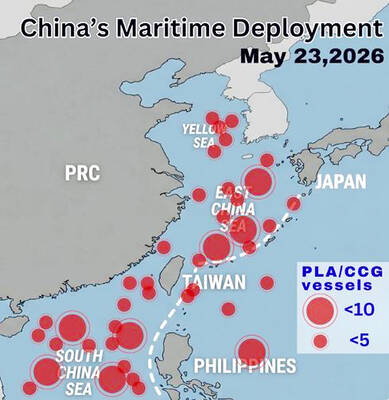
WARNING: China should stop engaging in actions that undermine regional peace and stability, as it would only build resentment among people across the Strait, the CGA said China has deployed more than 100 navy, coast guard and other vessels in waters from the Yellow Sea to the South China Sea and the western Pacific since US President Donald Trump and Chinese President Xi Jinping (習近平) met in Beijing, National Security Council Secretary-General Joseph Wu (吳釗燮) said yesterday. “In this part of the world, #China is the one & only PROBLEM wrecking the #StatusQuo & threatening regional peace & stability,” Wu wrote on X. In a separate post, he said Beijing was coercing Taiwan’s maritime domain, calling it illegal and provocative, after the Coast Guard Administration (CGA) expelled a
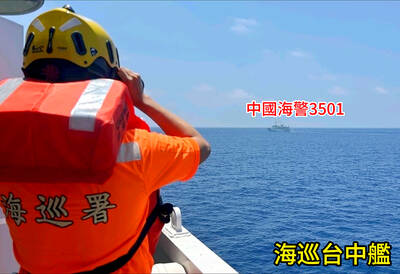
VERBOSE VESSELS: A CGA cutter and a China Coast Guard exchanged verbal barbs for more than a day in Taiwanese-controlled waters before the Chinese vessel left The Taiwanese and Chinese coast guards had a standoff near the strategically located Pratas Islands (Dongsha Islands, 東沙群島) in the north of the South China Sea, the Coast Guard Administration (CGA) said yesterday. The two sides engaged in intense radio exchanges over sovereignty claims during the 33-hour standoff. China Coast Guard vessel 3501 eventually left the restricted waters, 26.6 nautical miles (49.2km) west of the Pratas Islands, at 5pm yesterday, the CGA said. Lying approximately between southern Taiwan and Hong Kong, the Taiwan-controlled Pratas are seen by some security experts as vulnerable to Chinese attack due to their distance — more than
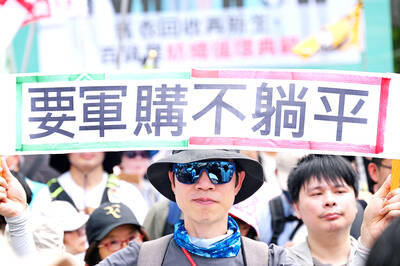
More than 8,000 people took part in a rally in Taipei yesterday to express support for more defense spending, after the opposition slashed the Cabinet’s proposed NT$1.25 trillion (US$39.6 billion) special defense budget and capped it at NT$780 billion. The demonstrators urged the Cabinet to propose another bill. Taiwan Economic Democracy Union convener Lai Chung-chiang (賴中強) said the main problem of the passed budget plan is the removal of funding for critical items, not just that the total amount is smaller. Critical budget items included purchasing or developing uncrewed vehicles, Strong Bow (強弓) missile systems, additional ammunition, artificial intelligence-powered combat systems and Taiwan-US


 RSS
RSS