


The “Sing! China: Shanghai-Taipei Music Festival” scheduled for yesterday at National Taiwan University’s (NTU) athletic field came to an abrupt end following protests by pro-Taiwan independence groups and students at the school against the university’s decision to rent the venue for the event.
The site quickly descended into further dissarray, as members of pro-unification groups joined the fray.
Three students were reportedly injured by a member of the pro-unification Patriot Association (愛國同心會), police said.
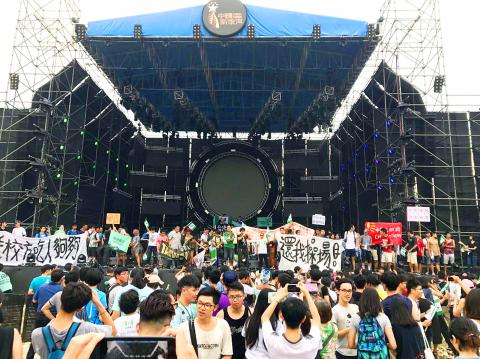
Photo: Chou Yen-yu, Taipei Times
At the center of the furor was the school’s decision to rent the athletic field for the event, which was cosponsored by the Taipei Department of Cultural Affairs and the Chinese reality television show Sing! China.
Representatives of the school’s student council on Saturday said that the event had not only caused structural damage to the facilities, but also denied NTU students and sports teams use of the field and its track.
The festival is included in memorandums of understanding on cultural and arts events signed by Taipei and Shanghai, but posters for the event called the school “Taipei City Taiwan University (臺北市臺灣大學).”
Accusing China of using the concert as a “united front” tactic that infringed upon Taiwan’s interests, pro-Taiwan independence groups Free Taiwan Party and 908 Taiwan Republic Campaign first staged a protest outside the venue before purchasing tickets.
Scuffles broke out when they were barred from entering by event staffers as they shouted slogans such as: “This is the land of Taiwanese, why can’t Taiwanese with tickets get in?”
The protesters rammed the entrance at 4pm waving a “Republic of Taiwan” flag, sounding air horns and holding banners that read “Refuse to be China Taiwan University.”
About 30 minutes later, a crowd of NTU students entered the venue, holding placards reading “return the track and field” and tossing joss paper as they demanded an apology from the school and the Cultural Affairs Department.
Citing safety concerns by NTU, the emcee at 4:40pm announced the concert was over, prompting cheers from the student protesters, some of whom climbed onto the stage, shouting: “We are Taiwan National University, not China Taiwan University.”
As the crowd dispersed at about 5pm, verbal altercations erupted between some students and members of pro-unification groups, and three students were injured after being hit by a stick.
Police later found the alleged perpetrator, a 61-year-old man surnamed Hu (胡), and took him for questioning.
NTU official later condemned the violence and the event organizer’s “belittlement” of the nation’s premier university.
NTU secretary-general Lin Ta-te (林達德) said that it was “very inappropriate” for the event organizer to borrow the venue while belittling the university.
Additional reporting by Kuo An-chia
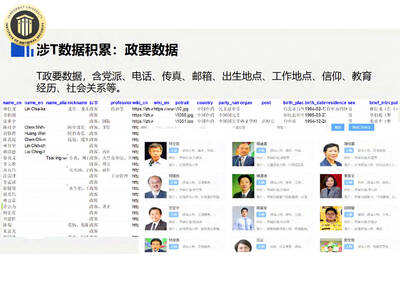
NETWORK-MAPPING PROJECT: The database contains 170 detailed files of Taiwanese politicians and about 23 million records of household registration data in Taiwan China has developed a network-mapping project targeting political figures and parties in Taiwan to monitor public opinion during elections and to craft tailored influence campaigns aimed at dividing Taiwanese society, according to documents leaked by Chinese technology firm GoLaxy (中科天璣). The documents, collected by Taipei-based Doublethink Lab, showed a database was specifically created to gather detailed information on Taiwanese political figures, including their political affiliations, job histories, birthplaces, residences, education, religion and a brief biography about them. Several notable Taiwanese politicians are in the database, including President William Lai (賴清德), former president Tsai Ing-wen (蔡英文), Minister of Foreign Affairs Lin Chia-lung (林佳龍),
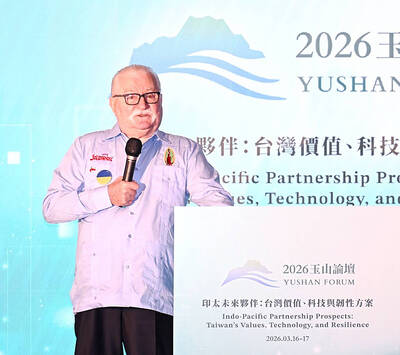
RECOGNITION: Former Fijian prime minister Mahendra Chaudhry said that Taiwan’s New Southbound Policy serves as a stabilizing force in the Indo-Pacific region Taiwan can lead the unification of the Chinese people, Nobel Peace Prize laureate and former Polish president Lech Walesa said in Taipei yesterday, adding that as the world order is changing, peaceful discussion would find good solutions, and that the use of force and coercion would always fail. Walesa made the remarks during his keynote address at a luncheon of the Yushan Forum in Taipei, titled “Indo-Pacific Partnership Prospects: Taiwan’s Values, Technology and Resilience,” organized by the Taiwan-Asia Exchange Foundation with the Ministry of Foreign Affairs. Walesa said that he had been at the forefront of a big peaceful revolution and “if
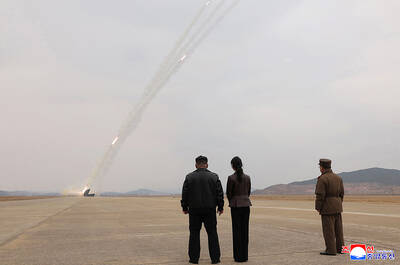
North Korea tested nuclear-capable rocket launchers, state media reported yesterday, a day after Seoul detected the launch of about 10 ballistic missiles. The test comes after South Korean and US forces launched their springtime military drills, due to run until Thursday. North Korean leader Kim Jong-un on Saturday oversaw the testing of the multiple rocket launcher system (MRLS), the Korean Central News Agency (KCNA) said. The test involved 12 600mm-caliber ultra-precision multiple rocket launchers and two artillery companies, it said. Kim said the drill gave Pyongyang’s enemies, within the 420km striking range, a sense of “uneasiness” and “a deep understanding
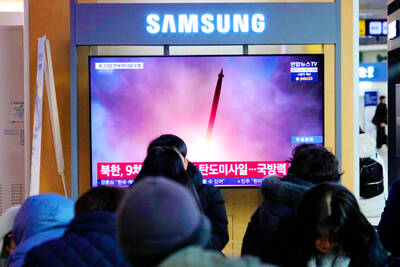
North Korea yesterday fired about 10 ballistic missiles to the sea toward Japan, the South Korean Joint Chiefs of Staff (JCS) said, days after Pyongyang warned of “terrible consequences” over ongoing South Korea-US military drills. Pyongyang recently dashed hopes of a diplomatic thaw with Seoul, Washington’s security ally, describing its latest peace efforts as a “clumsy, deceptive farce.” Seoul’s military detected “around 10 ballistic missiles launched from the Sunan area in North Korea toward the East Sea [Sea of Japan] at around 1:20pm,” JCS said in a statement, referring to South Korea’s name for the body of water. The missiles


 RSS
RSS